
Hilary Benn: Our balanced Troubles Bill includes protection for veterans
Northern Ireland is today transformed from the place that was once torn apart by decades of terrorist violence during the Troubles.
For many, that Northern Ireland is long gone. It is now home to world-leading science, engineering and creative businesses and absolutely central to our shared economic future as a United Kingdom. There is a bright future ahead.


But I know that for far too many people, all these years on from the Troubles, the pain of not knowing what happened to their loved ones remains. Of the more than 3,500 people who died, including almost 2,000 civilians and more than 1,100 members of the security forces, close to one third of those deaths remain unsolved.
This government is taking forward the Northern Ireland Troubles Bill to help victims, families and survivors to find answers through a body they can have confidence in. This will put in place a reformed Legacy Commission, which will benefit, for the first time, from the fullest possible information sharing arrangements with the Irish authorities.
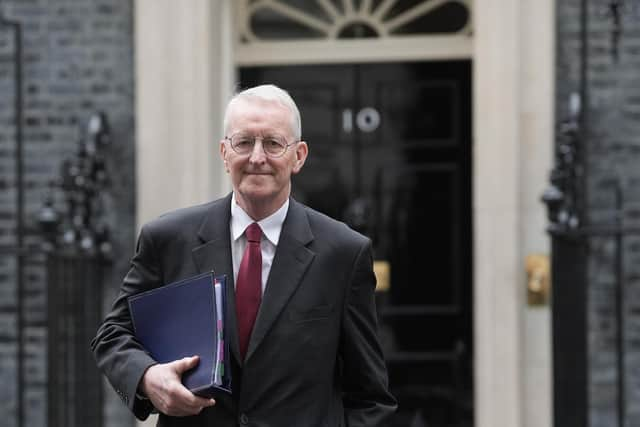
There will be no rewriting of history. It was paramilitaries who were responsible for 90% of the killings – each one a needless, and illegal, loss of life. And it was the professionalism, bravery and sacrifice of our security forces that helped to protect life and keep people safe across Northern Ireland and the rest of the United Kingdom.
There is not – and never was – any moral equivalence between barbaric acts of terrorism, and lawful actions taken by our security forces and there was always an alternative to violence.
The vast majority of those who served in Operation Banner did so with distinction and professionalism. On those rare occasions where individuals did not uphold the standards we rightly expect, as we saw through the Saville Inquiry and the Ballymurphy Inquest, the government should not shy away from recognising that.
The last government’s Legacy Act, in seeking to provide immunity from prosecution, drew a false equivalence between soldiers and terrorists. Whatever the last government’s intentions, the Legacy Act has been rejected by victims, by all of the Northern Ireland political parties and then, repeatedly, by the courts. That legislation failed to command confidence in Northern Ireland and any government would have to replace it.
The immunity that it appeared to offer to veterans was a false promise and has been completely undeliverable. I have spoken to many families who, while recognising the low likelihood of future prosecutions, are simply not prepared to countenance former paramilitaries being granted immunity for killing their loved ones. Indeed, they were dismayed that the previous government was prepared to do so.
In this newspaper last week (November 28), the Shadow Northern Ireland Secretary claimed that the Troubles Bill “strips out the conditional immunity introduced by the Legacy Act". But, as he well knows, the immunity scheme was never enacted by the government of which he was a part, nobody has ever claimed immunity and the courts struck it down.
He also asserted that the Bill makes it "very unlikely that terrorists will be prosecuted”, even though the truth is that the only legislation that sought to allow terrorists to escape prosecution was the last government’s Legacy Act. And he will be aware that the vast majority of prosecutions since the Good Friday Agreement have been for terrorist offences.
It is also often wrongly claimed that the so-called ‘on the run’ letters provided an amnesty for IRA terrorists. They didn’t, as is evident from the fact that it is reported that John Downey – who received one – is currently awaiting trial for the murder of two British soldiers in 1972. In the words of the then Prime Minister David Cameron in 2014: “There was never any amnesty or guarantee of immunity for anyone, and there isn’t now.” Brandon Lewis, who took the Legacy Bill through Parliament, also made clear that the so-called on-the-run letters have “no basis in law”.
In respect of our Operation Banner veterans, to whom we owe so much, the Veterans Commissioners for Northern Ireland, Scotland and Wales have called not for "immunity from the law, but for fairness under it". I agree with them, and I understand the deep anxiety for veterans of having to give evidence about difficult events, many of which occurred several decades ago.
That is precisely why I, the Defence Secretary and the Armed Forces Minister are continuing to work together to ensure that the protections in the Troubles Bill for those who served are as effective as possible. It is vital that the process itself cannot be used as a punishment.
Our approach will put in place six protections, rights and safeguards.
Veterans and former police and security personnel will be protected from the worry of non-essential repeat investigations. Those living in Great Britain will not be forced to travel to Northern Ireland to give evidence. Any veteran will be entitled to seek anonymity. No veteran will again be cold called or receive an unexpected knock at the door. And the forces community will be represented on the commission's new victims and survivors advisory group.
These are practical measures which will change the experience of those asked to give evidence on events long ago. None of these important protections were included in the previous government’s Legacy Act, and we will continue to work with the Veterans Commissioners, the Royal British Legion and other associations representing veterans to ensure that we get this right.
Finally, when the opposition says it sought to “draw a line” under the Troubles, the result was the closure on 1 May last year of over 1,000 police investigations, including into the murders of at least 264 members of our armed forces, without an alternative that all families could have confidence in. Another consequence was the removal of peoples’ right to bring future civil actions against paramilitaries. Victims and survivors have been let down so many times before, and that is why it has now fallen to this government to try to find a way of enabling families to receive the answers they have been seeking for so long.
The Troubles Bill is a fair and balanced way forward, and I hope it will enable Northern Ireland to look to a future that is freer of the burden of the past.
• Hilary Benn is secretary of state for Northern Ireland