
Ian Ellis: China is evolving fast and Sir Keir Starmer is right to maintain good relations for the sake of the future
It has been an especially challenging time for prime minister Sir Keir Starmer as a result of the nauseating Mandelson debacle.

Crises are part of political life and there is no doubt that, sooner or later, No 10 will face further challenging times.
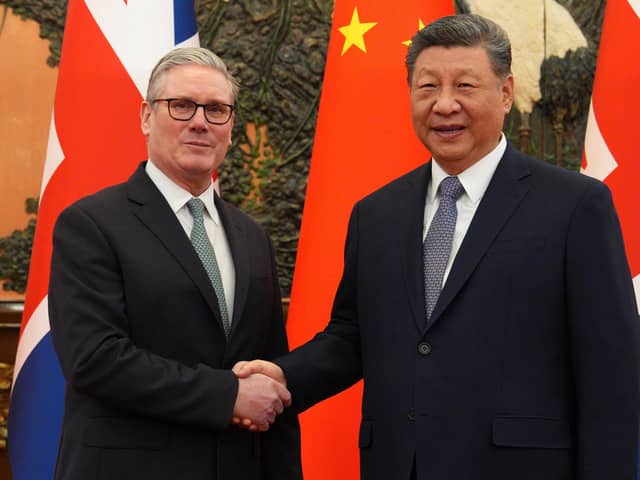
Setting the Mandelson issue apart for a moment, the prime minister's decision to proceed with a visit to China at the end of January met with differing views.
Conservative leader Kemi Badenoch was against it, saying that were she prime minister she would not have gone “at this time”, which seemed to be a rather qualified stance.

President Trump opined that the visit was “dangerous” for the UK, although he himself is due to visit China in the near future and he frequently refers to president Xi as his friend.
However, as US foreign and global trade policies have become decidedly unpredictable, it is understandable that countries will look elsewhere for more stability.
There were fears that a new Chinese embassy in London, situated as planned at Royal Mint Court in the city centre, would be a “spy hub”.
However, it was reported that the security services had indicated that appropriate mitigations could be put in place. On that basis, the government had agreed to the plan.
This cleared the air just before Sir Keir departed for Beijing. Indeed, it was reported by The i Paper that his visit would not have not been given the final go-ahead by China unless the embassy project had received the required government approval.
It is impossible to make an informed judgement about such a matter without being in possession of all the facts and without carefully considering them.
We live in a complex world that is very unsettled, to put it mildly. In such a context, it is right that leaders should reach out to one another and seek to take advantage of potential mutual benefits, while of course doing so with eyes wide open.
China is a player of immense economic power on the global stage. According to the China-Britain Business Council, based on Office for National Statistics figures, China was the UK’s fifth largest trading partner in the 12 months to the end of September 2025.
In such circumstances it seems reasonable for the prime minister and president Xi to hold a summit.
With regard to undoubtedly very serious human rights concerns about certain Chinese government policies, and concerns about China's relationship with Russia, it is surely only possible to have discussions of consequence about such matters when leaders actually meet and converse.
Shouting at one another across the globe is hardly productive.
While I understand the various fears I, for one, am inclined to believe the prime minister was right to proceed with the visit.
Yet, this is undoubtedly a subject in which there are many nuances, but my attention was drawn to the Starmer-Xi meeting for other reasons, not least the fact that an Ulsterman, Sir Robert Hart, was an extremely influential figure in 19th century China.
Born in Co Armagh and educated at Queen's University Belfast, Sir Robert served for over 40 years as inspector-general of the Chinese Imperial Maritime Customs service, a role which placed him at the centre of economic development.
In their book, 'Robert Hart and China's Early Modernization: His journals, 1863-1866', edited with accompanying narratives by Richard Smith, John Fairbank and Katherine Bruner, Sir Robert is described precisely as “an early modernizer” of a people who would together come to form one of the most powerful nations on Earth.
An introduction to his life produced by QUB states: “In China he was heavily involved in economics, politics, diplomacy, light-houses, railways, and the postal service. He wielded significant influence and made a substantial contribution to China’s early modernisation and its foreign relations with the West.”
The exact place of Sir Robert's 1835 birth in Co. Armagh is somewhat disputed, with some maintaining that it was in Portadown and others contending for nearby Milltown.
However, in Portadown he is honoured by having a local school named after him, the Hart Memorial primary school.
The Craigavon Historical Society's website contains a link to a lively and informative video about Sir Robert produced in co-operation between the society and the children of the Hart Memorial (https://www.craigavonhistoricalsociety.org.uk/).
China's real opening up to the rest of the world, under the 1978-89 leadership of Deng Xiaoping, enabled the country to learn from the successes of other nations and Deng developed a system which saw a pragmatic mixing of communism with elements of the market economy.
China is officially an atheist state, with considerable restrictions on religious life, but nonetheless Christianity is one of its formally recognised religions.
In 2017 and 2019 delegations of church leaders from Britain and Ireland visited China, and in 2019 two distinguished Chinese church leaders addressed a conference in Birmingham on the theme, 'China is Changing'.
China has changed further in subsequent years and how it will change in the future is of course unknown to us today, but with good relations between Western countries and China, there is the best prospect for change that will be good for the world.
l Canon Ian Ellis is a former editor of The Church of Ireland Gazette