
Ian Ellis: Churches have role to play in restoring needed global trust
Efforts to establish a ceasefire in Moscow's war on Ukraine have been taking place, brought about by US President Donald Trump's determination but at times very questionable tactics.
It is sometimes difficult to know whether Mr Trump's style of operating signals a real strategy, or is simply haphazard.
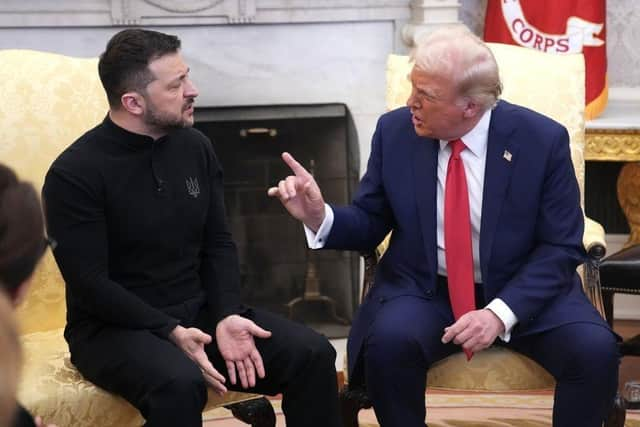

At any rate, the recent US-Ukraine talks in Jeddah, Saudi Arabia, and Prime Minister Sir Keir Starmer's marshalling of a “coalition of the willing” to assist with the implementation of a ceasefire, should it be agreed, have restored hope in the context of a very disheartening situation.
President Volodymyr Zelensky, as well as being a steadfast leader of the Ukrainian people in wartime, had the courage and maturity to take the first step to heal the breach between himself and President Trump, following the shocking Oval Office spat on Friday February 28.
As Baroness Foster rightly said on the BBC's Newsnight programme (March 11), Mr Zelensky had every right to feel “slighted” by what had happened, but in taking the initiative towards repairing relationships had done so for the greater good.
That is an example of mature and responsible political action.
The Oval Office debacle had been an exchange that a Ukrainian cleric in the US state of Oklahoma, Rev. Raphael Moore, described frankly in a television interview, speaking of it in terms of President Trump and Vice-President JD Vance having put President Zelensky in a position in which he had to defend himself.
The cleric said he was “infuriated”, adding graphically: “I was so mad there was steam coming out of my ears.”
It has been said that Mr Zelensky being subjected to such a tirade of verbal bullying by Mr Trump and Mr Vance was a moment that changed the world.
The events in London two days after the doomed Oval Office meeting, when the prime minister hosted an international gathering of European leaders along with Canada's then prime minister, Justin Trudeau, showed that the world has indeed changed.
This was reinforced by a March 6 assembling of EU leaders in Brussels for a special council on defence, with President Macron of France warning that Europe is facing a "turning point of history".
These events all have taken place in the immediate wake of the February 25 general election in Germany.
As had been widely anticipated, the far right Alternative for Germany party (AfD) moved into second position in the Bundestag, the national parliament, but the result left a coalition of other parties in position to form a government.
The new German Chancellor-in-waiting, Friedrich Merz, of the conservative Christian Democratic Union party and a strong supporter of Ukraine, was quoted by Politico as saying: “Germany and Europe must now undertake extraordinary efforts to ensure our defence capabilities.”
In 2019 I attended a church event in Germany, in the course of which then Chancellor Angela Merkel spoke on the subject of trust in international relations, an experience I have mentioned in this column before ('Extreme right-wing ideologies threaten to divide societies', News Letter, October 15, 2024).
Mrs Merkel said that without trust, international politics could not succeed.
She pointed to how the historic EU and transatlantic partnership had only been possible because of shared values and mutual trust. She also said that modern European history would have been very different if, after World War II, the Allies had not trusted the German people.
The then Chancellor stressed that the welfare of the world depends on trust and that no nation could achieve the highest goals on its own, adding that it is in one's own interests to be ready to trust.
Where is trust now in international affairs?
Those European and other countries which do trust one another have come to a recognition that the time has come to make plans not to depend on the US when it comes to defending European territory, with the US having suddenly become an unpredictable, if not an actually unreliable, ally.
Just as financial markets do not like unpredictability, so too diplomatic relations become extremely difficult when one cannot gauge how another party may act on the international stage, or may react to world events as they unfold.
This kind of situation becomes highly dangerous.
It is said that President Trump acts in an essentially transactional manner, thinking almost exclusively in terms of US domestic financial interests and with little thought out political or diplomatic strategy.
On the other hand, he does proclaim himself to have a vision of peace for the world's trouble spots. Nevertheless, he does still have America's economic interests very much in mind.
Trust usually comes in degrees. A person may trust another person to a greater or lesser extent, and it is surely the same with the nations of the world.
The chief executive of the British Council, Scott McDonald, has written: “Where trust is present in international relations, all kinds of collaborative behaviour for good is possible. Where trust is absent, nations, and their citizens, find themselves in a very hostile environment indeed.”
There is no doubt that the British Council and many similar organisations, and indeed the churches, all have a vital role in promoting the kind of trust that is badly needed in our world today.
• Canon Ian Ellis is a former editor of The Church of Ireland Gazette