
Ian Ellis: Harvest thanksgiving in our relatively prosperous part of the world should never be an act of complacency
There is no doubt that the annual harvest thanksgiving services are a very popular aspect of church life.

Some churchgoers are not particularly regular in their attendance but for so many in that category, alongside the major annual festivals of Christmas and Easter, harvest has its particular draw.
And rightly so, not only because saying "thank you" is a good thing to do, as children are often reminded, but also because we are truly fortunate to live in a part of the world where there is no shortage of food.
Some do indeed rely on foodbanks, which always deserve support, but that is a question of the management of the economy rather than about actual food supply.
This abundance of food is, of course, thanks first of all to the farmers who grow the crops and attend to the livestock, whether here at home or further away.
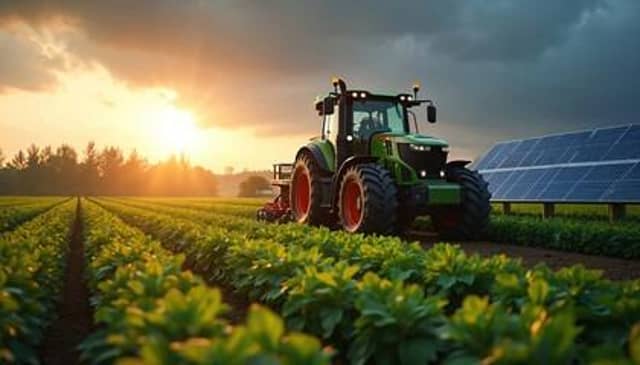
One image of harvest is that of a tractor at work in a field, but another is of fully stocked shelves in a grocery shop or supermarket.
Yet the complexity of this food supply is often not fully realised. Shops depend on the steady flow of the food chain, from farms and onwards, and delivery vehicles to bring goods from hubs to local outlets.
In between the farm and the table there are lots of jobs that are required to keep the process running smoothly.
I remember many years ago being asked to preach at a harvest thanksgiving service in a church situated in a really built-up, industrial area.
It seemed a long way from land and farm.
Yet the experience caused me to reflect on how there is a deep, inner drive in people everywhere to acknowledge their utter dependence on food to survive, and to express thanks to God for the food that they enjoy day by day.
It is of course true that there are many parts of the world where the harvest is far from abundant and where people struggle hard to avoid sheer starvation, whether that is because of adverse climate conditions, endemic poverty, or indeed wars.
Harvest thanksgiving in our relatively prosperous part of the world should never be an act of complacency.
Thanksgiving at harvest time is perhaps best seen as gratitude for the way the world is ordered so that there is seed time and harvest.
So, the measure of our harvest is, in a way, the measure of our responsibility to others, often far away, who have had a really disastrous harvest.
Harvest thanksgiving is not only about our good fortune to live where we do but is also about others in their need wherever they may be across the globe.
That is why it is so often linked to charity initiatives to help feed the hungry.
Christian Aid has drawn together the local and global emphases for harvest thanksgiving by urging prayers for neighbours in need in our localities, for those "global neighbours" in urgent situations such as South Sudan, and for local and global leaders' efforts to tackle food insecurity and the causes of the current climate crisis.
Indeed, one does not have to be a climate scientist to recognise that there are serious issues in our world as far as drought and floods, extreme heat and torrential storms, and raging wildfires are concerned.
A recent National Audit Office report, “Resilience of the food supply chain to disruptions”, has warned that the supply chain faces a wide range of risks, explaining: “These include acute risks - discrete events requiring an emergency response - such as extreme weather, cyber-attacks, energy disruptions and animal, plant or human disease outbreaks.”
The report also points out that the government’s National Risk Register has highlighted several risks that, while considered of low likelihood, could cause catastrophic disruption and result in food shortages because of a failure of the food supply chain, with examples of these risks including “a national power outage, pandemic, nuclear accident, or large-scale chemical, biological, radiological or nuclear attack”.
There is in fact a certain fragility about the way our society is organised. Nowadays, with us all becoming increasingly dependent on the internet for everything from health to banking, the situation undoubtedly requires great vigilance.
In many churches, the harvest season is set in the context of what is described as the season of creation. These weeks broaden the focus from the particular theme of harvest to that of the environment generally.
General secretary of the World Methodist Council Rev Dr Leo Neto, from Brazil, has written a refreshing and enthusiastic message for this year's season of creation, which has the theme of ‘Living Water’.
He says: "Let's clean up every river and finally the seas. Let's campaign to uncover every stream and river in our cities. Let's integrate the rivers back into the urban space and plant trees beside them. Let's enjoy the peace, healing and tranquillity they will bring. God made them all to be living waters."
Those words surely strike home to us in Northern Ireland, where the blue-green algae in Lough Neagh and other waters have caused acute concern.
Harvest thanksgiving time is also a time for recalling that creation really does require our active care.
Canon Ian Ellis is a former editor of The Church of Ireland Gazette