
Ian Ellis: In time of war, churches have a voice to be heard and many important roles to play
In time of war, wherever it may be, the churches are involved in different ways. It is difficult to rank these various roles because they are all of considerable significance, but some can be highlighted.
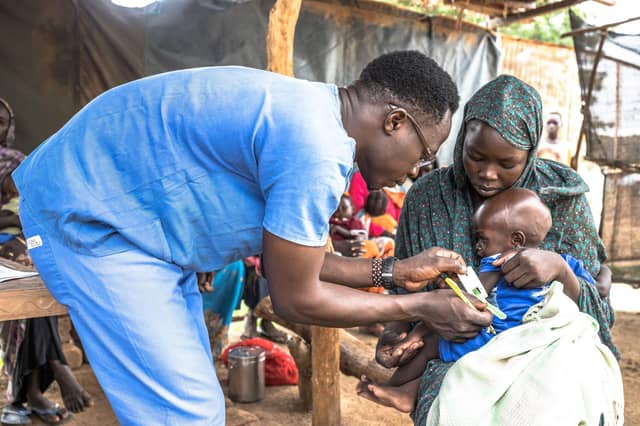

The churches provide spiritual ministry to civilians who suffer through violent attacks and, through chaplaincy work, they also minister to soldiers. They also provide aid, including the provision of food, clothing and shelter.
Often church figures are involved in mediation work in the search for a resolution of the causes of particular wars and, on the wider level, of course the churches always want to witness and pray for peace, for an end to violence and for restored relations between the nations.
Churches have certainly been involved in such ways with regard to the current wars in Ukraine and the Middle East, and in the ongoing civil war in Sudan, to name but several of the no fewer than 35 conflicts in different parts of the world listed by the Council on Foreign Relations Global Conflict Tracker.
Indeed, many conflicts across the world simply do not receive the same media attention as others.
In the West, we are well informed about what is happening in Ukraine and in the Middle East, with the issue of the Straight of Hormuz in particular affecting the global economy, but the situation in Sudan seldom features in news bulletins.
That civil war, which has been going on since 2023, has seen a brutal conflict between the Sudanese Armed Forces (SAF) and the Rapid Support Forces (RSF), the latter being a breakaway group from Sudanese government control.
The civil war has led to the displacement of a reported 12 million Sudanese citizens, more millions of refugees leaving the country, and devastating famine conditions, quite apart from so many brutal atrocities.
A church statement explains that the conflict “combines a struggle for political power, resource control and state sovereignty among rival elites, which has escalated into violent ethnic and inter-communal confrontations”.
Churches across Sudan and independent South Sudan have been taking initiatives to promote healing and reconciliation.
Neighbouring Kenya has been involved in supporting peace efforts in South Sudan, from where church leaders have called for renewed commitment to an immediate ceasefire, and conditions for credible elections.
In a discussion of the war in Sudan on a Foreign Policy podcast, Professor Adam Tooze of Columbia University, New York, pointed out that Sudan is a poor country with 34 million people having become reliant on aid, a situation only exacerbated by recent drastic cuts in US aid.
Relatively affluent countries are more able to face - but certainly not avoid - the effects of war, but a poor country like Sudan is all the more vulnerable and the scale of the suffering is indeed devastating, not least with the collapse of healthcare.
Professor Tooze described the conflict as a war over how to suppress Sudanese democracy, with both the SAF and RSF wanting to block democratic governance.
The country, he said, is agriculturally particularly fertile, with enormous potential for cultivation.
Given the chance, Sudan undoubtedly has the capacity for economic growth and wider development, but the warring factions are holding the country back because of their own vested interests.
Regarding the US-Israel-Iran conflict, in a joint statement from the Middle East Council of Churches, the World Council of Churches, the Lutheran World Federation, the World Methodist Council, the World Communion of Reformed Churches, and several other international church groupings, church leaders highlighted “the grave risks facing the more than 92 million people of Iran” who, they stated “already endure complex political, economic, and social challenges”.
The church leaders also expressed serious concern over reported violations of international humanitarian law, while calling on all parties to protect civilians and refrain from targeting civilian infrastructure.
They concluded their joint statement: “We pray for the people of the Middle East who have suffered too much violence for too long, and too often as the result of interventions by external actors. We invite all churches and Christians of the world, and all people of faith and good will, to join in praying for peace in the Middle East, and everywhere in our world where there is conflict and strife.”
The recent controversy over pope Leo's comments on the war and president Donald Trump's negative reaction centred around what Leo had said both in the Vatican and on a visit to Iraq.
At the Vatican he expressed “deep concern” over the situation in the Middle East and Iran, declaring: “Stability and peace are not built with mutual threats, nor with weapons, which sow destruction, pain, and death, but only through a reasonable, authentic, and responsible dialogue.”
He went on to warn of tragic consequences if the situation escalated out of control, appealing to the parties involved “to assume the moral responsibility to stop the spiral of violence before it becomes an irreparable abyss”.
In his comments made in Iraq and reported by the Associated Press, he referred to “a world marked by senseless and inhuman violence”, especially in the lands of early Christianity.
As also with much else going on in the world, the churches undoubtedly have their role to play, and a voice to be heard, in time of war.
l Canon Ian Ellis is a former editor of The Church of Ireland Gazette