
Ian Ellis: Vance remark has provoked a deeper reflection across the world on the subject of love
In a 2024 study by the highly regarded, Washington DC based Pew Research Centre, it was found that in the US both Protestantism and the Roman Catholic Church have experienced a “net loss” of denominational membership.

The report indicated that according to the 2023-24 Religious Landscape Study, 1.8 people had left Protestantism for every person who had become a Protestant after having been raised in another religious group or in no religion.
However, it described the picture for the Roman Catholic Church as “even more lopsided”, finding that for every US adult who had become a Roman Catholic after being raised in some other religion or without a religion, there were 8.4 adults who said they had been raised in the Roman Catholic tradition but who no longer described themselves as Roman Catholics.
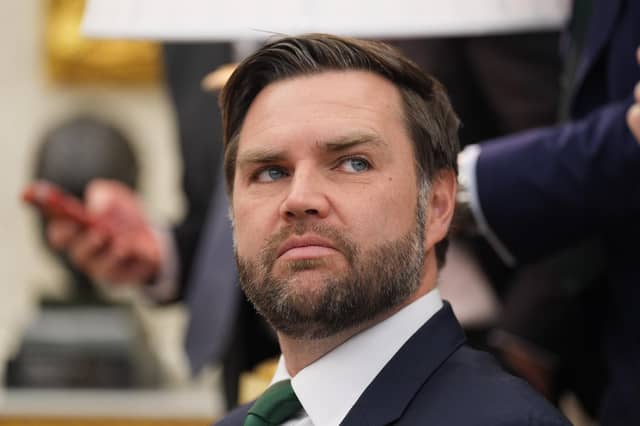
US Vice-President JD Vance is one prominent person from a Protestant background who has become a member of the Roman Catholic Church.
He did so at the age of 35, which was five years ago.
He made the change after considerable study and instruction by a priest of the Dominican order, Fr Henry Stephan, attached to St Gertrude's church and priory in Cincinnati, in the vice-president's home state of Ohio.
The New York Times has reported how, for months, the two met for what the newspaper's Elizabeth Dias described as a “bespoke private instruction, a hallmark of Dominicans who are known for their lives of intellect and study”.
Indeed, Mr Vance is clearly a man who can make up his mind but who also can change his course, because not only did he convert to Rome, he also converted to what is sometimes called “Trumpism”.
Last year, Reuters reported that in the lead-up to the 2016 presidential election, Mr Vance was a bitter critic of Donald Trump, adding that he had publicly called the Republican businessman an “idiot” and had said he was “reprehensible”.
Such public remarks are certainly uncomplimentary, to say the least. So, the now vice-president's conversion to Trumpism was quite an about-turn.
Naturally, relatively few people meet the Pope personally, yet the recent convert, JD Vance, has already met two Popes – Francis, shortly before the pontiff died, and very recently, Leo.
It seems, however, that neither Francis nor Leo has been on the same wavelength as the vice-president, at least when it comes to the issue of immigration.
In what became a controversial Fox News interview last January, JD Vance opined that "as an American leader, but also just as an American citizen, your compassion belongs first to your fellow-citizens".
He continued: "It doesn't mean you hate people from outside of your own borders, but there's this old school - and I think it's a very Christian concept, by the way - that you love your family, and then you love your neighbour, and then you love your community, and then you love your fellow-citizens in your own country, and then, after that, you can focus and prioritise the rest of the world."
This is a concept going back to St Augustine (354-430) and St Thomas Aquinas (1225-1274) that is known as “ordo amoris” – understood as the right-ordering of love.
Mr Vance's view of this philosophy was swiftly challenged on BBC Radio 4's Today programme by former Secretary of State for International Development Rory Stewart, who commented that the vice-president had been suggesting “that Jesus's teachings encouraged us basically to put our family and our country first and by extension not really care much about anyone else”.
That may not have been exactly what the vice-president had said, but Mr Stewart added that people did not need Christianity to teach them to put oneself and one's family first, as that is a very natural instinct.
Rather, Mr Stewart asserted, Christianity encourages people to go beyond “selfish tribal ethics” by being outward looking towards others beyond their personal circles.
Yet there was even more pushback by Pope Francis.
In a letter of February 10th last to the Roman Catholic bishops of the US, Francis commented that Christian love “is not a concentric expansion of interests that little by little extend to other persons and groups”.
He went on to stress how the true nature of “ordo amoris” is to be discovered in light of the scriptural parable of the Good Samaritan.
What is important here is to recognise that loving can be about emotions and feelings but it can also refer to the caring nature.
The modern rendering of the well known scriptural passage in 1 Corinthians 13 refers to the virtue of “love”, but in the older King James Version the word used is “charity”.
Of course, one's family comes first in terms of loving attachment, but Christian love is indeed a much wider concept than this.
No doubt JD Vance is aware of that and, to be fair to him, his comments about “ordo amoris” were undeveloped, having been a brief “by the way” remark that was part of an answer to a wider question.
Yet that remark of the vice-president has provoked a deeper reflection across the world on the subject of love, which can only be a good thing.
Canon Ian Ellis is a former editor of The Church of Ireland Gazette