
Ian Ellis: We must be told what the UK and Nato defence plan is if Russia tries to invade Republic
The recent resignation of John Healey as defence secretary had not been foreseen by political commentators and appeared out of the blue.
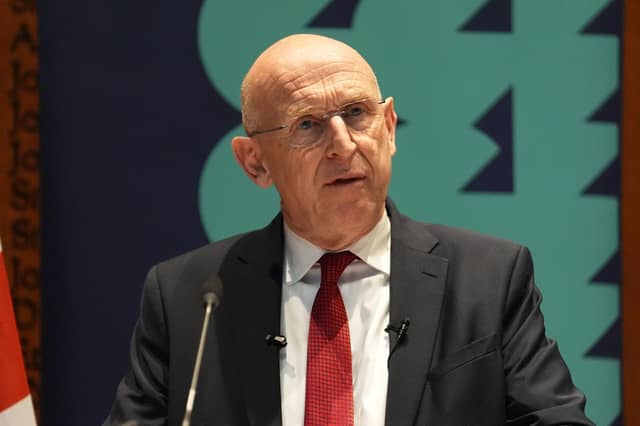

Mr Healey resigned over the then as yet unpublished Defence Investment Plan (DIP) financial settlement which he described as falling “well short of what is required for defence and the country at this dangerous time”.
His move demonstrated both the steadfastness of his commitment to the proper defence of the UK and his personal integrity.
In his resignation letter to prime minister Sir Keir Starmer, Mr Healey wrote: “After explaining to you that I would not be able to accept a DIP settlement that does not give our forces the resources they need, I am now left with no other option than to submit my resignation as your defence secretary.”
He referenced recent extra demands on the British military, including the conflict in the Middle East, leadership of Nato’s Arctic Sentry mission, and increased Russian activity towards the UK and other Nato nations.
For his part, Sir Keir has defended current defence spending plans and has explained how political leadership requires balancing a wide range of priorities.
Mr Healey's replacement as defence secretary, Dan Jarvis, has said he is "absolutely determined to make sure that we deliver for defence".
There is no doubt that we are in an increasingly dangerous world.
It is therefore to be hoped that all political parties will understand that defence is of the highest order of importance because our whole way of life – including our freedom of religion, speech and movement - depends on not being overwhelmed by a hostile power.
Indeed, Mr Healey's resignation was swiftly followed by that of the minister of state for the armed forces, Al Carns, who also said that the government was failing to give the military the necessary funding.
Further, Mr Carns also cited his objection to the current Legacy Bill as a reason for resigning.
Responding to this, the government pointed out that it had been listening to the concerns of the Armed Forces associations and that a substantial package of amendments would be brought forward to bolster the protection of veterans.
Then again, the Republic of Ireland's government is due to introduce reciprocal legislation but will not do so until the UK legislation has gone through.
Tánaiste Simon Harris has said that the British legislation has to pass first and that, “subject to the legislation passing the House of Commons, subject to it doing what it should do”, the Irish government would be in a position to move legislation.
Yet, with further amendments at Westminster it is questionable whether Dublin will agree to proceed.
However, there is yet another aspect to the whole topic of defence that is most concerning.
Last March, it was reported that London and Dublin had signed a “refreshed” memorandum of understanding with regard to “bilateral defence co-operation”, focusing on maritime, air and cyber security.
Of particular concern is the fact that neither government has yet published the full text of the memorandum, nor has the cost to the UK exchequer been spelt out.
I have enquired for this column on several occasions with both the Ministry of Defence in London and the Department of Defence in Dublin about the publication of the memorandum.
The former told me that any decision to publish it had to be taken jointly by both governments, adding that such a decision “has not been taken”, and the latter said that it would be laid before the Houses of the Oireachtas “in due course”.
It is entirely reasonable to conclude that the UK is in fact shouldering much of both the responsibility, in terms of personnel and materiel, and the financial cost of protecting the Republic from serious enemy attacks.
On a recent visit to Dublin, the EU's high representative for foreign affairs and security, Kaja Kallas, said: “Ireland's proud tradition of military neutrality is not in question, but neutrality does not provide immunity from the threats Europe faces today. No country in Europe is off Russia's target list.”
This is a critical point. What would happen if Russian forces were to land in the Republic, a non-Nato country, and attempt to occupy it?
It is not a far-fetched notion because that is precisely what Russia has done in Ukraine, another non-Nato country, and it is precisely the reason why Sweden ended its policy of neutrality and joined Nato in March 2024.
It is clear that, far from being a relatively remote place from a continental perspective, and therefore safe, the island of Ireland has a strategically key location, particularly when one considers vital undersea communications cables and its location en route to the now very contested high north Atlantic.
One particular question regarding the defence memorandum of understanding between the UK and Republic of Ireland is just what would happen if, for example, the UK were to have to attack a hostile Russian military aircraft threatening the Republic.
Would Nato support the UK should such an eventuality escalate to wider conflict between the UK and Russia?
The memorandum of understanding needs to be published without delay and Nato needs to make clear its stance towards its implications.
Canon Ian Ellis is a former editor of The Church of Ireland Gazette