
James Dingley: Ulster genius Francis Hutcheson had a huge impact on the world yet virtually no one here knows of him
In the run-up to the 250th anniversary of the US Declaration of Independence, it is important to remember the achievements of the County Down man who is accepted as one of the inspirations behind it

A prophet in his own land is rarely appreciated, and such was Francis Hutcheson’s fate, despite no other Ulsterman or Irishman ever having a more profound impact on the world.
Indeed, this philosopher from Co Down almost invented the modern world, yet virtually no one in Ulster appears to have heard of him. Why have our political and religious leaders let such an omission to happen?
Hutcheson (1694-1746, born Saintfield) is accepted as one of the inspirations behind the US Declaration of Independence, whose 250th anniversary we celebrate this July.
His idea of man being born with inalienable rights is a foundation-stone of modern liberal-democracy and constitutional government; such ideas were alien to the political and religious order of his day. Then there was his idea of a total separation of church and state, no official religion and each man free to worship God in his own way with no religious test for public office.
Both of these are foundational to the modern world of constitutional liberal-democracy, ideas deemed subversive in Hutcheson’s day, which was one reason they could only flourish in the new colonies in America, with no established elites to censor them.
Perhaps we take these things too much for granted today and forget that they had to be fought for in the face of major political and religious opposition. However, probably more immediately, we should remember Hutcheson as the man who taught Adam Smith economics in Scotland. Smith (1723-90) is usually regarded as the founder of modern economics, yet he always acknowledged that Hutcheson was his inspiration
So, the modern world of liberal-democracy, constitutional government and economics was the product of an Ulsterman and the beliefs and ideas that he stood for have always been at the core of Ulster politics, even today.
The triumph of these ideas required the American War of Independence to first establish themselves anywhere in the world, they then helped inspire the French Revolution to establish them in Europe. Ironically, after this, they became the platform from which the UK as a whole then proceeded to reform its political and economic institutions and develop as a modern state, after which the rest of Europe followed suit. The modern world began in Ulster.
Most of the above developments are normally attributed to what historians call the ‘Scottish Enlightenment’ of the 18th century, indeed, Hutcheson is known to historians and philosophers as the ‘Father of the Scottish Enlightenment’. Yet Hutcheson was born and bred in Saintfield, where his father and grandfather had been ministers of First Presbyterian Church. He went to school there and then went on to a Dissenting Academy (an independent ‘university for those excluded from the Anglican ones) in Killyleagh after which he went on to Glasgow University, to read moral philosophy, where he was a star student.
Here, he was much influenced by the new learning that emerged across Europe in the late 17th century, what we would call science and scientific thinking (natural philosophy) which was then closely associated with the Reformation – new thinking.
Hutcheson returned to Ulster as a licensed Presbyterian (New Light) minister and after a short spell in Armagh he was ‘head-hunted’ down to Dublin as both a parish minister and to found a new Dissenting Academy. It was here that Hutcheson made his name internationally, writing works that made his reputation as a major figure of the European Enlightenment (when we left the medieval world behind and created the modern one).
Meanwhile, in America his works were read by most of the major figures behind the revolution, which is most strongly revealed in the Declaration of Independence – reported by the Belfast News Letter in 1737.
Eventually, he was head-hunted back to Glasgow as the ‘chair’ of Moral Philosopher, where he implemented teaching reforms to modernise the courses and style of teaching. He was regarded by all as an inspirational teacher, as Adam Smith testified.
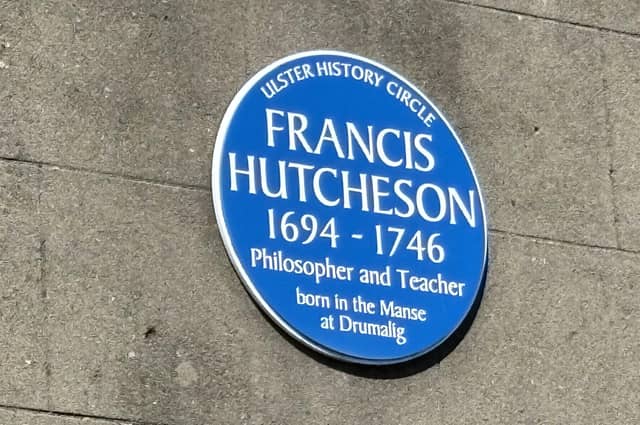
He died (1746) on a visit to Dublin. Unfortunately, the site of his grave has now been lost nor is there any memorial to him anywhere in Ulster, apart from one blue plaque on his old church in Saintfield.
On Saturday June 27 at 10am there will be a seminar about Hutcheson entitled ‘Liberty Equality Enlightenment – Ulster and the American Declaration of Independence’ at the Ulster Reform Club in Belfast. Entrance is free (note: the club has a dress code).
James Dingley is chair of the Francis Hutcheson Institute