
Jeff Dudgeon: Labour’s legacy bill which is biased against the security forces in favour of terrorists has stalled with MPs
It looks increasingly as if Labour’s plan to deal with the legacy of the Troubles is dying a legislative death, having faced significant opposition from cross-party MPs, the House of Lords, and the almost unanimous rejection of it by veterans.
That opposition includes those who have held the most senior military and intelligence positions, as reported extensively by the News Letter – a paper which has done much journalism on the legacy scandal, in which investigations have turned against the security forces while terrorists escape scrutiny.


Tomorrow the Northern Ireland Troubles Bill and the ludicrous Remedial Order return for late consideration by the Joint Committee on Human Rights at Westminster. Given the bill hasn’t moved in the Commons since November, its scrapping may be announced by Hilary Benn, at least for now given the parliamentary session end.
Labour’s war on the Legacy Act was a product of pandering to nationalism and the Irish government. They objected to the legacy plans put in place by the last Conservative government, and so those plans, had to jettisoned and arrangements found which met with the approval of nationalist legacy groups, the Queen’s University law department and the Irish.
Indeed if the legal aid gravy train is fully restored by way of reactivating civil suits, and legacy practitioners given a role on ‘oversight’ boards (to assist in re-writing the past), then all of a sudden the Independent Commission on Reconciliation and Information Recovery (ICRIR), or whatever new name it is given, would get nationalist approval.
In order to understand the nationalist war on ICRIR, the scandal of legacy over the last two decades has to be grasped. There has been an orchestrated campaign of ‘lawfare’, designed to re-write the past in terms of equivalence. Courts, inquests and academic legal departments have all been weaponised to enable a costly legal jamboree, usually driven and supported by activists and fuelled by legal aid.
Unionist or military involvement in legacy has been defensive, responsive to defending those targeted on a case-by-case basis. Nationalism’s campaign has been offensive and based not on individual personal interests but on strategically litigating a ‘cause idea’, namely delegitimising the military and police, and by stealth affording legitimacy to the IRA’s campaign as a purely ‘defensive’ and reactive one.
Returning to the present, we have seen, for example, the group Relatives for Justice publish wholly misleading ‘facts’ about ICRIR. Their ‘fact sheet’ (nationalism has a long history of assuming facts not in evidence) boldly declares the mere appointment of former RUC officer Peter Sheridan as ICRIR head of investigations was declared by Colton J in the Dillon case as a “conflict of interest”. This is demonstrably untrue and mutilates Colton J’s ruling.
These claims were then amplified by organisations such as the NI Human Rights Commission (NIHRC) which despite having a statutory obligation to be independent and impartial, launched an energetic campaign against the ICRIR and promoting what can only be described as nationalist propaganda. This was so beyond the norm, that Shankill bomb victim Gary Murray has brought NIHRC to court. It is noted the Chief Commissioner has been a lot less outspoken since that development.
But the war on ICRIR continues. And it is a battle for control of the legacy narrative. Nationalism sees their vice on legacy and thus the rewriting the past slipping away, and so must do all it can to break a body which risks both stopping the legal aid gravy train and actually delivering truth in respect of legacy matters. Even the courts are starting to push back, with McAlinden J labelling recent activism in the High Court (by the family of an IRA terrorist killed by the SAS at Coagh in 1991) as “ludicrous” and querying why legal aid was ever granted for such an “unarguable” case.
Sir Declan Morgan and Peter Sheridan are two exemplary public servants, who - despite a woeful lack of support from a hapless Secretary of State, a compromised Attorney General and a weak Prime Minister - have nonetheless continued to quietly go about their work with diligence and professionalism. Perhaps derived from their high judicial office and senior policing roles, both men have displayed a passive stoicism in face of unfair and relentless attack. They know, as we all know, just how contrived, political and malicious it all is. But they have largely kept their counsel.
ICRIR too has been less than assertive in the field of litigation. We understand it has a specific internal litigation team, but they appear to want to avoid robust defence of their own organisation, likely for fear of incurring the wrath of the Irish Government, legacy activists and academics. What is the point of having a litigation team that refuses to litigate in any meaningful way?
So if we were to be critical of Sir Declan and Peter Sheridan, it is that they have been too passive in defending themselves and their organisation. The reasons for their stoicism are admirable on one view, and it is perhaps why they are held in such high-esteem as public servants, but there comes a time when the gloves really must come off. We are long past that stage.
ICRIR must start defending itself to avoid being ground down by the NIO's series of reviews.
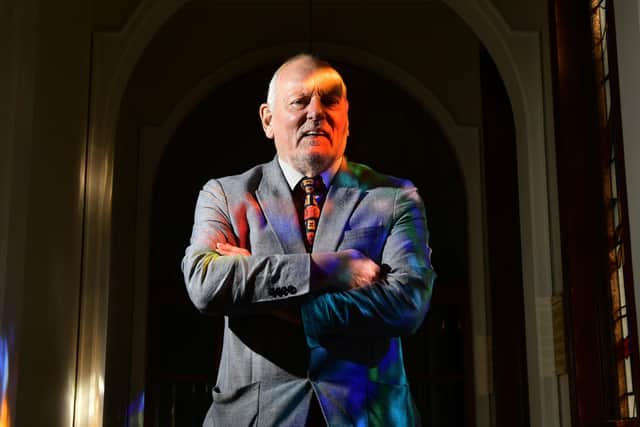
• Jeffrey Dudgeon MBE writes this on behalf of the Malone House Group, which campaigns against the imbalance on legacy, of which he is convenor. The other group members are: Professor Arthur Aughey; Jamie Bryson LL.B; Baroness Kate Hoey; Dr Cillian McGrattan; Dr William Matchett; Austen Morgan Barrister-at-Law