
Jeff Dudgeon: The government's legal challenge to coroner's flawed Clonoe inquest finding against the SAS is both welcome and essential
The ruling against the SAS for killing four IRA men reflects the judicial separatism of NI courts in legacy cases, writes JEFF DUDGEON in this long essay:
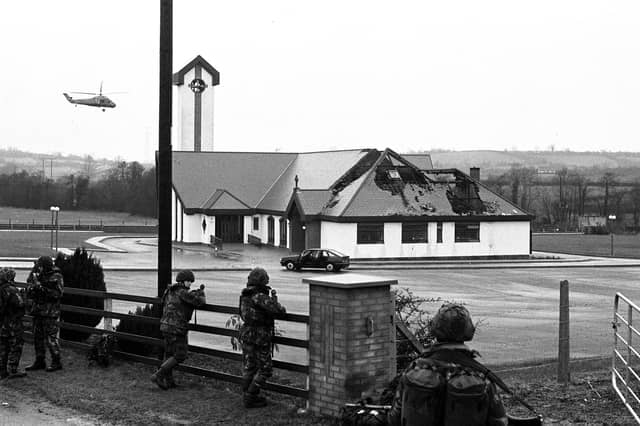

Last month, Mr Justice [Michael] Humphreys, gave his verdict in the inquest into the deaths of four members of an IRA unit at Clonoe, Co Tyrone in 1992.
I believe that there are obvious failures in his findings and that the two judicial review legal challenges to it, which have just been announced, are essential.
The shooting on the night of 16 February started at 10.40 pm with an IRA attack by machine gun on Coalisland police station from the nearby chapel car park. The gunfire could clearly be heard and green tracers seen in the sky by the soldiers at Clonoe chapel a couple of miles away.
The lorry on which the machine gun was mounted headed from the RUC station towards the Clonoe car park. A few minutes later, en route, further shots were discharged in a salute to Tony Doris at his nearby house. He had been killed at Coagh in June 1991, nine months earlier.
There was apparently a full moon. The soldiers had been hiding to one side of the chapel car park behind a straggly hedge since 7.40 pm. Some five cars suspiciously came and went during the three hour wait. They were reckoned to be on dicking circuits.
The lorry arrived in the car park preceded by a blue car. This made four vehicles in all present, two of which managed to drive off. The shooting was over by 10.48 pm, eight minutes after the first rounds were fired at the police station.
There were 12 soldiers at Clonoe chapel and at least 10 IRA operatives, six of whom were not killed. Three escaped across the border and were not charged or extradited. Three others were either arrested on the spot or later. Four of the six were wounded. Two of the dead had dismounted from the lorry with their rifles and were shot on the ground but not at close range.
That the machine gun’s safety lever was set in the ‘safe’ position and “was not in a ready state of firing” is a prejudicial statement by the coroner when unqualified by the obvious fact that the soldiers could not possibly have known. The coroner, in his 59-page verdict that was published on February 6, uses the term “heavy machine gun” many times but never indicates that its fire was armour piercing and could travel a huge distance. He frequently mentions soldiers’ bullets as being armour piercing. Why has Humphreys been inconsistent on this point?
Soldier A was the leader of a sub-unit of the army’s Specialist Military Unit (SMU). All 12 soldiers opened fire. Four Soldiers, B, C, D, and F, are specified as persons who may have shot three of the deceased but it was judged unclear which. In one case only, a single Soldier (H) is identified as having shot a particular man dead although Soldier L is identified as having wounded the same man.
Eleven of the 12 soldiers who opened fire gave evidence to the inquest. One, Soldier H, “absented himself and could not be located”. That soldier “had a bullet wound to the face” whose friendly fire origin, the coroner implies, must have been recognised at the time as, at most, the IRA unit fired one round. In the findings, H is later stated, definitively, to have been “struck by a ricocheted bullet fired by one of his colleagues”.
Some 50 paragraphs of the findings are devoted to modern evidence from ballistics and pathology experts designed largely to detect which soldier shot which person and how. They effectively confirmed that lethal force had been used and that the IRA unit had not engaged the soldiers. It was indeed shoot to kill, something permitted to the police in London (the government should explain this double standard).
There were 21 barristers at the inquest including nine silks. The Ministry of Defence (MoD) and the former soldiers had nine barristers between them. Their major line of defence seems to have been assertions of IRA firing in the car park which the coroner fiercely discounted. The next of kin of one of the dead was not represented.
Doug Beattie MLA, an army veteran, on Radio Ulster’s The Nolan Show on February 7 did explain, forcefully, “The military are a blunt instrument. They are not taught to shoot to wound. They are taught to aim at the visible mass and shoot until the threat is eliminated. Once the decision to engage was taken, that was it.”
Such realities on how armies operate were absent from the findings.
The same judge, Humphreys, presided over the Coagh inquest whose findings were published in April 2024. It related to the deaths of three IRA men at 7.30 am on June 3 1991 in very similar circumstances to Clonoe. However his verdict then was: “In each case, the use of lethal force was justified as the soldiers had an honest belief that it was necessary in order to prevent loss of life. The use of force by the soldiers was, in the circumstances they believed them to be, reasonable. The operation was not planned and controlled in such a way as to minimise to the greatest extent possible the need for recourse to lethal force.”
This planning failure was hinged to his assessment that an arrest was not really possible or seriously contemplated and thus lethal force was inevitable in order to protect an army decoy. The coroner passed his planning failure finding to the Public Prosecution Service (PPS) later that month for consideration of charges against the army commanders and RUC Special Branch officers. No prosecution decision has yet emerged.
The coroner did give context to the earlier event when he wrote: “In order to understand the background to the events leading up to the deaths at Coagh on 3 June 1991, it was necessary for the inquest to consider the threat posed by terrorist organisations at that time and how this was addressed by the security forces.”
After listing some 30 killings involving the IRA’s East Tyrone Brigade, Humphreys concluded: “This bloody recent history provides the backdrop to the events at Coagh.” No such context appeared in his Clonoe findings. Why not? Some have described east Tyrone at this time as a warzone.
On Coagh, he also stated, “The fact that several of the soldiers were labouring under a misapprehension that they were engaged in a ‘fire fight’ does not detract from the conclusion that, subjectively, they believed an immediate threat to life existed but rather reinforces it.”
There are cases of soldiers being killed in similar circumstances where it is likely insufficient fire power was brought to play early. The coroner however did not consider a possibility of military casualties at Clonoe should arrests of the 10 men have been attempted when the armed lorry appeared. Why does he not consider this?
No witnesses were called to explain the recent history of conflict in the area nor of the psychology of those involved. That the youthful IRA unit was behaving in a pumped-up manner, as illustrated by the Doris salute, and the stated fact it was to be a “show of strength”, ultimately involving rifles being waved in the air at the car park, went without analysis by the coroner. The agreed scope also prevented any assessment of whether future lives were saved by the elimination of the unit and the seizure of their guns.
In the event, Humphreys, as he carefully went about it, did find facts from which an inference of guilt could be drawn although using a reverse telescope methodology. He topped it with a definitive opinion or belief that the use of lethal force was not justified. The first two questions on force, which are essentially the same, were answered in the negative although he left out the word ‘genuine’, one he had earlier required at Coagh. This method of fact finding, however, can be perverse and irrational and become grounds for appeal, on top of points of law.
Either way – adjudicating or simply fact finding – he properly passed his assessment to the PPS although without specifying what crime(s) may have been committed. Will it be murder or will the soldiers face a lesser charge like joint enterprise manslaughter or even assault?
In a significant, related 2011 civil case, a wounded Clonoe getaway driver was awarded £75,000 damages by Mr Justice Treacy – oddly with no reduction for culpable negligence, which in the normal course of events would have meant an award of one penny – after alleging assault by the soldiers. He and two other accomplices in the car park, initially charged with attempted murder were, in 1995, sentenced to three years’ imprisonment, suspended for three years after pleading guilty to a lesser charge of assisting offenders.
Two other inquest witnesses, CC1 and CC2, left the car park that night and drove to Monaghan where a month later they were arrested by Garda. They and CC3 refused to answer questions at the inquest about the events or about their going on the run. The coroner recorded earlier, “In civil proceedings, it is recognised that the invocation of the privilege may lead to a court drawing an adverse inference against a witness”. Yet Humphreys drew no inferences on criminal liability from their evidence (or lack of same). Why not? He reported nothing of a criminal nature to the PPS.
None of the 11 soldiers in the car park (the twelfth, Soldier H, “absented himself”) answered questions at the inquest about the period of the shooting, as they were entitled to, although their 1992 police interview notes and statements were extensively drawn upon by the coroner as having “undoubted evidential value”. The assertions and comments made therein “were not subjected to any testing by way of cross-examination”.
The costs of reopened inquests are seen as irrelevant to Northern Ireland judges although not to those in England, who have to take into account costs (why not in NI?). We know that the Clonoe inquest which involved 20 daily sittings has so far run up legal fees alone of £1.25 million. That excludes PSNI and MoD expenditure and the ordinary expenses of the Legacy Inquest Unit.
The third leg of the findings and of the effective determination of criminal liability was the question whether the military planned and controlled the operation “so as to minimise, to the greatest extent possible, the need to have recourse to lethal force”. The coroner’s answer was again, as at Coagh, negative.
The issue of the confusion around whether the IRA unit was to form up in the car park or conclude there to disassemble the machine gun and then disperse was paramount to the coroner. The RUC Special Branch memo of that day “contained a specific reference to the chapel car park being used, after the event, to enable vehicles to collect the weapons and personnel and take them to a safe house. It also appears in an undated report prepared by [the RUC’s] Frank Murray in the aftermath of the shootings.”
“In the event, and for whatever reason, this information was not shared…That alone constitutes a serious flaw in the planning of the operation.”
If that flaw was based on confusion, it falls as a component part of criminal liability. Nobody at the inquest suggested a reason for the mix-up. Many of the soldiers did not know the locality while there were two nearby chapel car parks involved. This combination may have the source of the error. Certainly no malign reason for the mistake sprang to the coroner’s mind. Who provided the key information goes unmentioned, as you would expect.
The other aspects of alleged control failure were that the lack of cover in the car park made arrests difficult as soldiers, if standing up, might be ‘skylined’ by headlights, while there was no alternative plan to surprising the suspects as they assembled the gun.
This yet another finding from Humphreys that seems remarkably weak. Few any army operations in hindsight would not be judged as failing, should death occur.
There is not the slightest suggestion by the coroner of how arrests might have been effected in the dark in either scenario but particularly when the lorry arrived tooled-up, just minutes after the attack on the barracks. After a crouching wait of three hours, the chances of soldiers engaging without gunfire was minimal, or of contrary instructions being issued to a dozen men without being heard. Inability to break radio silence went unmentioned while shouting by Soldier A to his unit would have alerted those waiting in the car park. The unlikely assumption made is that the 10 would have gone quietly. That three of the men were carrying AKM rifles is not taken account of.
How many alternative arrest plans should an SMU have? In his Coagh findings, Humphreys stated, “It is not the role of this inquest to seek to devise alternative plans which could have been put in place by the SMU.”
However if you believe viable or feasible arrest alternatives were possible, and you send a file to prosecutors, they surely must be outlined. Indeed Humphreys proffered one when stating Soldier A could “have ordered his men to wait until these [dismantling] steps were being taken, which would have reflected the intention of the original plan. Instead, he and others stood up and opened fire on the lorry.”
The tone and content of later army statements is seen by the judge as further evidence of guilt because of the use of the words ‘success' and ‘dead bravos’, and he gives a fussy analysis of a contradiction by Colonel A on the use of the word ‘ambush’. That ‘false justifications’ were spun by the army about an exchange of gunfire and simultaneous firing is determined as yet more proof of control failure.
A judicial review of the coroner’s findings was urgently sought by a large number of public figures – in the Commons by James Cartlidge MP, the Conservative Shadow Defence Minister, Gavin Robinson MP, David Davis MP at Prime Minister’s questions, in the Lords by Baroness (Arlene) Foster and Lady Hoey, and by several retired service chiefs in a letter, including Lord Dannatt, Lord West and Col Tim Collins.
On March 21, the surprising but welcome news of a judicial review came through. Indeed the news, in the form of a reply from the Veterans Minister, Alistair Carns MP to James Cartlidge, was of two judicial reviews, one being taken by the MoD, with a pre-action protocol letter already issued to the coroner, and one by the “Specialist Military Unit veterans”.
Whether the Attorney General Lord Hermer, advised on and endorsed the decision or recused himself, as might be expected given both his views and his previous representation of Gerry Adams, will remain unknown. The review will hinge particularly on the law as opposed to contested facts, on issues such as delegated discretion, that is whether or not to arrest or shoot.
Baroness Kate Hoey in a Lords legacy debate on February 26 spoke of a comparison: “We have had the same issue of police responses to terrorism in London. The Metropolitan Police have a policy, first enunciated by Sir John Stevens, now Lord Stevens that armed officers must shoot to kill if they believe that someone is trying to detonate explosives on their body or in a vehicle. I know that this can lead to horrible mistakes, as with Jean Charles de Menezes, a Brazilian electrician mistaken for a suspected Islamist terrorist, who was shot dead by armed police officers on a tube train at Stockwell station in my former constituency.
"That was a terrible tragedy. None the less, there was never a suggestion that the officers concerned or the commanders—who included, ironically, Jon Boutcher, now the chief constable of the PSNI—should be charged with murder.”
The judicial review by the MoD, is essential to clarify the law and pre-empt a prolonged and costly legal operation. Otherwise we would have to – and may yet if the judicial reviews fail – go through the process of the PPS considering the coroner’s views as submitted, and probably finding insufficient evidence to mount a case. The PPS would then be subject to a judicial review which after bringing in a different KC who would recommend prosecutions would oblige a change of mind. Of course “a direction not to prosecute any of the soldiers concerned issued from the office of the DPP on 15 October 1992” so this would reverse an earlier decision made over 30 years ago.
Some five years from now, prosecutions against Colonel A and Captain A, the RUC officers and the 12 soldiers would in all likelihood fail, 40 years after the event.
Could these judicial reviews be the turning point for Hilary Benn and the Labour government? This far and no further in concession to legacy lawfare against the state.
It is time is to begin to curb the separatist judicial power exercised by so many Northern Ireland judges in our semi-detached jurisdiction.
• Jeffrey Dudgeon is convenor of the Malone House Group, which campaigns against the imbalance in legacy investigations