
Jeff Dudgeon: We cannot just dismiss as racist concerns about the huge problem of mass immigration in Northern Ireland
We need to talk honestly about immigration, without immediate accusations of racism.
First of all, and until relatively recently, you were not permitted to mention the word immigrant on mainstream broadcast media.
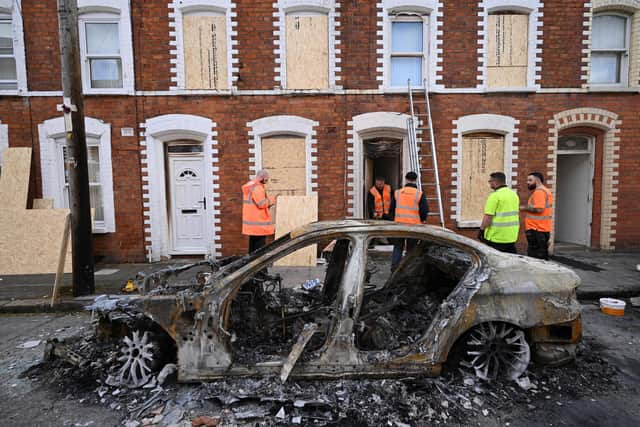

That has changed, so last week – following disorder after a man was nearly beheaded in Belfast in an attack in which the chief suspect is an asylum seeker – we had two of BBC NI's major interviewers, Mark Carruthers and William Crawley, reminding us forcefully that Northern Ireland, being ‘97% white’, is the least diverse part of the UK.
This is mentioned in tones that could suggest they think it is almost reprehensible, and needing correction, assuming that diversity is our strength. I am arguing that diversity is not our strength.
They rely on the 2021 census for that figure. Anyone with eyes in Belfast can see that percentage is seriously out of date. However we are not supposed to have eyes while the debate they promise never gets started. Indeed it can’t as there is nothing agreed or accepted on which to base a discussion.
The debate is initially and perhaps deliberately hampered by lack of facts and clear statistics – to play down the role of immigration in social problems. Those who claim to be anti-racist are the first to pick out a couple of lead or distorted numbers and repeat them on social media as ‘Gotcha’ statements. I provide here some other data and analysis to advance the debate.
The 2021 census figures are of course more complex than the actually 96% white number indicates. The 3.4% of non-whites is no longer acceptable to the PSNI and the Northern Ireland Executive in terms of targets to be met to bring about equity in employment, and to attribute guilt. With the assistance of the NI Statistics and Research Agency, they have silently switched to using a doubled ‘ethnic’ (as opposed to non white) figure of 8.1%. That is then quoted to criticise black and minority ethnic under-representation.
Which is it – 3% or 8%?
The greater figure includes ‘white’ Europeans like Roma who will probably not speak English, and is, of course, five years out of date as it takes no account of the surge in recent arrivals. Obviously media folk did not switch from 3.4% to 8.1% when addressing last week’s disturbances – after all, that would undermine their point (that one of those charged in east Belfast was Polish will not be reported).
The 2021 census also found the never-mentioned facts that 10% of Belfast’s population came from outside the British Isles and 7% were non-white.
The numbers of immigrant arrivals are difficult to quantify and the different categories numerous. Sources of information include that 2021 census, the number of national insurance numbers issued to foreigners, the number of asylum seekers funded by the Home Office, the number of those granted some form of leave to remain, the various resettlement schemes involving Syrians, Ukrainians and Hong Kongers, the number of foreign students, the number of illegal immigrants, the level of cross-border arrivals, and deportations, the amount of foreign-born school children without English as a first language, the number of those who have a skilled worker visa, the figures for new medical card registration, the plainly differential birth rates, and FactCheckNI’s report on which the above two interviewers relied – of which more later (For the FactCheckNI figures, click here)
I will try to explain the complexity of immigration statistics, but there are difficulties in that some figures refer to Belfast City Council as a local authority and others to Northern Ireland.
The liberal elite want to downplay the level of immigration and then emphasise its value, regardless of financial and resource costs. One fact to bear constantly in mind is that a unit of accommodation is required for every extra 2.4 people. When 1,000 people are added to our population, we need over 400 new homes.
The BBC’s Business correspondent, John Campbell, has written a number of informative articles for the NI News website on migrants and demography. His posts however tend to concentrate on visa’d economic migrants and students, not on illegals or asylum seekers (to see that data online, click here). The corporation has perhaps 150 journalists in Belfast – vastly more than the city’s three daily newspapers but otherwise, over the last decade, has provided minimal information, always majoring on good news stories about successful immigrants or bad stories about race attacks, in which the local population is shown to be racist, but never, ever, on immigrant crime levels. Anyone with eyes to read knows the number of foreign-born individuals in our courts for sex crimes, and our jails (10-12% if you are asking) is disproportionate.
Northern Ireland, despite its whiteness and lack of diversity and supposed racism, fully and generously played its part in the three resettlement schemes mentioned above:
Hong Kong: In the last census, there were nearly 2,000 Hong Kong-born residents in Northern Ireland. However, the NI Law Centre estimates the number has roughly doubled since the 2021 introduction of the British National (Overseas) Visa Scheme. This means around 2,000 have arrived in the last five years.
Ukraine: Around 3,600 Ukrainians arrived in Northern Ireland under official UK schemes since the 2022 invasion. The vast majority came through the Homes for Ukraine sponsorship programme, with smaller numbers via the Ukraine Family and Ukraine Extension Schemes.
Syria: Under the Syrian Vulnerable Persons Resettlement Scheme (SVPRS) which ran until 2021 nearly 2,000 arrived in Northern Ireland.
Those groups alone will have required over 3,000 units of accommodation at a cost of £600 million – basically taking half the number of new homes built in a given year.
Several, perhaps four, primary schools in south Belfast, indeed one visited by Queen Camilla recently, have a minority ethnic pupil majority where up to 80% of pupils do not have English as a first language. A BBC report spoke of the rise in “newcomer” children “making schools more diverse and sparking interest in different cultures and religions”. That is all very well but white flight first shows itself in school enrolments and I hazard a guess that not many children with BBC connections go to these particular primary schools.
After last year’s riots in Ballymena related to allegations about Roma, there was a new crackdown on illegal workers and illicit entrants from Ireland, with raids on premises and at Scottish ports. This, according to Hilary Benn in 2025 netted a surprisingly large number. He asserted in interviews, “We removed 1,000 people from Northern Ireland who had no right to be here”. The major ethnic groups and nationalities involved were indeed Roma but also Albanians. He did not say if they were actually deported but it would seem they did not claim asylum and were flown home willingly.
Of course, they were sent to their home countries not Ireland whence most had come. The hostile environment policy that provoked so much criticism of Theresa May when Home Secretary, is back. This time the media has gone silent – perhaps to avoid criticism of Mr Benn or the fact so many arrived from Ireland.
The BBC NI journalist John Campbell has written up various migrant statistics, some surprising or unspoken. For example, he stated there were 2,000 Indian students at Queen’s and Ulster University, and 2,000 Indians on work visas in Belfast. They would be visibly middle class and, in the latter case, well paid but it also tells us of the other side to growth and economic development. Our universities are far from training sufficient local graduates to fill new posts in recently attracted tech and financial firms. That there were 3,000 applications from Indians in 2024 to register for a medical card reinforces that annual arrival figure. There were some 10,000 applications from foreign workers for national insurance numbers last year in Northern Ireland.
Figures for the number of asylum seekers are the most contested and are especially distorted by those advocating open borders who jump on any reverse trend to say look away, the matter is now resolved.
Belfast, over a number of years, has been the asylum capital of the United Kingdom. Out of 360 local authority areas in 2023 it had reached number four, per capita, beaten only by Hillingdon and Hounslow in London, Halton and at times Glasgow City Council. In other words over 350 British local authorities have taken fewer asylum seekers than Belfast. That is hard to digest, as it is neither said nor emphasised.
But how is that, given the Home Office does not disperse asylum seekers – mostly small boat males and students switching to asylum claims – to Northern Ireland? The unsayable answer is that they have arrived here of their own accord and must in most cases have come through Dublin. The Irish government and its elite media supporters still claim the traffic is in the other direction but provide no evidence. The only time the other way mattered was when Rwanda threatened – the deterrent working in advance.
The Belfast figure hovers around the 2,000-2,500 mark (about one asylum seeker for every 150 residents and many more in south Belfast) as those granted leave to remain under the government’s accelerated processing policy (designed to get numbers in hotels down) are replaced by new arrivals. These individuals need to have claimed asylum in Northern Ireland at Drumkeen House like the Sudanese suspect in the north Belfast attack and his brother to receive support here.
Those granted leave to remain cease to be enumerated as asylum seekers and instead join with locals claiming social benefits and going on the Housing Executive list for these seeking accommodation. Housing benefit or local housing allowance, if a private rental tenant, becomes payable. The numbers in that category of post-asylum seeker in Belfast are unknown but they are competitors for scarce resources, often with stronger cases for housing allocations than locals.
On ‘alien culture’, a phrase which Jim Allister MP was attacked for using, the historian Tom Holland put it succinctly, “Islam is uniquely indigestible in secular societies”, and a high proportion of our current asylum seekers come from majority Muslim countries. Dominant ethno-religious population density is yet to become a pivotal issue in Belfast but will, even though we are behind parts of London and northern English cities in numbers.
I mentioned in the first part of this essay one FactCheckNI report quoted by BBC commentators several times on X as evidence. It was dated September 2025. But first who are FactCheckNI? They have three staff and are funded by the European Commission, Dublin’s foreign ministry and the Joseph Rowntree Foundation (To read the FactCheckNI page about its funding, click here)
Their efforts are devoted to debunking often silly viral claims regarding immigrants. They assemble straw men and knock them over, then provide baffling statistics that lead nowhere or at the end to confirmation of key problematic facts that are not highlighted.
In August 2024 they fact checked this question – ‘Has Northern Ireland the lowest number of registered asylum seekers in any part of the UK?’
The statement was rated ‘Accurate with consideration’ since “The number of people seeking asylum in Northern Ireland reduced between March 2023 and March 2024. Northern Ireland has the lowest number of people – 2,748 as of March 2024 – seeking asylum in receipt of support in the UK, with the next being Wales with 3,031 individuals.NI ranks in the middle of UK regions for people seeking asylum when overall population is factored into the calculation.”
First, we are gratuitously told asylum seeker numbers are going down. Then, unsurprisingly, NI has the lowest number in the UK, indeed lower than Wales, and that we are a middle UK region when a per capita rate is used. A per capita rate of course is not used initially by FactCheckNI. I call this disinformation.
The September 2025 claim supposedly debunked by FactCheckNI was by Edwin Poots, who said that “Belfast has the second highest number of asylum seekers [he wrote ‘migrants’] in the UK”. It was judged ‘inaccurate’ while statistics about percentages in the south of the city were ‘unsubstantiated’.
FactCheckNI said: “Belfast does not have the second highest number of asylum seekers in the UK. According to the most recent statistics, Belfast City Council area has 2,103 asylum seekers. Several cities – including Leeds (3,326), Glasgow (4,553), Birmingham (4,654), Manchester (3,321) and more – are currently home to a higher number of asylum seekers. London has a great many more asylum seekers than Belfast, indeed several of its 33 individual boroughs are currently home to more asylum seekers than Belfast (Barnet has 3,398, Hillingdon has 3,304, Hounslow 3,132 and so on).”
These facts are of course irrelevant when the statistic that matters is number per head of population. The checkers then repeat this irrelevancy “Belfast does not have the second highest number of asylum seekers in the UK. Several places have more, including London, Birmingham, Glasgow, Leeds, Liverpool, Coventry and Bristol.” They needlessly add, “Belfast City Council area has the 20th highest number of people seeking asylum in the UK”. We are then told Northern Ireland I overall has much lower figures than Belfast, although Mr Poots only spoke of Belfast.
Way down the piece, we are finally advised about proportionate numbers, as opposed to absolute numbers:
"Home Office data also includes information on the relative population of asylum seekers in each local authority area, by calculating the asylum seeker population as a percentage of the total population. By this measure, Belfast is 32nd among the 361 local authority areas in the list, with 0.60% of its population currently seeking asylum – or around one in every 167 people. This is quite a high proportion of asylum seekers in the UK context – being 32nd out of the total of 382 local government areas in the UK (not every local authority is on the Home Office list) means Belfast is in the top 10% of local authority areas for asylum seekers as a proportion of total population.”
The quarterly Home Office figures of course fluctuate and Belfast goes from 4th to 32nd out of the now 382 council areas but the key “quite a high” fact is only indicated, ten screen pages in.
That 90% of the UK has lower numbers of asylum seekers than Belfast is a figure we will not be hearing trumpeted on Talkback or The View, which is why people sadly get so angry.
The author, David Goodhart, explained recently that the problem in Britain has been political. When the mainstream political left in the 1990s under Tony Blair largely accepted the economic reforms of the Thatcher period they needed something to distinguish themselves from, and feel morally superior to Conservatives, and they found that mainly in the cultural sphere, and in particular in being more open towards immigration and giving a special priority to race equality issues.
He went on “Just as the majority was beginning to feel more comfortable about Britain’s ethnic minorities, thanks in part to much lower immigration in the 1980s and 1990s, a large part of the political class – increasingly dominated by progressive university graduates – decided to liberalise immigration and embrace diversity as an unqualified good, creating new legal and linguistic protections for minorities that left many less well educated people feeling anxious and confused around race. Instead of embracing colour-blindness, progressives began to absorb critical race theory ideas from America about white privilege, systemic racism and how minorities cannot themselves be racist.”
This sort of thinking then filtered down, very noticeably in Belfast, by non governmental organisations (NGOs) to civil servants, teachers and broadcasters.
Instead the challenge is to have a debate based on all the facts, not just what little the liberal elite allows us to hear. As recently as yesterday, Sunday Sequence on BBC Radio Ulster was an illustration of the corporation’s failures in covering this topic. It had a discussion on the recent events and the lack of a Stormont race strategy. It was no surprise that the panel of three and the interviewer seemed to be of one mind – that unhappiness at immigration is a matter of racism.
Only the pros of immigration and negative responses to that immigration are highlighted – the downsides to immigration are not even discussed but dismissed as racist.
• Jeffrey Dudgeon is a free speech campaigner and former Ulster Unionist councillor