
John Wilson Foster: Ireland's story would need to be retold in order to avoid the macabre absurdity of unionists being "invited" to unite with a country in whose story they (and the British as a whole) are the villains
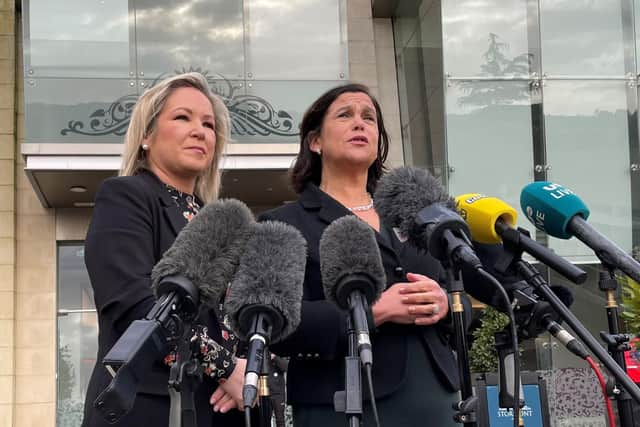
Leo Varadkar and Mary Lou McDonald have upped their demand for Irish unification. The first of two excerpts from John Wilson Foster's paperback, ‘Ireland Out of England and Other Inconveniences’ argues neither has an inkling of what it would entail
In 1958, three Protestant evangelists in Killaloe, the Co Clare village where water-skiing was introduced to Ireland that same year, began to preach to passers-by.

The playwright Sean O'Casey related in a letter to Paul Shyre, the American producer and dramatist, what happened.
As O'Casey tells it, a violent little crowd gathered and the Gardai advised the evangelists to move on. They obeyed, but on their way to their car the crowd attacked with fists and sticks. When charges were lodged against the assailants, the case against three Catholic farmers was dismissed by the district justice. Here's the kicker: the DJ said the evangelists deserved their beating and that, in any case, “religion is above the courts”.

Adds O'Casey: “Not the evangelists' religion, of course, but the religion of the assailants”. The police, the law, the Catholic Church in a common sectarian pursuit: was this not engrained discrimination? Did it not demonstrate a covenant between Catholic Church and Irish State enshrined in the 1937 Irish Constitution?
Am I dredging up a past within living memory that I hope southerners will find embarrassing? Yes. For I implore the South not to pursue the unity campaign unless it is prepared to deplore, as it requires the North to do, elements of its own nature and tracts of its own history. This necessary work of national introspection has not even begun in the Republic.
A campaign for unification founded on the assumption of historical oppression and state failure in Northern Ireland but sunny equity and state success in the Irish Free State and Irish Republic, will not fly.
Yet the unification campaign is founded precisely on the alleged imperatives of history. Inevitably, any confirmed unionists who become involved in planning a new Ireland will bring up the past fate of Protestants over the border.
One southern Protestant historian has unconvincingly assured northern Protestants that the alarming collapse in the Protestant population since 1922 (from roughly 10% to 3% before a slight recovery to 4%) has had diverse causes and that systemic discrimination was not among them. Robin Bury in ‘Buried Lives: The Protestants of Southern Ireland’ (2017) tells a very different story.
The naked sectarianism of the 1907 Ne Temere decree affecting mixed marriages (permitted only when a solemn promise was made to bring up all children as Catholic) is the premiss of the splendidly directed and acted 1999 RTE-BBC film, ‘A Love Divided’. This dramatised the 1957 Catholic boycott of Protestant businesses in Fethard-on-Sea, Wexford.
The boycott was organised by the local priest after a Protestant wife, renouncing the pledge she signed when she married to bring her children up Catholic, fled with her children to Scotland in order to prevent their enforced enrolment in the local Catholic school. The script is sympathetic to husband and wife and unsympathetic to the priest. Rome is portrayed as guided by Realpolitik which provides the cynical resolution.
The southern Protestant historian's depiction of his co-religionists who didn't leave the Free State but stuck it out, keeping their heads down and practising their religion in “privacy”, makes sad and embarrassing reading; Protestants, he claims, “didn't do badly”. In ‘A Love Divided’, the Protestant minister refuses to help his parishioner, telling her that “the prevailing wisdom is that we [Protestants] keep our head down and our mouths shut”.
If the current unity campaign actually became a serious debate, I suspect some buried resentment among southern Protestants would disinter itself. An early signal of that resentment was expressed by W B Yeats in 1925 when he told the Irish Senate, about to ratify the bill to outlaw divorce, that this was an insult to Protestants. Rebuked from the chair for his apparent bitterness, he replied: “We shall be all much bitterer before we are finished with this question”. Words to keep in mind even a century later.
It is all far too soon and too headstrong. Southerners are being led into this by a small number of public activists, and of course Sinn Fein, still celebrating those who carried out terrorist atrocities for 30 years. Southerners would be wise to fall sensibly back and reflect on what may otherwise lie in wait.
In Northern Ireland there will be a deepening polarisation between nationalists and unionists, Catholics and Protestants. The Alliance Party will implode. Party members will be pressed to declare themselves on the very issue whose avoidance was the party's reason for being. A crucial time-sensitive work in progress – making a non-sectarian Northern Ireland work which is a prerequisite to any civil talk of a united Ireland – will be cancelled overnight.
Other unforeseen fractures will appear in southern society, too, were the “debate” to move from rhetoric to reality. Over the question of a new flag. Of a new national anthem. Of the official role of Ulster Scots dialect in public sector life. Of unionist symbols to be incorporated into the southern public sphere. Of the future status of the Catholic Church in 90% of the south's primary schools. Of the bureaucratic compulsion in the south of the Irish language. Not to speak of representation in an entirely new police force.
Dubliner Vincent Keaveny, lord mayor of London 2021-2022, gave the Brian Lenihan Memorial Lecture at Cambridge University in September 2023. Thinking of what changes Republic of Ireland citizens would entertain to accommodate northern unionists, he admitted that support for a united Ireland drops significantly if a new anthem or a new flag is the cost to be paid. And they would be the bare minimum.
Do unity campaigners imagine the Republic will reinvent itself in happy unanimity? If hard-line republicans are driving the campaign, there will be civic war as the nature of Irish citizenship is contested. Already, the question of how to speak publicly of IRA bombings and shootings has divided southerners after Mary Lou McDonald saw no comparison, moral or otherwise, between contemporary gangland murders (bad) and IRA killings unsanctioned by the Irish state (justified).
How to narrate the IRA terror campaign, 1970-1994, into the history books will be an incensing challenge. Or do campaigners think that almost a million unionists will quietly assimilate to the Republic as it is and so pre-empt the need for any southern soul-searching?
In fact, it would be necessary to strip out all extant and residual anti-British, anti-Protestant and anti-unionist political and cultural manifestations so that no public spaces would make unionists feel unsafe or uncomfortable: this is the new human rights landscape of western liberal societies. (And human rights advocates and lawyers will be dancing attendance.)
The Republic prides itself in being a progressive liberal society; it would have to prove it in its biggest test ever. And would it be recognisable thereafter if it did? How many citizens welcome sea-changes to a society in which they're on the whole content? And need to face higher taxes to pay for the sea-change?
The national story would have to be re-told. As the historian Jeff Fynn-Paul reminded us in his Spectator essay on the new story of the discovery and settlement of North America that is challenging the familiar story: “It is times like these that we realise the stories we tell ourselves – about our history in particular – are of fundamental importance to the direction our societies take. The shift from Weimar Republic to Nazi Germany was accomplished, first and foremost, by a shift in who controlled the national narrative”.
In the Irish case, the national story would need to be retold in order to avoid the macabre absurdity of unionists being “invited” to unite with a country in whose story they (and the British as a whole) are the villains.
So content and perspectives offensive to pro-British and pro-Union sensibilities would have to be removed. New school textbooks would need to be written to promote parity of esteem and a balance between unionist and nationalist values, heroes and icons. Easter 1916 and the War of Independence could no longer be the “onlie begetters” of a unified island, but rather contested partisan contributions.
In Unherd recently, Norma Costello wrote of the Republic: “This is a nation with a national anthem entitled 'The Soldier’s Song'. Our war for independence [against the British] is the most deified part of our history books.”
Will the “deified” be voluntarily reduced to the ordinary and scrutinisable? ‘Amhrán na bhFiann’ (‘The Soldier's Song’) by Kearney and Heeney would have to go. Bunreacht Na hÉireann (Constitution of Ireland) would have to be tortuously redrafted as an Irish-British, nationalist-unionist constitutional hybrid stripped of any embedded veneration for a way of life hostile to unionists.
l John Wilson Foster, originally from east Belfast, is professor emeritus at the University of British Columbia. He is the author of 20 books on natural history, RMS Titanic, and Irish and British literature and culture.
l ‘Ireland Out of England and Other Inconveniences’ is available by Belcouver Press, £10.99 from Colourpoint Books, Amazon and bookshops, and for £5.99 from Amazon Kindle.