
Jon Burrows: It is shocking that our government has co-designed legacy arrangements with an Irish state that has not been honest about its role in the past
Last month, the UK and Irish governments published a new framework for dealing with the legacy of the Troubles.
The Ulster Unionist Party which, unlike every other Executive party, opposed the legacy arrangements set out in the Stormont House Agreement and we are deeply sceptical of these new proposals.
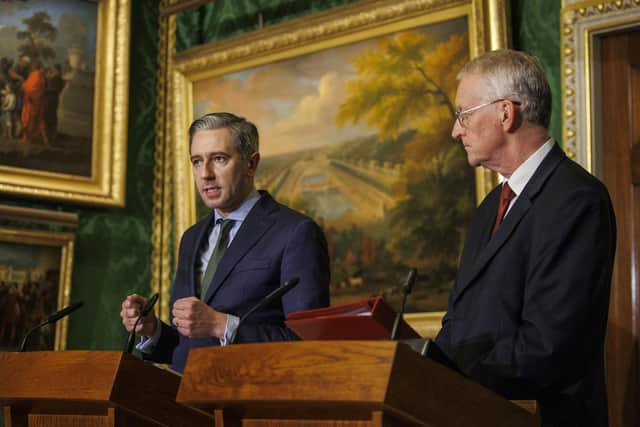

It is shocking that our government considers it right to co-design legacy arrangements with Dublin. The Irish state refused to extradite all but a handful of terrorists wanted for atrocities committed in Northern Ireland. Since the Belfast Agreement, it has failed to demonstrate honesty about its role in the past.
While the UK government is holding a full inquiry into the Omagh Bomb, Dublin dragged its feet on basic cooperation — despite the fact that the bomb was constructed in the Republic, the car was stolen there, and the suspects fled back there after spending barely 45 minutes in Northern Ireland. The Irish security services successfully prevented the Real IRA from sending car bombs to England however several detonated in Northern Ireland in the run up to the Omagh bombing.

The Ulster Unionist Party approach to legacy is anchored by three unyielding principles:
• Victim makers are not victims; innocent victims deserve justice, not gaslighting.
• Those who served with honour must be protected from lawfare, vexatious investigations and any employment discrimination.
• History must not be rewritten, we will resist all attempts to twist the past to fit the warped narrative of republicanism.
Every proposal on legacy will be tested against these standards.
Two weeks ago, a UUP delegation including Lord Elliott, Lord Empey, Robin Swann MP and myself met with the secretary of state, Hilary Benn MP, for a frank discussion. We reaffirmed our opposition to the Stormont House Agreement, expressed concern over Dublin’s co-design role, and restated our guiding principles clearly.
We have yet to see the draft legislation underpinning the new legacy proposals. Nonetheless, we began immediately to press the secretary of state for answers. One key element is the replacement of the Independent Commission for Reconciliation and Information Recovery (ICRIR) with a new Legacy Commission to investigate Troubles-related crimes.
Our delegation made clear that former members of the RUC GC must never face employment discrimination, not just due to fairness but because their expertise is unparalleled. Mr Benn said that current ICRIR investigators who are former RUC or PSNI officers will not have to reapply for their posts under the new body, and that there will be no bar on such officers applying for future roles. We welcome this statement, but the proof will be in the legislation, and I we want to put it on the public record as an accountability mechanism.
We also pressed Mr Benn on the six ‘protections for veterans’ announced by the government. These are meaningless until details are provided and they are enshrined in law. However, we specifically asked why the so called “protection from repeated investigations” does not extend to RUC officers who served alongside veterans. The secretary of state admitted there was no logical reason for this omission and said he would explore broadening the scope of the protections.
There is no equivalence between the actions of soldiers or police officers acting in good faith and the calculated malice of terrorists. Too often however, modern investigations into state actions during the Troubles are conducted without appreciation of the operating environment of the time. Split-second decisions made under exhaustion and threat, by human beings already affected by trauma are judged in a cool and detached analytical environment.
We urged Mr Benn to ensure inquiry into the actions of former RUC officers and soldiers is legally required to consider expert evidence of the standards, training, and threat levels of the period. Further, that the unique psychological burden borne by RUC, UDR and RIR personnel who lived under constant threat 24/7 is specifically evidenced when assessing how those affected reacted in a split second when they perceived danger.
He accepted this as a fair point. Time will tell if action follows.
A particularly troubling element of the new agreement is the creation of the Independent Commission for Information Recovery (ICIR), allowing terrorists to disclose information about crimes without fear of prosecution. Its aim is to help families learn more about the fate of loved ones murdered by terrorists. We worry it risks becoming a backdoor amnesty. Mr Benn said only the information provided to the ICIR will be inadmissible in a criminal case, and other evidence can still be used to mount prosecutions. Again, we need to see the legislation.
Even if this is the case, terrorists could manipulate the truth, offering self-serving or false information to ease their consciences or rewrite history. Mr Benn could offer no convincing reassurance on this point. And how will the Provisional IRA engage with such a body when republicans claim it no longer exists?
The Irish government has pledged to create a legacy unit within the Garda Síochána to cooperate with Northern Ireland investigations and pursue unsolved Troubles-era crimes in the Republic. We asked whether Dublin’s legislation would require unredacted intelligence sharing and what independent oversight would exist — given the Irish government’s insistence on independence in Northern Ireland’s arrangements.
We also sought clarity from Mr Benn on previous comments by former Irish Justice Minister Michael McDowell, who claimed that after the Belfast Agreement, Dublin at the request of Sinn Fein agreed that the An Garda Síochána would not investigate republicans for any crimes anywhere in Ireland. Who exactly asked for this, what is its scope and does it offer republicans a get out of jail card from the proposed Garda legacy unit? Let us have transparency.
The Ulster Unionist Party opposed the legacy proposals made in the Stormont House Agreement. We will still oppose the distrotion of history.
• Jon Burrows is a UUP MLA