
Jon Burrows: The law must adequately punish anyone who drives a car like it’s a lethal weapon
Five teenagers dead in Ireland. An innocent family of four, including a seven-year-old boy, travelling to the airport for a holiday seriously injured.
Seven people dead in Cleveland, including two police officers.
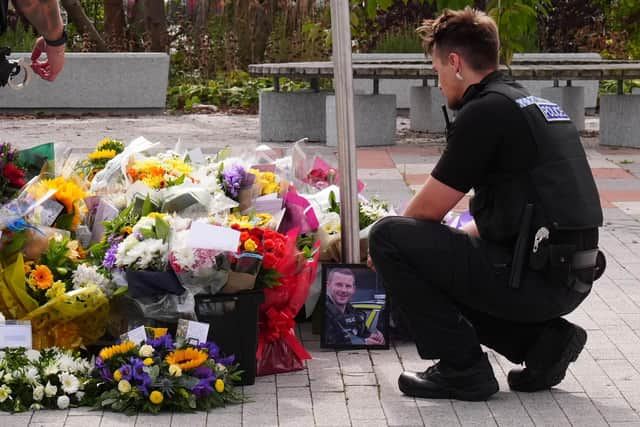

Police Constables Matthew Blades and Tom Clough went to work to protect the public and never returned home. They were killed when a car travelling the wrong way along the A66 struck their police vehicle.
These horrific events should force us to confront an uncomfortable truth: a car driven at extreme speed, against the flow of traffic or deliberately used to evade police, is no longer simply a means of transport. It is a lethal weapon.
For too long, extreme dangerous driving and deliberately failing to stop for police have not been treated with sufficient seriousness by our law or our courts. Unless someone is killed or seriously injured, such behaviour is too often treated primarily as a motoring matter. But to create a real deterrent, there must be serious and certain consequences for the behaviour itself, even when, through chance alone, nobody is killed or seriously injured.
In Northern Ireland, the maximum sentence for dangerous driving is five years following conviction on indictment, but only six months when dealt with summarily.
Justice Minister Naomi Long has initiated a review of sentencing. I have written to her asking that dangerous driving be included within its scope, with particular attention given to the sentences available for the most extreme cases and how those cases are prosecuted.
Driving at enormous speed through residential areas, travelling the wrong way along a motorway or dual carriageway, mounting pavements and deliberately fleeing from police, creates an immediate risk of catastrophic loss of life.
When nobody is killed or seriously injured, the current sentencing options can be too limited to provide a meaningful deterrent or adequately reflect the danger deliberately created.
The difference between wiping out an innocent family and narrowly missing them may be a matter of seconds, inches or sheer chance. The criminal culpability does not suddenly appear only when someone dies. The driver has already chosen to create the lethal danger.
That principle is recognised elsewhere in criminal law. Someone caught carrying a loaded gun does not escape serious consequences because they did not manage to shoot anyone. We punish the possession and creation of the danger, not only the eventual outcome.
Our law must take the same approach to the most extreme forms of dangerous driving.
Where someone drives at extreme speed, travels against oncoming traffic or deliberately evades police in circumstances creating an obvious threat to life, the courts should have sentencing powers reflecting the lethal nature of that conduct, even if, through good fortune alone, nobody is killed.
I am committed to trying to secure a substantial increase in the maximum sentence available for the most extreme forms of dangerous driving. Tougher sentencing for the most harmful crimes will be a key part of our manifesto.
We must ensure the punishment reflects the lethal danger deliberately created. There is also a need for consideration of a distinct aggravated offence in worst cases, with clearer guidance ensuring they are never treated as ordinary motoring matters.
We must also confront the online culture surrounding this behaviour.
Videos showing stolen cars, high-speed pursuits and vehicles being driven against motorway traffic are not entertainment. They glamorise criminality, reward recklessness and encourage imitation.
Social media companies must remove this material and stop their algorithms promoting it. There must also be meaningful action against those who drive, film, encourage or upload such footage.
Parents have a responsibility too. They need to know what their young people are watching, sharing and doing. Social media can turn destructive behaviour into a performance in which attention and online approval become the prize.
Policing must be risk-led, with enforcement focused relentlessly on the people, vehicles, locations and times presenting the greatest danger. Speed enforcement matters, and nobody should speed anywhere. However, enforcement cannot become overly predictable, with camera vans appearing in the same convenient locations during nine-to-five hours. That can sometimes feel more like revenue raising than a strategy for preventing deaths.
Resources should target those most likely to kill or seriously injure: prolific car thieves, extreme dangerous drivers and organised groups repeatedly using vehicles to escape detection. Enforcement must operate where and when the greatest risks exist.
This issue also demonstrates why I opposed the recent Alliance proposal to increase Northern Ireland’s minimum age of criminal responsibility.
Causing death by dangerous driving was not included among the proposed exceptions. What would happen if someone under 14 deliberately drove at extreme speed, travelled against traffic and caused a death? The justice system could be left unable to prosecute that person for the death they caused.
Children should be treated differently from adults. Rehabilitation, welfare and early intervention are essential. But compassion and accountability are not opposites.
A justice system unable to respond when a grave offence is committed is not fair to victims, or communities.
As a former police officer, the deaths in Cleveland brought back painful memories of my former colleague Constable Philippa Reynolds.
Philippa was killed in the line of duty in 2013 when a stolen vehicle, driven at high speed by thieves, struck the police car in which she was travelling. She was only 27. My thoughts remain with her family and all those whose lives were changed that night.
Matthew, Tom and Philippa represented the very best of policing and public service. Their sacrifice must never be forgotten, and the lethal behaviour that took them from their families must never be glorified or tolerated.
A car driven like a weapon must be treated like one. The law must punish the deliberate creation of lethal danger, not merely the consequences when chance finally runs out. We need to better protect the law-abiding public from those who present lethal risk.
l Jon Burrows is leader of the Ulster Unionist Party and North Antrim MLA