
Jonny McCambridge: Awe-inspiring Artemis moon launch reminds us to reach for the stars
There is the threat of a last-minute hitch just minutes before the mighty Artemis II rocket is due to take off from the Kennedy Space Center in Florida.
With the eyes of much of the world, and everyone in my house, watching, word comes through that there may be a fault with a battery unit at the tip of the Orion spacecraft.
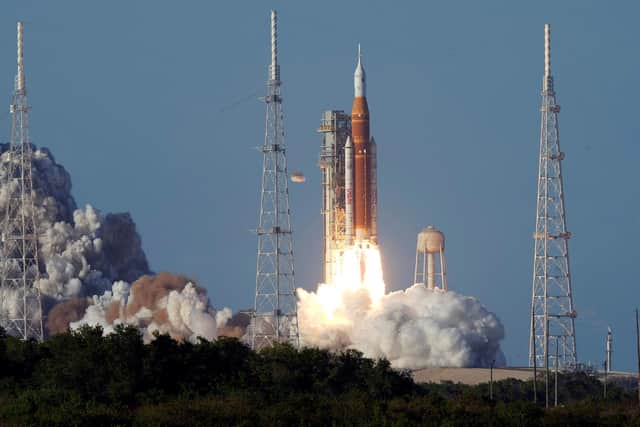

I have been annoying my family by switching constantly between several rolling new channels, unable to settle on one to watch this moment of history. On one broadcast, a breathless news presenter is speaking to an expert at Cape Canaveral. They have been doing this for several hours. The potential battery glitch, at least, gives them something fresh to talk about.
'What do you think might be happening?', the reporter inquires.
'I have absolutely no idea,' the expert responds.
'Thanks for that....now let's head back to the studio.'
Around half an hour later, with the mysterious battery issue now resolved, the final countdown resumes. My son settles from his previous habit of jumping around the room. I am surprised at how nervous I have become, how aware of the potential that something could go wrong.
The jovial atmosphere in the room is replaced by something more subdued as the moment for launch draws near.
There is a furious emission of power, flames and smoke as the rockets are powered and the vessel is lifted upwards at a rate which seems to catch the following camera by surprise as it struggles to keep it in shot.
Even for the most cynical, the sight of this spectacle is awe-inspiring, the scale of human achievement undeniable.
The story of space travel is, I suppose, familiar to us all. My son recently did a history test where one of the questions was to name the first two men to walk on the moon. One of his classmates answered Niall Strongarms and Buzz Lightyear.
However, as I watch the parts of the soaring Artemis rocket separate, I also consider this is the first time I have witnessed such a sight in my life. I have been alive for more than half a century, but the last occasion humans left the earth's orbit and headed for the moon in 1972, predates my existence. That sense of shared experience watching the flickering black and white pictures, was something my parents' generation spoke about.
The closest I got to something like this were the Space Shuttle launches in the 1980s. I was watching live on television in 1986 when the Space Shuttle Challenger exploded just 73 seconds after take-off, killing all seven astronauts on board, reinforcing how the risk can never be eliminated when the challenges are so vast.
Perhaps it is the lived memory of that which explains why I am now more nervous than my son as the rocket rises.
I know that as a follower of the arts, rather than the sciences, I will never be able to properly understand how space travel works. I simply don't get the maths.
But on the emotional level there is something about watching the rocket launch which brings me back to being a little boy watching Flash Gordon, Buck Rogers, Battlestar Galactica, Star Trek and Star Wars. It is that infectious awe of the cosmos that never leaves us. The Artemis crew, travelling around the dark side of the moon and back, are boldly going where no woman or man has gone before.
Recently, I was searching for something to watch on telly with my son during a lazy afternoon.
I came across a documentary, which while initially unpromising, left a deep impact on me. The film was called Good Night Oppy and told the story of the Mars rover Opportunity.
The little wheeled robot was launched to the red planet in 2003. It was designed to operate for 90 sols (just slightly longer than an Earth day). Instead, it explored Mars for 15 years, sending back vast amounts of photographs and data. At the end of every sol, ground control would wish it 'Good night Oppy'. The following morning the unit would wake up again and continue its tireless, seemingly endless solitary trek.
As we watched the film, I had a clear sense that my emotions were being manipulated. We were being urged to root for the plucky little rover which, despite being nothing more than a melange of metal, plastic and wires, was overcoming overwhelming technical obstacles to continue on its journey. The story was told through a series of interviews with the scientists and engineers who built Oppy and it was clear that they had a deep bond with their creation.
Coming to the conclusion of Oppy's 15 year odyssey and having sent back incalculable amounts of information, the rover was riven with whatever the robotic equivalents of dementia and arthritis are. The end was near. Ground control decided to do something different. The unit had sent back hundreds of thousands of photographs of Mars, but it had not been seen itself since its long distant launch. The engineers reprogrammed its arm to point the camera at itself. A series of photographs were sent to Nasa which put them together to form a composite selfie.
There, all alone, in the middle of a vast red desert, was the battered wee robot, its solar panels caked in thick dust and close to inoperable. Like an eejit, I had to tell my son that I needed a bathroom break as I left the room to compose myself.
I guess my fears for the Artemis astronauts or my tears over Oppy amount to much the same thing; it is where cold, calculated science meets with our sense of wonder, intersects with our hopes about what human ingenuity can achieve.
A quick glance at the rest of the news bulletins reminds us that we are all in the gutter most of the time. But, just occasionally, there is a chance to look towards the stars.