
Jonny McCambridge: Preserving days – the secret ingredient that goes into my jams, jellies and chutneys
Aside from public and bank holidays, there are usually two periods within the year when I will attempt to take some time away from work.

A week off will be booked for a family vacation in July or August. Depending on the state of our finances, this can be anything from a hotel in southern Italy to a tent in north Antrim.
Then, as the crisp-brown edges of autumn give way to the harsher winter temperatures, I use up remaining leave in late October and early November.
Those who are familiar with my routines and eccentricities know what I will be doing on these days off. However, there is usually someone less well-acquainted who will ask why I take time off now, rather than when the sun shines. I then have the task of awkwardly explaining, while trying not to leave the impression that I am a peculiar relic from another time, that these are my ‘preserving days’, (to be clear, I am talking about preserving food –rather than my reputation, dignity or sanity).
This particular adventure started more than a decade ago. The legendary success of the little crab-apple tree my wife planted in the front garden led to a harvest of hundreds of shiny red orbs each autumn. The crab-apples are too bitter to eat off the tree.
I was loathe to allow the fruit to rot so the solution was to buy a jelly bag and preserve the bounty. After a few mis-steps, I started to get the hang of it.
The process is slow and requires reserves of patience. I start by heating the fruit in water until it is pulped, then wait for hours as the clear juice trickles drip by drip from the jelly bag. The liquid is then boiled furiously with sugar, watching keenly for the moment when the pectin reaches setting point. Jars are sterilised before the perilous process begins of pouring the still scorching jelly from the giant pot into the glass containers.
Once I had mastered it, I was delighted with the brilliantly crimson viscous jelly. There were so many apples that I ended up with more jars than I could consume, so I started giving a few away as presents, marketing it as a far superior alternative to cranberry sauce in a Christmas dinner.
It grew from there. My da has an allotment. When I visit, I always come away with a huge box or several bags heaving with freshly dug or picked fruit and veg. I use much of the produce for day to day cooking, but there are only so many beetroots I can eat in a week. Inevitably, I end up preserving.
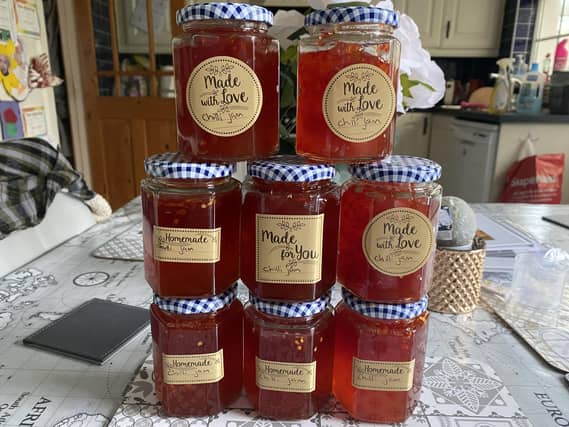
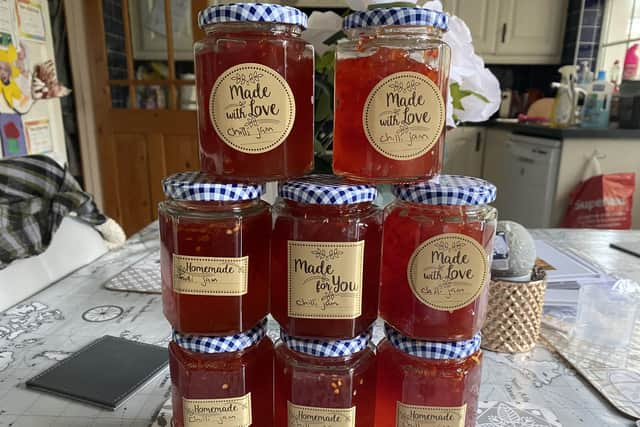
Over the years I have concocted a rum mixture of jellies, jams, chutneys, ketchups, sauces, pickles and purees. Some experiments have been more successful than others. I am especially proud of the hot chilli jam with the tiny flecks of fiery chilli flesh suspended in the jelly like fossils caught in sap. On the other hand, the most charitable thing that could be said about my sweet turnip jam was that it was an acquired taste. The crab apple ketchup may well have been my crowning achievement, but I cannot say for sure as I have been unable to persuade or force the luscious, thick sauce to come out of the bottles.
Up until this point there has been a certain logic in everything I have explained (to my mind at least). It has involved tales of preserving produce to prevent it from rotting away and attracting flies in my fruit basket. But the story goes further. I want to make plum jam. There are no plums at the allotment so I’m now buying fruit with the specific aim of jamming it. Which creates a slight logic problem. There are rows of plum jam on the supermarket shelves. I can buy one for cheaper than it costs me to buy fresh plums, pectin sugar, vinegar and glass jars. The economic argument has flipped on its head.
Take the reasoning a step further. Preserving is an ancient practice developed so people would have enough to eat through the darkest days of winter when there was no fresh produce available. Unless there is a catastrophic and unforeseen set of circumstances, there is no danger that I will be going hungry anytime soon.
I’ve spent a lot of time over the past week staring into giant pots full of urgently bubbling sugary syrups. Inevitably, I’ve been inclined to wonder whether this is a useful or sensible way to spend my time. As I watch the temperature on the jam thermometer inch slowly upwards, I have found myself asking more than once why I bother.
Perhaps it is done simply because I enjoy it, or because I appreciate having a sharp chutney to add some zing to my sandwiches. Maybe there is a culinary interest in maintaining ancient techniques of elongating the shelf-life of food. Perhaps it is done for the adulation, counting the paltry number of likes I get when I post a photo of a jar of jelly on social media. There’s probably some truth in all of these.
But I also think there’s a deeper explanation, something which reaches deep into my emotional core. It’s the same constant yearning which makes me want to invite family and friends to my house so I can cook dinner, or to spend hours baking loaves of bread and cakes even when I know they can be made better by others and bought for cheaper.
The reasoning is not completely transparent in my mind, but I think I see food as a manifestation of love. I come from an emotionally constipated culture where I cannot comfortably express to most people how I feel about them. So, I express it instead through food. The reward of the labour is the inherent hope that it might make someone’s day a tiny bit sweeter. There’s a little bit of love in every jar of jam which I give away.