
Jonny McCambridge: Sunny food for sunny days – salad cream sandwiches in my salad days
In a simpler time, sunny days meant sunnier food. When I was a boy, the good weather, when it came, would have led to the staple dinner of boiled spuds being temporarily set aside in favour of the great Northern Ireland salad.
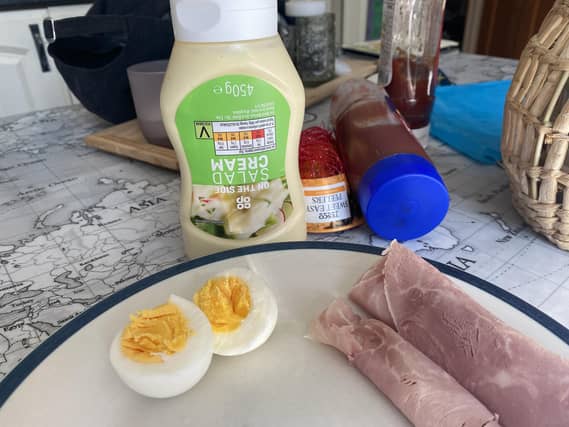

Our culinary habits were more regimented in the 1970s and 80s. Now we can serve a salad at any time of the year without thinking anything strange. When I was young, the idea of eating salad in winter would have been as preposterous as washing your hair with mayonnaise.
This sense of regimentation extended to what was on the plate. Before Jamie Oliver came along and encouraged us to just throw everything together on a giant platter using our fingers, the old-fashioned salad consisted of multiple ingredients each with their own designated place on the plate.
These were the days before hummus, olives, halloumi or avocado. Tomatoes were all the same colour, shape and size (red, round and tomato size).
While there were no set rules, I think the power of nostalgia can assist me to list the basic components of the famous old summer salad.
Lettuce: The world of greens used to be much simpler. There was no rocket, chard, lamb’s lettuce or watercress. Not even an iceberg, cos or romaine. A lettuce was just a lettuce. A big dark green leafy plant which you could imagine a rabbit nibbling at. If you didn’t wash it thoroughly there was every possibility you might find a caterpillar between the leaves. Conversely, there was no salad spinner to dry the lettuce if you did wash it.
Meat: Slices of cooked ham, rolled up like a scroll to look fancy. I am aware that some people substituted the ham with tuna from a tin (remember to drain the brine first).
Boiled egg: Hard-boiled until the yolk was power-keg dry. Could be served halved or sliced in one of those little machines with the wires. In my school dinner salad, I liked the devilled eggs they served.
Tomatoes: Served sliced or quartered. I don’t recall that we had any really sharp kitchen knives, so we often had them squashed.
Pickles: Beetroot from a jar, corrugated if you were daring. Perhaps a pickled onion.
Cheese: Occasionally cheddar, served grated or else in a wedge which could have held a door open. More often Dairylea triangles.
:Exotic ingredients: Coleslaw. Potato salad.
:Optional extras: I don’t recall that cucumbers were common in north Antrim supermarkets 40 years ago, but I could be wrong. Sweetcorn from a tin added a sunny yellow and a pleasing texture to the dish. If you wanted to unearth your inner-chef, you could snip scallions with a pair of scissors over the top.
Bread: Served on a side plate. Sliced white pan with butter. Wheaten as an alternative.
Dressings: This is where it gets interesting. I don’t remember being aware of the concept that salad leaves needed to be dressed. The process of emulsification was one I imagined best left to painters and decorators.
Our cupboards contained no French dressing, no vinaigrette, no apple cider vinegar, no chipotle, no olive or rapeseed oil (we had lard, but that clearly wasn’t an option).
There was no spice rack or tahini, no herbs growing in pots on the windowsill. We did have yoghurt, but it wasn’t of the Greek variety and was usually strawberry flavoured and came in little tubs with ‘Ski’ or ‘Petit Filous’ written on the label.
I do remember becoming aware of mayonnaise when I went to a restaurant as a boy and had to choose between egg mayonnaise and prawn cocktail for my starter.
The main course which followed was chicken Maryland (complete with battered pineapple and banana) and the meal finished with a knickerbocker glory in a tall glass with a long spoon.
I was unimpressed when I first tried the mayonnaise (ruined a perfectly good boiled egg). I recall well my thought process: "It’s a poor man’s salad cream”.
Which brings me neatly around to salad cream itself, which was the golden hero that bound all the disparate elements of the salad together.
In the days before plastic squeezy containers, it came in a tall glass bottle that you had to thump at the bottom occasionally when the thick sauce within didn’t want to shift.
The bottle was kept at the back of the fridge and, after a while, little bits of the sauce turned a deeper yellow would go crusty and hard at the top.
I was a huge fan of salad cream and couldn’t get enough of it. In terms of pure volume, I probably ingested more of the thick and gloopy sauce than any other foodstuff during my adolescent years.
So alluring and irresistible was the condiment that I thought it was doing it a disservice to limit it merely to salads (although in fairness they couldn’t really just call it ‘Cream’).
I quite liked it with chips, on toast or crackers.
But my favourite was salad cream sandwiches.
By this I don’t mean that I replaced butter or mayonnaise and had a separate filling. The yellow sauce was the filling.
Many days when I came home from school, I would take four slices of white bread, slather them with salad cream and then fold the rounds over before devouring them as a snack.
At the time I suppose I imagined that everybody ate salad cream sandwiches.
It is only as I’ve grown up that I’ve discovered that this was a habit that seemed peculiar to myself.
Buoyed by my success with the novel sandwich, I expanded my range. I tried out the same method with white bread filled with tomato ketchup, and then brown sauce.
I once undertook an experiment, which perhaps exposes something of my daring personality, where I tried out salad cream, tomato ketchup and brown sauce combined in a single sandwich.
It did not end well and was not repeated.