
Liam Kennedy: Catherine Connolly - an Irish president who has seemed soft on Assad and on Hamas
It is a year since the collapse of the Bashar al-Assad regime in Syria. We knew this was one of the most repressive regimes of the modern world.
The repertoire of terror included the use of poison gas against Assad’s own people. But the recent release of secret photographs of torture victims of the regime underlines its sheer viciousness. It is estimated that half a million Syrians were slaughtered by Assad’s regime and millions displaced. Putin’s Russia supplied essential airpower to crush popular uprisings when the conflict was in the balance.
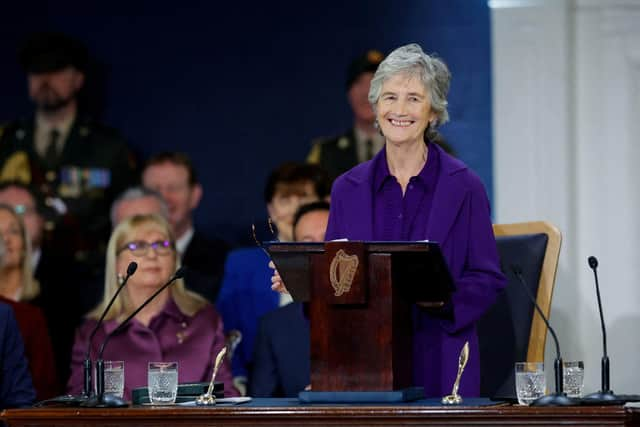

Eight years ago, in the run up to Christmas 2017, Dáil Éireann debated a motion on sanctions against Syria. One deputy, Catherine Connolly, now President of Ireland, denounced existing sanctions against the Syrian regime.
She had a point. She argued that indiscriminate sanctions might deepen the suffering of the Syrian peoples by preventing the importation of medicines such as insulin, anaesthetics, antibiotics among other vital supplies.
The Irish government’s position, however, was that it would continue to work with the European Union and the United Nations using ‘targeted sanctions, to put pressure on the Syrian regime to end the violent repression of civilians’.
The following year Connolly undertook a ‘fact-finding’ visit to Syria in the company of political activists, some of whom could be described as ambivalent on the Syrian conflict. During her presidential campaign in October of this year, Connolly was remarkably reticent about the trip, refusing to say who had organised it. She did, however, claim she had funded it herself. It turns out it was funded from her parliamentary allowance. Whether this was being economical with the truth is a matter for judgement.
During that election campaign denouncing Israel took up much of Connolly’s airtime on international affairs. She did agree, when pressed by William Crawley on BBC Radio Ulster, that Hamas was a terrorist organisation but did not agree the October 7th attack on Israeli civilians was genocidal. She went on to say that Hamas was ‘part of the fabric of the Palestinian people’ and later criticised the British prime minister, Keir Starmer, for saying that Hamas could not be allowed to participate in the future governance of Palestine.
How a totalitarian faction with genocidal intentions such as Hamas could govern with others was never explained. One of Hamas’ first actions after coming out of hiding following the recent ceasefire was the public execution of fellow Palestinians.
Connolly’s attitude to the Russian invasion of Ukraine seems contradictory. (In ultra-left circles, there is only one imperial power in the world system, that of the United States.) When the German government announced it was increasing spending on its armed forces in response to the Russian threat, Connolly likened this to Nazi rearmament during the 1930s. Mr Putin, sleepless in the Kremlin, may be reassured, President Connolly is in favour of ‘peace’.
Nearer home, there were questions as to whether the barrister Connolly had acted for banks in repossessing people’s homes in the years after the financial crash of 2008. In less polite words, had she offered legal advice to those in the business of evicting homeowners? This might be seen as normal legal work except that Connolly, divested of her wig, had made impassioned speeches in the Dáil denouncing the housing crisis. Some saw possible hypocrisy there. After a period of silence, Connolly admitted in carefully crafted words that she had ‘acted for credit institutions’. The emotive word ‘banks’ was not in view.
Surprisingly, for a largely Europhile country, one that has benefited greatly from EU largesse, Connolly’s negative attitudes to the European Union, did not grate. This will raise a smile among Brexiteers who may need to be reminded of Connolly’s congratulatory message to the 17 million voters, as she put it, who had supported Brexit. Should Nigel Farage and his Reform UK Party sweep to power at the next general election, the lady in the Phoenix Park and the gadfly of British politics will have at least something in common.
A united Europe may be a bridge too far, but she will use all in her power to secure Irish unity during her term in office. This promise may have been at the prompting of her principal backers, Sinn Féin.
In fairness to the Irish electorate, which in recent decades has chosen a sequence of outstanding presidents – Mary Robinson, Mary McAleese, and Michael D. Higgins – Connolly might be seen as a president by default. Due to a series of mishaps, including the late withdrawal of the Fianna Fáil candidate during the election and a rather byzantine nomination system, the Irish electorate was presented with only two candidates.
The other candidate, Heather Humphries, from a Presbyterian background in County Monaghan, was visited with a fair amount of sectarian bile despite favouring a united Ireland. Apparently, the unity of Catholic, Protestant and Dissenter wasn’t all that urgent after all.
The turnout in the election was less than half (46%) but the more significant point is that there were more spoiled votes than in any previous Irish election. Almost a quarter of a million voters took the trouble of going to the polls to cast a spoiled vote, a sure sign of the electorate’s disenchantment.
There is a longer-term issue, one that stretches over seven years. Can a president, who with considerable determination and guile has avoided or deflected questions about her political past and her current world view, command moral authority in her public pronouncements? My guess is that in Ireland the wagons will be circled round the Áras in the Phoenix Park, as the presidency is one of the few sacred institutions in Irish society still standing tall. Nonetheless, seven years is a long time, not least in politics.
• Liam Kennedy is emeritus professor of History, Queen’s University Belfast