
Liam Kennedy: Iran conflict represents rare opportunity for Northern Ireland's nationalists and unionists to come together and voice solidarity with democracy campaigners
For months, Iran has been convulsed by massive street demonstrations calling for democratic freedoms, in opposition to its grim-faced ruler, Ayatollah Ali Khamenei.
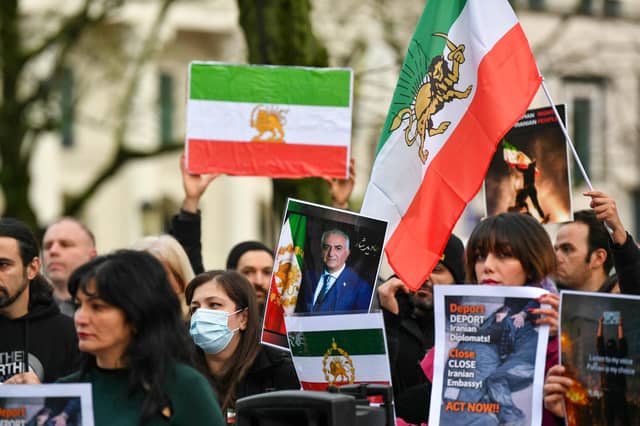

Earlier demonstrations for ‘Women, Life, Freedom’, we may recall, were by women outraged at the arrest and death in custody of Mahsa Amini, a young Kurdish woman who was detained by morality police for allegedly not wearing her hijab properly.
That was 2022 and the regime prevailed. It is now under more serious threat. True to its traditions of intolerance and a presumed hot line between the Ayatollah and Allah, the theocratic regime has responded to the current waves of protest with lethal repression.
When Edeh Zamani and some fellow Iranians organised a protest meeting outside Belfast City Hall two weeks ago, it was thought that in the region of 5,000 freedom campaigners had been slain by the regime. Horrific as that toll is, it now seems that it may be a gross underestimate.
The BBC reports of morgues overflowing with corpses, of faces too disfigured to allow identification, of snipers on roofs firing indiscriminately into crowds, of troops at street level firing live rounds at demonstrators. One human rights group based in the United States has confirmed the killing of nearly 6,000 people, including women.
Ominously, it is investigating a further 17,000 reported deaths. Comparisons are being made with the mass killings of Muslim men by Serb forces at Srebrenica, in the former Yugoslavia, on July 11, 1995, an atrocity seen by some as genocide.
Against the backdrop of the unfolding Iranian tragedy, surely this is a time when nationalists and unionists, and those who refuse such labels, can come together in solidarity with the brave freedom campaigners in Iran.
And in speaking with a united voice, help break with the practice of using crises elsewhere to add edge to communal divisions at home.
It is not often acknowledged but within Northern Irish society, there is a tendency to over-identify with certain outside causes, particularly so if it helps to sharpen communal identity at home. Possibly this is a feature of divided societies elsewhere.
This is not of recent origin. One can go back to the Boer Wars in South Africa at the end of the 19th century when ‘advanced’ nationalists and unionists took diametrically opposed positions.
The Great War produced more complicated patterns. Most Irish people supported the United Kingdom and its allies against the authoritarian German Kaiser. In fact, more than 200,000 Irishmen served in that war, a majority from Catholic, nationalist backgrounds. But a minority of extreme nationalists, including Sir Roger Casement, embraced the German cause.
Similarly, in World War II, Irish republicans sympathised with Nazi Germany, and some were active collaborators. By contrast, the Orange Order and unionists more generally, strongly supported the Allied cause.
The Falklands/Malvinas War in the early 1980s and the longer-running Basque terrorist campaign in Spain also reproduced divisions along traditional party lines in Northern Ireland.
But the Israel-Palestinian conflict has brought over-identification with outside causes to an even more polarising level. That tragedy has been appropriated as part of the culture wars in Northern Ireland, which already includes differences over language, sport, street signs, legacy issues, not to mention constitutional status.
It seems there is a certain jouissance in protesting communal difference, rather like tribal cheering at Celtic-Rangers matches. Surely it should be possible to decry the disproportionate force used by Israeli forces in Gaza, the huge civilian casualties, and the associated war crimes. And in the same breath, it should be possible to recognise the genocidal intent of Hamas and of Jihadi Islamists in the Middle East, as signalled on October 7, 2023.
We might accept that there are deep existential issues at play for both Israelis and Palestinians, and it might be more helpful if we recognised the dilemmas binding both.
At the moment we have over-identification with one side or the other and purely partisan public statements and street demonstrations. As so often in the past, over-identification rules, and to our cost in terms of community relations.
Which brings us back to Iran and its murderous civil conflict. Here is a rare moment of opportunity for nationalists and unionists, Orange and Green, socialists and trade unionists, to come together and voice solidarity with the democracy campaigners in Iran.
This might take a variety of forms, including street demonstrations, debates in council chambers and at the NI Assembly.
Shorn of the divisive communal subtexts that so often underpin attitudes to conflicts internationally, expressions of solidarity with the victims of Iranian terror might be productive of some good at home as well as abroad.
As I write, the spectre on the horizon is the American armada heading towards Iran. It remains to be seen if we can manage the possibly explosive fallout in a way that shows real concern for ordinary Iranians while avoiding exacerbating local divisions.
Dr Liam Kennedy is emeritus professor at Queen's University, Belfast