
Liam Kennedy: Paul Durcan - the Irish poet who expressed revulsion at IRA terrorism
The poet Paul Durcan died last week. I almost met him. This was at the beginning of the 1970s. I was a student at University College Cork and part of a slightly bohemian circle that included Paul’s wife Nessa.
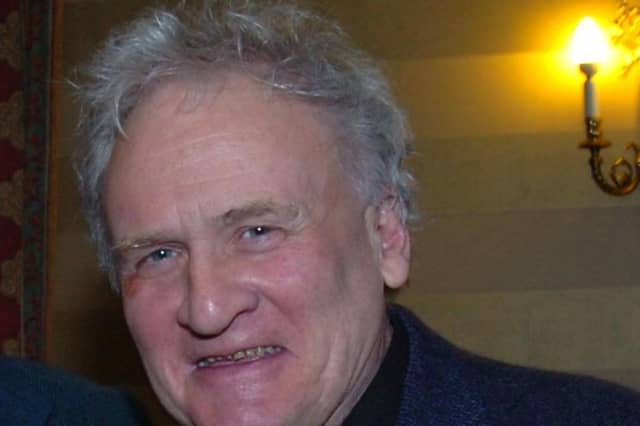

Dublin-born Durcan was rarely mentioned by name. He was known to us simply as ‘The Poet’, although he had yet to reveal himself as one of the leading poets of his generation.
Curiously, in view of his calling, he was studying archaeology and medieval history rather than literature.
Again and again, we were assured that the The Poet would be joining us for a drink or a conversation at one of our regular watering holes. It was like waiting for Godot. The Poet was due, overdue, but never appeared. He remained a mysterious, unseen presence.
Durkan was his own man, individual, iconoclastic, and gifted. The author of some twenty volumes of poetry, he captured in his writings the repression of intellect and sensuality that characterised Southern Irish society in the decades after the Second World War.
As a poet in his prime in the 1970s and the 1980s, and indeed beyond, he produced vignettes of Irish life that had the surreal quality of scenes from Italian film directors such as Fellini or Visconti. As with the film makers, there was humour and humanity, as well as searing insights.
Few of us can have resisted laughing out loud on reading Durcan’s depiction of love-making outside Áras an Uachtaráin (the President’s official residence) set in the Phoenix Park in Dublin.
For Durcan’s generation, the Áras was associated with Eamon de Valera, the ascetic, monk-like face of Catholic nationalist Ireland. De Valera was president for 14 years (1959-1973) and was virtually blind in his later years.
In Durcan’s imagination de Valera is presented as a hangover from Old Ireland, with ancient rifle in hand stalking the young lovers.
Surges of erotic energy arise in a number of his poems, most revealingly in Durcan’s love poems to Nessa. Lines such as the following could only have offended the sensibilities of holy Catholic Ireland but Durcan was undaunted:
“On the way back I fell in the field/ And she fell down beside me./ I’d have lain in the grass with her all my life/ With Nessa:/ She was a whirlpool, she was a whirlpool,/ And I very nearly drowned”.
Northern readers may be surprised by how much attention Durcan devoted to the politics of terror in Northern Ireland. By contrast, most Southern poets had little to say on the ‘Troubles’.
But it is not wholly surprising. Durcan came of ‘patriotic’ lineage. He was related to John McBride, seen as one of heroes of the 1916 Rising in Dublin. Prior to this, McBride had fought against the British and on the side of the Dutch colonial settlers during the Boer War in South Africa.
But Durcan’s engagement with the North did not run true to inherited nationalist group think. He was repelled by ethnic warriors bearing guns and drums and explosives, of whatever stripe. He excoriated loyalist violence in ‘In Memory of Those Murdered in the Dublin Massacre, May 1974’. He lays it on the line:
‘And I think of those heroes – heroes? – and how truly Obscene is war.’
In more playful mood, in the ‘The Dublin Belfast Railway Line’, Durcan satirised the absurdity of the Provisional IRA’s campaign to destroy the rail links between Belfast and Dublin, while arguing that the objective was to unite the two parts of the island.
His poetic solution was to send the gunmen (‘the heroic democrats of the IRA’) on a train round Ireland that circled endlessly. The critic Edna Longley in her acclaimed collection The Selected Paul Durcan singles out his poem, written through the eyes of a child, ‘What is a Protestant, Daddy?’, to illustrate the point that sectarian prejudice was not confined to the North.
But it is the unspeakable atrocities that inspired some of his most heart-felt verse. In an utterly human response, he was outraged by the mass killing of workmen near Kingsmill in south Armagh on January 5, 1976.
In ‘The Minibus Massacre: The Eve of the Epiphany’, Durcan merges images of a residual Catholicism and Irish history but the victims remain centre stage.
Ten men in a minibus/Glimpse a red torch/ & are machine-gunned to bits/ Fleshrags and bloodrags:/ The narrow mountain road/ Strewn with corpses/ Slaughtered fish on a slipway/ Corpse upon corpse/ Workman upon workman …
In a revealing interview with Martin Doyle of the Irish Times, Paul Durcan left us with a personal recollection that could do much to correct some of the reflex Anglophobia that deforms political discourse in Northern Ireland, words that are even more telling in the age of Kneecap and the unbalanced legacy debates.
Durcan was expressing his revulsion at bomb attacks in London but they speak to a larger historical experience:
‘Like many Irish people, I feel helplessly angry with what the IRA do because London was a home to me when I had nowhere else to go. It gave me work, work which I wouldn’t have got back in Ireland. …. and here I was married and here my children were born. This country has been home to thousands and thousands of Irish people.’
Liam Kennedy is emeritus professor of history, Queen’s University Belfast