
Liam Kennedy: Two years after October 7, the threat to peace comes from Islamists, not just from Israeli warplanes
One of the very useful sayings in the Irish language is a bheith idir dhá intinn (the state of being between two minds).
There’s much folk wisdom there when it comes to reacting to complex problems that have deep historic roots.
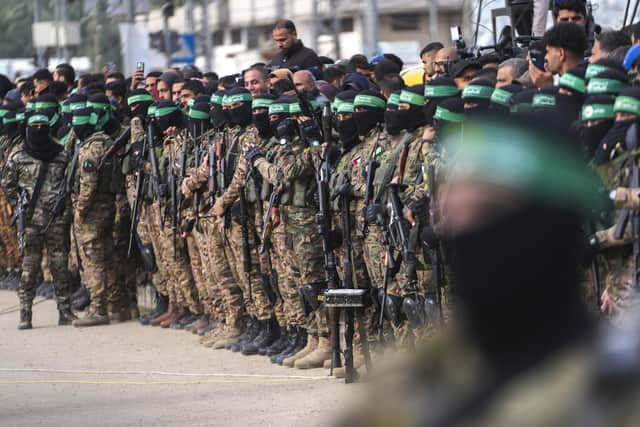

That is how I find myself in relation to the Israeli-Palestinian conflict. The invasion of Israeli border areas by Hamas on the seventh of October 2023, exactly two years ago, had all the signs of genocidal intent: the rape and sadistic killings of civilians, the abduction of hundreds of men, women and children, and the indiscriminate firing of hundreds of rockets into Israel. The only check on genocidal intent was the military limitations of the Islamist forces.
Faced with an existential threat, it was no great surprise that Israel struck back with fury. Its defence options were limited but most neutral observers would say that the response over two long years has been disproportionate. Images of mass movements of civilians, of emaciated children, of families decimated by Israeli bombings, have shocked the outside world.

The inflammatory statements of the ultra-right partners of Benjamin Netanyahu’s coalition government, notably by those in Otzma Yehudit (Jewish Power), give some credence to allegations of genocide. The existence of Jewish supremacist attitudes, albeit a minority viewpoint, stain Israeli consciences and society.
The fall-out from the war is being felt across Europe. In England, the most recent murderous example is the killing and wounding of Jewish civilians at a synagogue in Manchester on Yom Kippur, the holiest day in the Jewish liturgical calendar. Anti-semitic attacks are on the rise. According to one source, there were 1,500 or so anti-semitic incidents in Britain during the first half of 2025. Between June and September 2025 there were 17 attacks on mosques and Islamic institutions, though this does not include individual incidents.
In any case, the differences are dramatic. The vulnerability of Jews is even more visible when one considers the demographic picture revealed in the 2021 Census. Jews represent about 0.5% of the population of England and Wales (there are relatively few Jews in Scotland and Northern Ireland), whereas the Muslim population accounts for almost 7%. In other words, in the population at large, for every one Jewish person there are 14 Muslims.
Of course, most Muslims and most Jews are peace-loving, but this demographic contrast helps us to understand the insecurity felts by Jews in many parts of the world, outside of Israel and the United States.
Then there are the massive pro-Palestinian demonstrations across the world, though interestingly not in some Arabic countries. It is hard not to see these as linked to rising anti-semitism, however idealistic the motives of many of the participants. The demonstrators would argue, and I think correctly, that Israel has committed war crimes in Gaza.
Personally speaking, I would like to see Benjamin Netanyahu, and members of Jewish Power, and in particular the Security Minister, Itamar Ben-Gvir, answering charges at the International Criminal Court in The Hague.
But here’s the rub. The reality, which so impresses us as we watch the horror unfolding daily on our screens, is of the vastly superior firepower of the Israeli state as against that of the puny terrorists in their tunnels. But paradoxically, it is this overwhelming military advantage that serves to obscure some fundamental moral responsibilities.
It is true the Israeli state has shown scant regard for the welfare of Palestinian people in its crusade to crush Hamas. But it is also the case that Hamas has turned a blind eye to the tens of thousands of Palestinian casualties and bears its own responsibility for the civilian carnage. Its failure to release the hostages has brought death and destruction raining down on the captive Palestinian men, women and children over the last two years.
It would be helpful if the many pro-Palestinian demonstrations across Europe, as well as denouncing Israeli actions, also charged Hamas with the war crime of sacrificing its own people in pursuit of Islamist victory and martyrdom. I can’t recall many platform speakers making demands of Hamas, and fewer still calling for the release of the hostages. More generally, it would be good if these massive mobilisations in many countries took a more balanced and a more global perspective. Slogans such as ‘From the Jordan to the Sea, Palestine will be free’ has the implicit punch line of ‘Judenfrei’.
It is time those of us aching for peace in the Middle East also recognised the threat posed, not just by Israeli warplanes, but also the racism, misogyny, and religious intolerance embedded in Islamist ideology, with Hamas as the exemplar. The women of Iran and Afghanistan might tell us a thing or two. But perhaps, in our self-righteousness and our pursuit of black-and-white stories, we don’t want to listen.