
Lord Dodds: My EU withdrawal bill would oust sea Irish Sea border and deliver Brexit for whole of UK
Last week I introduced a bill in the House of Lords which would get rid of the Irish Sea border.
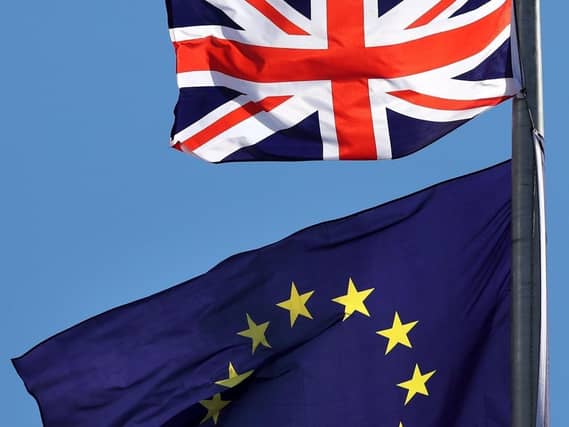

This follows the King’s Speech where the first bill mentioned was a European Partnership Bill. That bill will seek to dynamically align Great Britain with EU law in three areas: plant and animal health, biosecurity and food laws; carbon emissions trading; and the single electricity market. It will also create a mechanism allowing further areas of UK law to be brought into dynamic alignment with EU law in future.
Labour may seek to justify their bill by reference to its 2024 manifesto commitment to a “reset” of relations with the EU. However, that commitment was explicitly framed within respect for the Brexit vote and ruled out re-joining the EU single market. Now Labour is reneging on that.
First, from 1973 until Brexit, the cornerstone of UK membership of the EU was Section 2 of the European Communities Act 1972, which provided a mechanism for dynamically aligning UK law with EU law. The proposed bill would effectively recreate this principle in the areas covered, while leaving open the possibility of extension into other fields. It is therefore difficult to see how such an approach is consistent with respecting the Brexit vote or Labour’s manifesto commitments.
Rather than taking back control of law-making, it transfers legislative authority in the affected areas to institutions over which the UK has no representation. At least as an EU member, the UK participated in making the laws it was required to follow.
Secondly, the bill amounts to re-joining important elements of the European single market. The European Commission made this clear in recommending negotiations on UK participation in the common electricity market.
It stated that the EU seeks a permanent and legally binding mechanism for UK financial contributions towards reducing economic and social disparities within the Union, with payments reflecting both the size of the UK economy and the extent of its participation in the internal market.
The government has sought to counter accusations that it is taking the UK back into the EU by arguing that some of these measures are intended to reduce friction on the Irish Sea border. This allows ministers to present their policy as a practical effort to address Northern Ireland’s unique circumstances rather than a broader retreat from Brexit. However, if Brexit is to be sustainable, it cannot be fully enjoyed in one part of the United Kingdom while another remains subject to significant areas of EU law.
The bill the country needs is not the European Partnership Bill but the European Union Withdrawal Bill, which I entered into the Lords Private Members’ Ballot shortly after the King’s Speech and which emerged in fifth place. The bill was originally introduced by Jim Allister MP with cross-party, UK-wide unionist support. It has now received its first reading in the House of Lords.
Rather than extending to Great Britain the arrangements that have disenfranchised the people of Northern Ireland, the European Union Withdrawal Bill would place Brexit on a stronger and more sustainable footing. It would remove the Irish Sea border, restore democratic accountability in Northern Ireland and deliver Brexit across the whole United Kingdom.
At the same time, it would protect the integrity of both the UK and EU internal markets without creating a hard border with the Irish Republic through a combination of mutual enforcement provisions and alternative arrangements technology.
Although prompted by the failure to secure Brexit for Northern Ireland, the bill should be seen as a measure for the entire United Kingdom. It restores Northern Ireland’s full place in the internal market of the UK and reinstates democracy to its people. It removes the argument that Great Britain must remain aligned with EU law to prevent divergence with Northern Ireland.
In doing so, it ends a key source of pressure for renewed EU influence over UK law. Instead, it delivers Brexit on a sustainable, whole-country basis and reaffirms the territorial and democratic integrity of the United Kingdom.
l Lord Dodds is an ex-MP and former deputy leader of the DUP