
Human rights chief commissioner has been campaigning against former RUC officers being investigators into the past Northern Ireland Troubles: Legacy group
This is a joint essay by Austen Morgan, Jeffrey Dudgeon and Jamie Bryson of the Malone House Group:
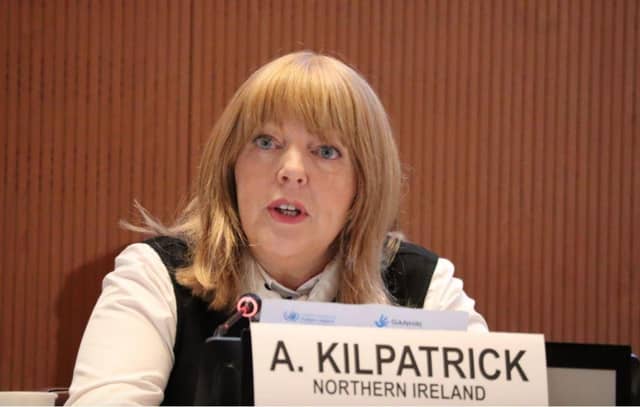

On Monday the Northern Ireland Human Rights Commission (NIHRC) published a 44-page report in regards their position on legacy and ICRIR, the Independent Commission for Reconciliation and Information Recovery.
This elaborate document focussed specifically on trying to justify the controversial and politically partisan comments of Alyson Kilpatrick its chief commissioner which had targeted the appointment of Peter Sheridan ICRIR’s Commissioner for Investigations and the independence of Sir Declan Morgan, its chief commissioner.
It is telling that a lengthy portion of the report was dedicated to explaining that all commissioners are bound by collective responsibility, and prohibited from publicly dissenting – for all time - in respect of any decisions with which they disagree if these have been approved by a majority.
It is of note that this need not be a numerical majority, but rather, if there is an equal split on an issue, the chief commissioner has a casting vote. There is however nothing in the enabling statute allowing the chief commissioner to have such a turbo-charged ‘double-vote’
That this is included at all would suggest significant division amongst commissioners about the chief’s activism.
Likewise, it is stated the chief commissioner is the ‘spokesperson’ for the NIHRC. Again, this power is not found in the enabling statute but is a self-made construct.
It further appears there is a subtle conflating of acting as a ‘spokesperson’ and unilaterally discharging the functions of the NIHRC by making significant public statements, such as that carried in the Irish News on July 14 2025.
In that public statement, Ms Kilpatrick stated it was “incompatible with Article 2 ECHR” for Peter Sheridan to fulfil the role of head of investigations, because he was a former RUC officer.
There was the additional assertion that Sir Declan Morgan was similarly not sufficiently independent, because he sits as a supplementary judge of the Supreme Court.
The latter, somewhat bizarre, assertion in respect of Sir Declan has vanished from the most recent note, which is unsurprising because there is, and never was, any legal basis for it. Plainly the chief commissioner was acting unilaterally and slapped down.
However, the NIHRC note does double-down on the attack on Peter Sheridan, continuing to assert that due to his former role as a senior RUC officer, he cannot be independent.
This argument was advanced at first instance in the High Court in the Dillon litigation, and dismissed. That was also the case at the Court of Appeal, who did not disturb the finding of Mr Justice Colton that the ICRIR had sufficient investigative independence.
The applicants in the Dillon Judicial Review had sought permission to appeal on the point of arguing the ICRIR could not be independent due to Mr Sheridan being ex-RUC. Permission was refused, this being deemed “unarguable” by the Supreme Court, in legal terms meaning the argument is without any merit.
The NIHRC seeks to evade this fatal blow to its argument by asserting in terms that everyone has somehow misunderstood the nuance of the Supreme Court finding that the independence argument is unarguable. With respect, the only person who seems to fail to understand the unarguable nature of the attack on the independence of Mr Sheridan, is the NIHRC chief commissioner.
Extraordinarily, the NIHRC note draws upon the commentary not of any authoritative judicial figure (which is unsurprising given every Court which has looked at the argument has dismissed it), but rather Baroness O’Loan.
As Ms O’Loan she served on the Police Authority, overseeing the RUC from 1994-1997. Applying her own standard, and that of Ms Kilpatrick, Ms O’Loan would be unsuitable to oversee any investigations which may involve the RUC. On that footing, we would expect Ms O’Loan to urgently remove herself as an assessor from the Pat Finucane inquiry, and the NIHRC to argue the Baroness is unsuitable for this appointment.
If not, then how is this inconsistent approach to be explained?
NIHRC’s commentary has increasingly been characterised by repeating propaganda and partisan political activism (under the guise of dubious legal arguments, otherwise known as ‘lawfare’) emanating from the network of nationalist legacy groups. Indeed, NIHRC when sharing a panel at the NI Affairs Committee in the Commons with activist groups CAJ and Relatives for Justice plainly operated in concert with them.
There is now nothing separating NIHRC and these political campaign groups, raising questions for the secretary of state Hilary Benn as to how the organisation is representative of any section of the community other than nationalism – contrary to its statutory requirement.
We are deeply concerned how NIHRC is actively misleading the public in regards the settled law, and continuing to wage what can only be described as a targeted campaign against former RUC and PSNI officers, and in particular Mr Sheridan.
In our view, which we trust is shared and should be openly articulated by the leaders of political unionism, the only position which is in fact untenable is that of Alyson Kilpatrick.
• Malone House Group: Dr Austen Morgan, Barrister-at-Law, Jeffrey Dudgeon MBE, Jamie Bryson LL.B