
Neil McCarthy: US interventions in UK and Irish politics are unprecedented and surreal
With a general election in Germany looming, the spectre of Elon Musk is haunting Europe.
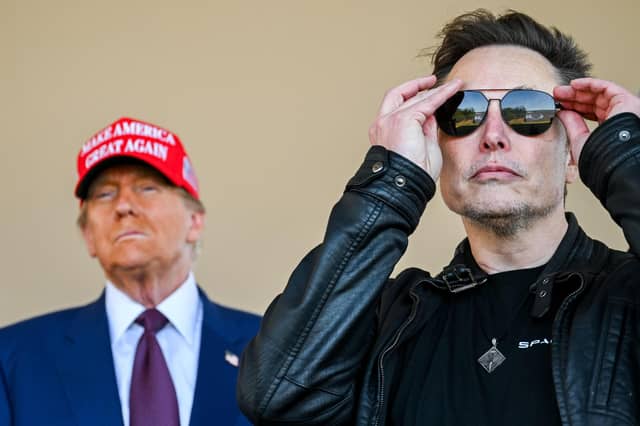

Aside from his alleged Nazi salute at Trump’s inauguration, he is already telling Germans that “there is too much focus on past guilt” in their country and that “we need to move beyond that”.
These comments were live-streamed to a rally organised by the AFD, a “far right” party once considered beyond the pale in respectable German society.
His recent, and dramatic, interventions in the domestic politics of Great Britain - culminating in his question on X (formerly Twitter) as to whether “the United States should liberate the people of Great Britain from their tyrannical government” - were foreshadowed on this side of the Irish Sea last year.
Helen McEntee, the minister for justice in the last Irish government, had sought to bring in a new law criminalising ‘hate speech’, and initially faced virtually no opposition in Dáil Éireann, the Irish
parliament.
Indeed the main opposition party, Sinn Féin, was, if anything, even more enthusiastic about the bill’s provisions than she was herself. Opposition - such as it was - mostly came from fringe political groups associated with anti-immigrant agitation; grist to McEntee’s mill as she sought to cast any and all opponents to the bill as intolerant racists.
Three extraordinary things then happened. First of all, Musk started tweeting about the proposed legislation, saying that it was a flagrant attack upon freedom of speech. Then, in January last year, he went further and said he would fund “the legal fees of Irish citizens that want to challenge the bill as well”.
The third extraordinary thing was the intervention a couple of months later of the then Ohio senator and vice-presidential hopeful J D Vance, when he revealed he had written to the Irish ambassador to the United States to express his concern over “authoritarian legislation pending in the Irish parliament that would severely undermine freedom of speech in the country”.
These interventions at the time were unprecedented. They were particularly surreal in that such attention was being paid by powerful figures in America to events in such a tiny faraway jurisdiction, albeit one which tugs upon the heart strings of millions of Americans at least once every year.
Something had changed irredeemably. Dublin itself, long boastful of being the centre of European operations for the likes of Google, Facebook and X/Twitter, was now in the cross-hairs of the insurgent political and media forces whipping up a storm across the Atlantic.
Keir Starmer may well not have noticed these interventions in southern politics, or if he did, may have thought they had something to do with the importance of the Irish diaspora in American politics.
He certainly won’t be thinking that now as he gears up for his first official meeting with Trump.
McEntee’s bill was eventually shelved shortly before last year’s general election in the Republic.
In Britain itself, with the grooming scandal coming back into public consciousness these past few weeks in such a shattering fashion, Nigel Farage’s Reform UK party is now only one per cent behind Labour in the most recent opinion poll, with the Tories trailing behind them both in third position. It was Musk who brought the grooming scandal back into public consciousness.
Politics in these islands has never seen such overwhelming power exerted by a media mogul based thousands of miles away.
The left may have bewailed the ‘Murdoch press’ and its alleged role in making or breaking governments in London back in the day; yet one can easily imagine Starmer only thinking wistfully of those times when he looks at what Musk has achieved in Britain in the last few weeks.
What makes Musk all the more potent an enemy is that, apart from his own staggering wealth and the force of nature in social media that is his platform X, he has become inextricably associated, for now at least, with the administration of Donald Trump.
Lenin once used Leon Trotsky as his roving ambassador in the early years of the Russian revolution to fan the flames of (communist) insurrection across the world.
Trump appears to be employing Musk in a similar fashion to serve his own political revolution, though an obvious question arises as to who precisely is using whom in their relationship.
Trump himself is already rewriting the world order. His envoy to the Middle East, Steve Witkoff, is said to have achieved more in a couple of hours talking to Netanyahu than Biden’s people managed in a year.
Dublin’s lionising of the Palestinian cause has surely not escaped Trump’s attention. The new Irish government will need to do more than drop a hate speech bill as they contemplate a new dawn where all - in Yeats’ words - is “changed, changed utterly”.
Indeed there are already indications that they are permanently dropping the proposed legislation seeking to ban imports to Ireland from the “occupied territories”.
Unionists might take note that the J D Vance who worried about authoritarian legislation in the Dáil last year is now indeed vice president of the United States.
Vance is known to speak proudly of his “Scots-Irish” roots.
If the usual motley crew of politicians from this island troops across to Washington this coming St Patrick’s Day, the unionists among them may well prove Dublin’s new best friends in its efforts to mend fences with Trump.
Unionists should think about what price they might demand in return for such a favour.
Neil McCarthy is a writer and a teacher based in Dublin and London