
Owen Polley: An immigration border between Northern Ireland and Great Britain may be one provocation too far for unionists
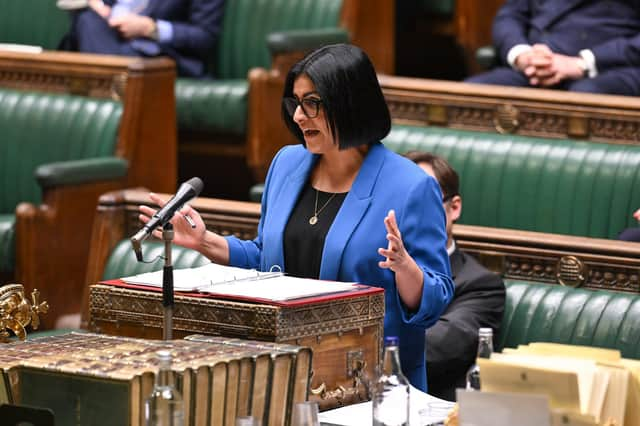
Last week, the Home Secretary, Shabana Mahmood, announced a new set of proposals to tackle immigration. For a Labour minister, her House of Commons statement set out a relatively robust plan, albeit one that has probably come too late.
Many of the measures were based on policies devised in Denmark, a traditionally left-leaning country that was forced to implement a tough regime to protect its high-trust, well integrated society.

Predictably, some of Mahmood’s Labour colleagues reacted to her ideas with anger, as did other unserious ‘progressive’ politicians across the UK.
These types will never admit the scale of the problems our leaky borders have created or acknowledge that strong action is required to reverse them.
All they offer, in response to a crisis that is overwhelming much of Europe, are anaemic soundbites about cruelty.
They should properly be ignored and treated with contempt.
Unfortunately, it is more likely that the latest proposals, like others before them, will be diluted, as Sir Keir Starmer struggles to maintain control over his party.
The prime minister is terrified of attacks from the left, even though Labour’s main electoral challenge is currently from Reform UK.
Even if Starmer’s back-benchers do not manage to gut Mahmood’s proposals, the plan might not even apply in Northern Ireland, due to the Windsor Framework.
The courts here have already struck down immigration legislation that they deemed incompatible with EU law, when the Tories introduced their Rwanda resettlement scheme.
The Conservative government appealed that judgment, but the challenge was effectively withdrawn by Labour.
At the same time, much of the new scheme is based on the Danish model, and Denmark is an EU member state. For that reason, you might expect the courts to accept that it is lawful. Alas, there is no guarantee they will follow this logic.
Denmark is already fighting human rights cases against its policies. In the UK, and in Northern Ireland in particular, there is a thriving industry of activist lawyers, many of whom are opposed to any new restrictions on migration.
Our courts also tend to take a broader, more inventive view of human rights than some of their equivalents on the continent. That’s why the application of the European Convention of Human Rights has become a particular problem here, and illegal migrants have used the legal system successfully to abuse our hospitality.
Labour’s new migration blueprint centres on drastically cutting the period that refugees can stay here. Refugee status will be granted for 30 months and reviewed every 30 months thereafter, whereas refugees can currently stay for at least five years.
In addition, asylum seekers will be returned home if their country becomes safe.
People who arrive here illegally will only have ‘leave to remain’ (which means become permanently settled) after 20 years (currently the period is five).
The right of refugees who are not working or studying to bring family members to the UK will be drastically reduced. They will also be required to contribute towards their upkeep, if they have valuable belongings.
Mahmood proposes to remove the requirement to support asylum seekers who would otherwise be ‘destitute’, making help from the authorities discretionary.
This provision is designed to stop the state’s generosity from being abused, but it creates an issue for Northern Ireland. The requirement was introduced to satisfy EU law, and it would certainly be challenged under the Windsor Framework.
Indeed, the possibility that, thanks to the framework, Northern Ireland could become a ‘back door’ for migrants is already causing anxiety in Dublin. The Republic has repeatedly tried to blame its own problems with newcomers on Britain.
Despite demanding the Northern Ireland Protocol, on the basis that it could not contemplate even an extra camera on the frontier with Northern Ireland, the arch-hypocrites in Dublin increased their immigration checks on the land border last year.
For unionists here, the new migration proposals present more challenges.
Pro-Union representatives will have to ensure that the government understands its new plans will be completely futile, unless they apply equally to the whole UK.
At the same time, Westminster must receive and accept the message that an immigration border in the Irish Sea will simply not be tolerated.
The pro-Union side here has swallowed as much as it can take in recent years, with our economy and legal system being cut off from the rest of the UK. If this issue is also resolved in favour of nationalists, it could be one provocation too far.
Meanwhile, the tone of the national debate shows that, even on the centre-left, semi-sensible politicians recognise that immigration is the biggest problem facing the UK. It has changed our societies in ways that we’re only beginning to understand.
The shocking thing is not that Shabana Mahmood floated these ideas last week, but that they are in the least controversial and that there is no serious pressure to go further.
While even mainstream Labour is starting to explore tougher policies on migration, there is an extreme but not insubstantial fringe, made up of so-called progressives, that simply will not treat the issue seriously. This fringe includes the parties now dominating Stormont.
On immigration, as on almost every other challenge facing Northern Ireland, nationalists and Alliance refuse to accept responsibility. For them, politics is little more than a performance, through which they try to exhibit their supposedly higher morals and vent their contempt for Britain.