
Owen Polley: Andy Burnham may not be any better for Northern Ireland than Sir Keir Starmer - there are reasons to be sceptical about his views on the province
The Labour Party’s victory in the Makerfield by-election is likely to become fodder for future history programmes and trivia questions. It was one of the strangest political contests we’ve seen.
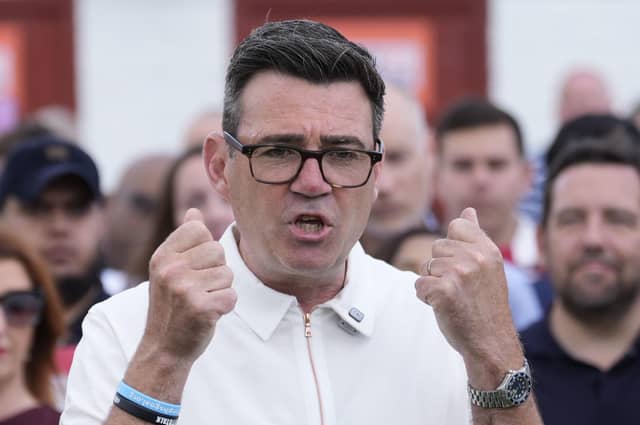

The outgoing mayor of Greater Manchester, Andy Burnham, eventually topped the poll comfortably, defying predictions that Reform UK might scupper his return to the House of Commons.
In almost any other situation, Sir Keir Starmer would have celebrated a Labour win with undisguised relief. In this election, though, no matter who won, he was bound to be the resounding loser.
If Reform had taken the seat, it would have entrenched the view that this government is untenable and Nigel Farage is likely to become the next prime minister.
In contrast, Burnham’s win is interpreted as a sign that Starmer’s leadership of the Labour Party is almost over.
If he does become prime minister, though, what kind of premier will Burnham make, and what are the potential consequences for Northern Ireland?
I’ve written before that, despite Starmer’s weak leadership, there is a risk that what comes next may be worse.
Sir Keir and his Northern Ireland secretary, Hilary Benn, at least voiced open support for the Union, before they came to government.
They have been more careful about expressing those sentiments in office and have arguably damaged our place in the UK.
Far from lowering barriers to trade with Great Britain, Labour rigorously enforced the Irish Sea border and justified its existence as necessary for ‘peace’. The government also negotiated a ‘framework’ on dealing with the legacy of the Troubles that resembled a capitulation to Dublin.
At the same time, Benn argued against calling a referendum on our place in the UK and implied that it would not be needed in the foreseeable future.
Burnham could take a similar approach, but it is not guaranteed.
When he previously stood for the party’s leadership, in 2015, the now Makerfield MP expressed support for Labour candidates standing in elections in Northern Ireland.
He claimed he wanted to allow people here to “make their voices heard” in national politics. In fact, Burnham repeated this view in an interview for The House magazine at the start of this month.
For decades, Ulster’s Labour members have campaigned to contest elections. Just like local Conservatives, they argue that we should have the same say in choosing our national government as other citizens of the United Kingdom.
This view is certainly not shared by everyone in Labour. Some GB activists point out that the SDLP is its ‘sister party’ and, in any case, there has always been a contingent that supports the claims of Irish separatists that we should be ruled from Dublin.
Despite Burnham’s support for Labour candidates here, there are reasons to be sceptical about his views on Northern Ireland. Unionists may be worried, for example, about the company he kept during recent visits to the province.
The then Manchester mayor gave a keynote speech at this year’s Alliance Party conference, when he implied that the devolved regions should get more powers. That prospect will dismay anyone who has witnessed Stormont’s failures to use its current powers responsibly.
In addition, the former transport secretary, Louise Haigh, was a key member of Burnham’s campaign team, and is expected to be offered a high-profile Cabinet post, should he become prime minister. Ms Haigh is reportedly in a relationship with the former SDLP leader, Colum Eastwood.
This may seem like a tenuous reason to question Mr Burnham’s approach to the Union, but it will add to anxieties that he could receive bad advice on Northern Ireland.
The national policies of a new prime minister, of course, will also affect us deeply. The winner of any Labour leadership contest is likely to come under huge pressure to borrow and spend more money.
Burnham has tried to reassure investors that he will be careful with the nation’s finances, but already there are signs that they do not believe him. Similarly, during the by-election he voiced support for the home secretary’s attempts to tighten up the UK’s borders, but previously he was regarded as pro-immigration.
There is a sense that, despite Mr Burnham’s many years as a high-profile figure, we do not know with confidence what he stands for.
His slipperiness could mean, ultimately, that he is not that different to Starmer, favouring a non-committal, managerial style, rather than being driven by well-defined beliefs.
Equally, there will be a dangerous amount of pressure on him to be distinct, decisive and radical, which could be incomparably worse than dithering.
If Burnham does win a leadership contest, there is also a strong possibility that there could be an early general election. A new prime minister may feel that his best chance of victory is to capitalise on some early popularity and a sense of relief that Starmer has gone.
The parties in Northern Ireland will have to be prepared for that possibility and whatever changes at Westminster it might ultimately bring.
Many unionists were previously inclined to see the Conservatives as the Westminster party most sympathetic to their cause. After the last Tory government erected the Irish Sea border, some argued that Labour would be an improvement.
That has turned out, so far, to be a wildly inaccurate analysis. There’s not much evidence, either, that an Andy Burnham premiership would be any better for the Union.