
Owen Polley: Andy Burnham should resist calls from Stormont for more cash - he would not be helping Northern Ireland by capitulating to the executive’s demands
Andy Burnham is due to be sworn in as prime minister later today.
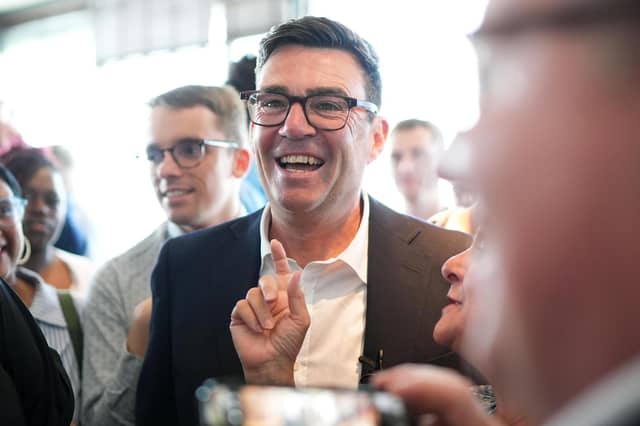

The Stormont Executive may be tempted to see this change in leadership as a potential solution to its financial problems. Burnham launched his bid to become PM by stressing that he wanted more devolution and greater regional equality.
If those are the expectations of ministers here, the Northern Ireland secretary tried to dampen them last week.
At the Northern Ireland Affairs Committee, Hilary Benn said that the executive should do its job and set a budget. Since the new financial year started, in April, our public services have been funded under contingency arrangements, because there is no agreement on finance for 2026/27.
The Stormont parties periodically blame each other for this failure, presided over by the Finance Minister, Sinn Fein’s John O’Dowd. Most of all, though, they blame Westminster, which they accuse of underfunding Northern Ireland.
This criticism, when it comes from nationalists, is loaded with anti-British venom and the implication that things would be different if we were ruled from Dublin. The unionist parties are less vicious, but generally repeat the same threadbare, self-pitying line.
The chairman of the Northern Ireland Fiscal Council, who also gave evidence at last week’s committee, was scathing about this mindset. The council is an independent body, charged with bringing transparency and scrutiny to our public finances.
It is also supposed to assess the executive’s ability to balance its budget.
Against that backdrop, Sir Robert Chote described the effects of “a cycle of expectation that there will always be a bailout coming” at Stormont. His view is that the new prime minister will have one chance to break this pattern.
His analysis suggested that there is a perverse incentive for the executive to act irresponsibly. When ministers fail to agree budget allocations, or refuse to implement spending cuts, the Treasury repeatedly provides more cash, usually in the form of a ‘loan’.
If they were to manage their money effectively, stripping out services or costs that they could not afford, Westminster would have no need to provide them with more.
Consequently, the parties at Stormont are far more inclined to frisk the government for extra money than make the difficult decisions that are supposed to be an unavoidable part of exercising power.
Indeed, this was probably how they viewed the recent discussions at Hillsborough Castle, convened by the secretary of state to discuss the lack of a budget.
So far, they have been disappointed.
At the committee, Mr Benn admitted: “There is a bit of a pattern where the government does ride in. The difficulty with that … is that some people may draw the conclusion ‘well if we just sit here, then someone will come and do that again.’”
That was an accurate enough summary and it accorded with Sir Robert’s assessment.
At the same time, the secretary of state suggested his first duty this week would be to explain the options to Mr Burnham. This would include setting out, “the options for doing something about it” and “the conditions that we would suggest that we put in place in return for any help – if there is going to be any help.”
This was a rather ambiguous message. It may have been intended to encourage the executive to make responsible decisions, but it certainly did not dismiss the possibility that there could be more cash, even if it is tied to ‘conditions’.
The previous ‘loans’ were attached to conditions too, but ultimately this did not persuade ministers to alter their behaviour.
The new prime minister will presumably bring some changes in approach, so the secretary of state probably cannot be too adamant about what will happen after today. It is not certain, either, that he will remain in his job, when Burnham picks his new cabinet.
Despite the grievances against Westminster that nationalists in the UK’s devolved regions like to nurture, Scotland, Wales and Northern Ireland have been treated in general with financial generosity.
The Stormont Executive has also been extended a vast amount of political patience, through its various crises and failures. There is clearly a feeling at Westminster that our devolved institutions must be protected, which has been exploited by ministers here.
This forbearance may have revived the assembly on occasion and kept it just about running on others. Ultimately, though, it has also allowed our executive more easily to ignore longstanding problems with the structure of our health service, the size of our public sector and the inadequacy of infrastructure.
Burnham’s instinct may be to permit the Stormont parties to shake-down the Treasury again. He will want to avoid the potential embarrassment of a collapse in power-sharing at the start of his premiership.
No doubt, as well, the regional administrations will attack his commitment to devolution, if it does not translate into almost endless quantities of extra cash.
The new prime minister, though, would not ultimately be helping Northern Ireland, if he capitulated to the executive’s demands.
The immediate crisis over the 2026/27 budget might be overcome, but he would be facing similar demands next year. And even if the government were to reach an entirely new funding settlement with Stormont, you can guarantee that it would soon be claiming it was not enough.
Let the executive write its own budget then and, if it cannot manage that, impose one from Westminster.