
Owen Polley: Badenoch should apply her ‘British people first’ line to Northern Ireland
Last week, the Alliance for Responsible Citizenship (or ARC) held its conference in London. This organisation, founded by the psychologist Jordan Peterson, wants to ‘re-lay the foundations of (western) civilisation’, which it assumes are on shaky ground.
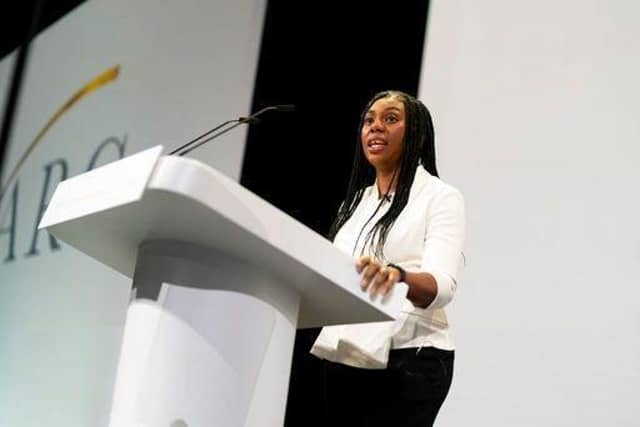

ARC events have quickly become influential forums for debate among conservatives and the centre-right. They reflect the belief that western societies have moved in risky directions and more needs to be done to preserve our ways of life. It is not an accident that the organisation’s name recalls the ark in the bible.
On the stage last week, speakers included the leader of the Conservative Party, Kemi Badenoch, and Nigel Farage from Reform UK. They joined figures like Daniel Hannan, Douglas Murray and Niall Ferguson, as well as big names from conservatism in the US, Australia and beyond.
This was a gathering of the modern centre-right, so it included plenty of people advocating free trade, freedom of markets and trimming back the state, above all else. At the same time, there was an emphasis on putting ‘families, communities and nations’ back at the heart of politics, countering excessive migration and reviving traditional values.
Mrs Badenoch’s speech made some points that were harder than we have become used to hearing from Tory leaders. She said recent waves of immigration brought, “behaviours, cultures and practices that will undermine the West and the values that helped make us great”.
She argued that the rule of law had been undermined by “novel and expansive interpretations of human rights law,” fuelled by the “poison of left-wing progressivism”, and exploited by lawyers who created “loopholes in liberalism”.
This was strong stuff, even if Badenoch might struggle to persuade voters that her leadership can overcome these challenges.
The Conservative Party, most obviously, was in government for 14 years, when the surge in immigration took place. Many people voted for Brexit because they believed the numbers would fall, as Britain took back control of its borders. We subsequently discovered that net migration more than tripled after leaving the EU, during the so-called ‘Boriswave’.
Against that backdrop, Mrs Badenoch used the example of Donald Trump to argue that the Conservatives could do better in a new term. “It’s the second time around”, she claimed, “when you really know how to fix (problems)”.
As the columnist, Henry Hill, wrote on the Conservative Home website, it was a “little presumptuous” to compare Trump’s four years to the Tories’ 14. He described the party’s diagnosis of where it went wrong as “statements of the obvious”, and claimed its conclusions should not have taken “a decade and a half… to work out”.
That was fair.
All the same, the ARC conference and Badenoch’s speech showed two things. Firstly, political energy across the western world is currently concentrated right of centre. And secondly, the Conservative leader wants to harness that spirit to revive her party, rather than clearing the way for Farage and Reform.
She now has to persuade voters that the Tories can genuinely face up to their mistakes and take a different approach in the future. As Henry pointed out, it’s all very well identifying problems like immigration and high taxes, but it’s harder to put them right.
In one of the more strident passages of her speech, Mrs Badenoch said that the “British people must come first,” adding that “our country is not racist” and does not need to apologise or pay reparations.
In this part of the UK, that’s a salient message, albeit one that carries different connotations than in the rest of the country.
The Conservatives have spoken out on issues like inquests, the Finucane inquiry and compensation for former terrorists, particularly since they became the opposition at Westminster. In government, though, they were often reluctant to challenge Dublin’s hostility or reject Irish nationalists’ attempts to malign Britain.
In particular, they erected an Irish Sea border to placate the EU and the Republic, rather than face down nationalist grievance mongering. Indeed, the Conservatives still argue that Safeguarding the Union successfully reversed the dilution of Northern Ireland’s place in the UK’s political, legal and economic life, despite growing evidence to the contrary.
If Mrs Badenoch wants to persuade voters back to the Tories, she will have to distance the party from its previous failures. And while the estrangement of this province will not be one of the Conservatives’ main themes, it surely deserves a mention.
Many experts, including the former Brexit minister Lord Frost, believe that the EU will use the protocol and framework as tools to control the whole UK, using Northern Ireland as an excuse. These arrangements, at the very least, attempted to humiliate Britain, by stripping it of authority over an integral part of its national territory.
Badenoch spoke powerfully about immigration threatening the whole of western civilisation. While the sea border is clearly not a menace on that scale, it could eventually undermine the UK’s future as a nation state.
If she wants a second chance with voters, then why not include Northern Ireland as part of a broader reset?
A good start would be admitting that the Conservatives got the sea border badly wrong. Badenoch could also acknowledge that Safeguarding the Union was never an effective solution and support Jim Allister’s ‘mutual enforcement’ bill.
That would align her party with fellow unionists, putting British people first, when the legislation comes back to the House of Commons later this year.