
Owen Polley: Combating republicans is just as crucial to Northern Ireland's success as is Stormont
The new term at Stormont has supposedly seen a cooling of relationships between the DUP and Sinn Fein.
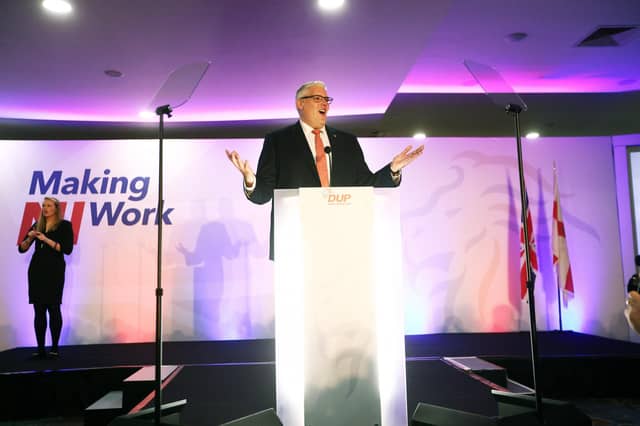

Some commentators have explained this fractious atmosphere as the ‘end of a honeymoon period’. But others have claimed that it signals the start of a campaign, ahead of the next election.
If that interpretation is accurate, it is depressing and alarming.
In Northern Ireland, voters may not go to the polls until spring 2027, when assembly elections are scheduled. If the parties are focused on that contest already, they are even less likely to govern well, with almost two years left on their mandate.
More importantly, the idea that unionists are merely electioneering, by taking a tougher stance with republicans, implies that their current disagreements with Sinn Fein are for show. This belies the fact that many of the issues in dispute are important, and they should draw a robust response from pro-Union politicians.
Take, for example, Sinn Fein’s behaviour over a jobs fair in Londonderry.
This was an event that took place at the Foyle Arena leisure centre, which is owned by the local council. The Ministry of Defence planned to take a stall and advertise Army careers, but was forced to pull out after objections from nationalist councillors.
The assembly (and Westminster) had no responsibility for this incident, but the controversy caused a row between the DUP’s Gavin Robinson and Sinn Fein’s Michelle O’Neill.
O’Neill advised Robinson to ‘butt out’, after he questioned her claim to be a ‘first minister for all’ and criticised her support for the council’s decision.
If anything, this was a mild reaction. The MoD’s treatment exposed the contempt and hostility that nationalists show to key UK institutions, or indeed any outcome of our British status, wherever they gain political control.
It implied, not only that joining the Army is an unacceptable career choice, but that the council is not interested in catering for people with a non-republican perspective at all.
With this in mind, the DUP leader was actually rather quick to de-escalate the argument.
Before the party’s conference, he insisted that it would not undermine power-sharing or damage relationships in the executive. The emphasis, as usual, was on stability at Stormont.
Despite that backdrop, the ‘electioneering’ thesis was also used to explain Paul Givan’s decision to withdraw outdated guidance on transgender pupils in schools. The education minister was responding to a high-profile Supreme Court case which found that biological sex, rather than gender identity, should determine how single-sex spaces are used.
His actions should properly be replicated across all Stormont departments.
Instead, the hostile reaction from some MLAs showed how quickly nationalist and liberal parties in Northern Ireland have adopted extreme trans ideology. Indeed, they have been gripped by this nonsense just as the rest of the world has started to question it and dismantle its worst excesses.
On one hand, the non-unionist parties’ attitude shows their thinking on this issue is deeply unserious. On the other, it would be disappointing if unionists’ opposition to these ideas was almost as facile and hinged more on creating a row than genuine conviction.
For that reason, the implication that these matters are not important, or that they can be dismissed as electioneering, is not so world-wearily clever as its proponents think.
At its recent conference, the DUP claimed repeatedly that Stormont was working well and delivering for unionists. The Deputy First Minister, Emma Little-Pengelly, said it has “never been clearer… (that) Northern Ireland is stronger when devolution is functioning”.
This insinuates that, while there are disagreements, partnership with Sinn Fein achieves important goals.
If that theory is sound, the current assembly has provided little supporting evidence. In fact, where unionists have done admirable work, it has tended to be in defiance of Sinn Fein and the Alliance party.
During this executive’s lifespan, Naomi Long and her colleagues have finally demolished the notion that they are constructive or moderate.
In an argument over the new legacy framework, for example, Alliance last week objected to an amendment distinguishing ‘innocent victims’ from perpetrators of the Troubles. The party once claimed to represent the ‘middle ground’, but now it will not even draw a distinction between terrorists and those who suffered from their violence.
That means that, besides the pro-Union parties, the executive consists of Sinn Fein, with its IRA past, deranged left-wing populism and hatred for the United Kingdom; and Alliance, in hoc to every fatuous ‘woke’ trend, to the point that even voters who previously saw it as pragmatic are beginning to notice.
Previous executives already had a patchy record of delivering for Northern Ireland. Now, the depressing fact is that we’ve never had a group of ministers less likely to reform public services effectively, manage Stormont’s finances sensibly or protect our society with decency.
There is a limit to what even the most capable unionist party could achieve with colleagues like these. A lot of its work would, by necessity, involve stopping the worst excesses of other ministers. Only then could it really concentrate on making sure that its own departments were run competently.
The DUP and other unionists are certainly free to argue that Stormont is critical to Northern Ireland’s success. It is currently at least as important, though, to stop republicans (in league with unhinged ‘progressives’), from changing our society in ways that are destabilising and dangerous.