
Owen Polley: DUP has big challenges to face before the next election
The DUP’s annual conference took place over the weekend, at the La Mon Hotel in Belfast.
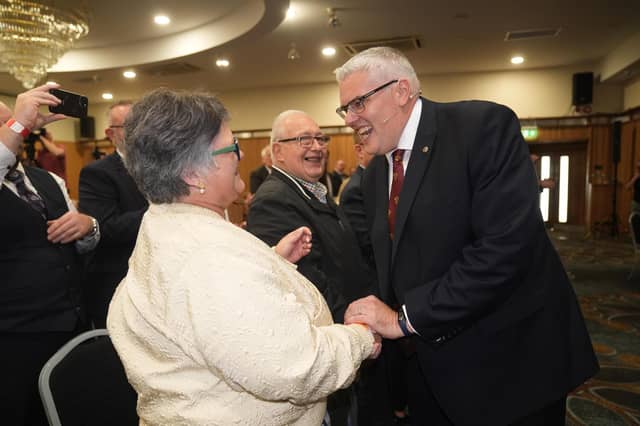

A carefully managed event like this always tries to leave party members and supporters with a sense of optimism.
At the same time, everybody at the conference must have known that it was a difficult year and that the party’s future is uncertain.
The reaction to Jeffrey Donaldson’s conviction for child sex offences has by now calmed down a little.
In the aftermath of the verdict, the party faced difficult questions over who knew what about Donaldson’s behaviour.
The offences for which he is remanded in custody clearly shocked and sickened even his closest colleagues.
However, other allegations emerged that had been more widely circulated.
They made people ask how a party, which often stressed themes of morality, could have chosen Donaldson as its leader.
Some former DUP politicians also seemed fairly blatantly to relish making things uncomfortable for the current leadership. This suggested that the party still has divisions that have not healed.
The DUP is trying to put this horrible episode behind it, as it looks to the Assembly election next year. The first opinion poll after Donaldson’s conviction showed a 3% drop in support, suggesting the Ulster Unionists had edged ahead as the most popular unionist party.
Gavin Robinson will hope that by next spring, when the election is likely to take place, the most visceral aspects of the coverage will have faded from voters’ minds.
The party has enough political challenges, aside from the Donaldson scandal.
It will fight this election, effectively, as the voice of establishment unionism. The DUP has defended the merits of power-sharing at Stormont from attacks by Jim Allister’s TUV.
The strength of this position is that there is no realistic current alternative to devolved government. Westminster has repeatedly shown that it is not interested in ruling Northern Ireland directly.
The DUP’s biggest problem remains that it restored Stormont on the false premise that it had removed the Irish Sea border.
Robinson maintains that the Safeguarding the Union deal was ‘progress’, yet the evidence suggests that Windsor Framework problems are only getting worse. The DUP leader explained some of these issues himself, at a parliamentary committee only last week.
Of course, Jon Burrows’ Ulster Unionists support power-sharing too, but they always maintained that boycotting Stormont would damage unionism and fail to remove the sea border.
On this basis, the UUP has questioned the DUP’s negotiating prowess and will no doubt continue this line of attack.
Indeed, Lord Empey, writing in the News Letter on Friday, broadened the party’s criticisms of DUP deal-making, to encompass historic agreements.
Sinn Fein can only boast about occupying the first minister’s role, he argued, because the DUP changed the way that position was appointed, as part of the St Andrews Agreement in 2006.
This is an old Ulster Unionist complaint, but it was revealing to see it resurface ahead of an election in which the DUP will ask voters to make it the biggest party again, to get rid of Michelle O’Neill.
The broader point about power-sharing is that many voters believe this Assembly has not achieved very much and it is difficult to dispute this assessment.
The counter-argument is that the executive could have done a lot more damage, if it weren’t for unionists’ ability to veto bad legislation and decisions.
This was the implication of Gavin Robinson’s claim that his party was ‘building common cause for common sense’. He would not put it like this, but the DUP’s most important job in this Assembly has often been to stop Sinn Fein and Alliance from doing stupid and damaging things.
This was demonstrated again last week, as Stormont debated Eoin Tennyson’s ill-conceived ‘conversion therapy’ bill. This badly-drafted, imprecise potential law proved perfectly how certain parties try to score ‘woke points’, with scarcely a thought about the practicalities of their legislation.
The DUP’s best performances recently have often been in pulling apart arguments from nationalists or Alliance. Some of their younger MLAs, like Philip Brett and Jonathan Buckley, have been particularly effective in this role, while the communities minister, Gordon Lyons, has shown calm and resolve, when faced with aggressive nationalist campaigning.
Meanwhile, the theme that every DUP conference features is an appeal for ‘unionist unity’. In the past, that often seemed like a thinly veiled demand that its rivals wind up their own parties and join a kind of ‘Greater DUP’, which would be presented as a united unionist party.
This time, the language was about ‘cooperation’, reflecting the fact that the UUP and TUV are doing relatively well.
The parties should certainly discuss how they can return more unionist MLAs, at the next election, and improve representation at Westminster.
They could do with talking, as well, about their broader aims.
How can Northern Ireland play a greater role in the UK? How do we bring more aspects of life here in line with the rest of the country?
That conversation should certainly cover glaring long-term problems, like the Irish Sea border, and what we could do about them.
It should not ignore, either, the things we could improve right now.
That might include acknowledging Westminster’s fiscal generosity more often, and not constantly joining in with nationalist claims that we are badly done by, as part of the UK.
ENDS