
Owen Polley: DUP helps push Sinn Fein’s anti-British budget line
People love to say that the DUP and Sinn Fein rarely agree, as if that’s a great pity. Let’s be honest, all the non-pro-Union ministers in the current executive are either hardcore republicans or increasingly radical ‘progressives’. It would be worrying if unionists found common cause with them.

It is bad enough that the one thing that reliably unites all the parties, is the idea that Northern Ireland is underfunded and deserves more money from the Treasury.
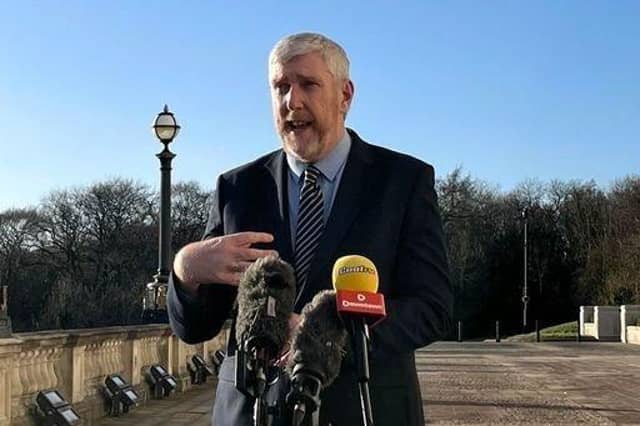
Last week, the finance minister, John O’Dowd, claimed that he was in talks with the government about “a proper financial package… to allow us to fund public services.”
The executive previously announced that it would offer 340,000 lower income households a one-off payment of £100, to assist with heating bills. This commitment was not part of Westminster’s plans to help with the cost of living and should be paid out of the block grant.
Nevertheless, the finance minister, with no apparent sense of irony, said that, “We cannot plug every gap the British government creates... The executive cannot afford to bail out the British government.”
This line should perhaps be expected from Mr O’Dowd, who represents Sinn Fein and takes every opportunity to rubbish Northern Ireland’s place in the UK.
He is also understandably keen to shift the blame. During the last two and a half years, his party has been in charge of the finance department, but it has failed to pass a budget or deal with overspending.
It is less explicable that the DUP, which is supposed to champion the benefits of the Union, has made similar arguments and has not hit back at Sinn Fein's claims. This is all the more jarring, because the claims are so ridiculous.
The Treasury recently conducted an ‘open book’ review of Stormont’s finances. It claimed that the executive could unlock £3.3 billion of extra spending power, if it implemented rigorous revenue raising measures and reformed our enormous public sector.
The deputy first minister, Emma Little-Pengelly, cast doubt on this figure, on the basis that we have a population of fewer than 2 million people. Strictly speaking, she may be right.
The idea, though, that politicians here have avoided difficult financial decisions, is beyond dispute. And the report also concluded that, if Stormont had implemented even an eighth of the budgetary options available to it, it could have balanced its books.
Northern Ireland is funded mostly by a ‘block grant’ from Westminster, which is calculated using the ‘Barnett formula’ and a ‘needs-based’ 24% uplift. In other words, at least £124 should be available to spend here for every £100 spent in England.
This system was revamped only in 2025, when our parties performed yet another shakedown of the government in return for restoring Stormont.
With crushing predictability, they now say that that financial deal was insufficient, quoting fanciful data about need.
As a result, the Treasury has repeatedly had to bail the executive out with loans, because it refused to cut spending. The latest was announced in February when the government provided an extra £400 million to keep Stormont’s departments going.
The real problem is that the parties here refuse either to reform the public sector, in line with changes made decades ago in the rest of the UK, or raise more money through measures that are taken for granted in Great Britain.
Northern Ireland’s water service, for example, is in perpetual crisis, with infrastructure that cannot keep up with demands from businesses and property developers. Still, none of the parties will support introducing water charges.
This policy has been blamed for pollution in Lough Neagh, which has been choked with blue-green algae in recent summers, threatening livelihoods, the environment and our drinking water.
Stormont health ministers have commissioned a series of independent reports, over the past three decades, all of which recommended centralising services in fewer acute hospitals, but none of them were properly implemented.
The province’s ministers have dispensed freebies and gimmicks - free prescriptions, transport passes for over 60s and heavily subsidised tuition fees - while neglecting the basic infrastructure we need to grow our economy.
Domestic rates bills are substantially lower than in England, while rates relief is higher.
The executive’s response to criticism of its budgetary choices is to claim that Northern Ireland’s circumstances are unique.
Ministers are even inclined to blame the legacy of the Troubles, which largely ended thirty years ago, for the social and economic problems that they have failed to address.
The DUP, to be fair, is more inclined than Sinn Fein to acknowledge that Northern Ireland’s public sector could be more efficient or consider the theory that high government spending might crowd out businesses. It is still wedded, though, to the principle of using every opportunity to demand more from Westminster.
Indeed, no party has argued with any conviction that the answer to Stormont’s problems is to make difficult spending decisions or raise more money, rather than perpetually frisking the Treasury for cash.
That is, to be fair, partly a drawback with devolution. At Holyrood, the SNP has followed the same template of taking populist decisions, while blaming its failures on Westminster.
For separatists, there is almost no down-side to exploiting the politics of resentment like this. For parties that are supposed to value the United Kingdom, like the DUP, it may provide short-term excuses, but in the end it damages the Union.