
Owen Polley: Fans of the Irish Sea border have dropped the lie that it did not dilute the Union - and are now simply telling unionists to ‘suck it up’
For a number of years, the proponents of an Irish Sea border kept telling unionists that it was not a constitutional issue.
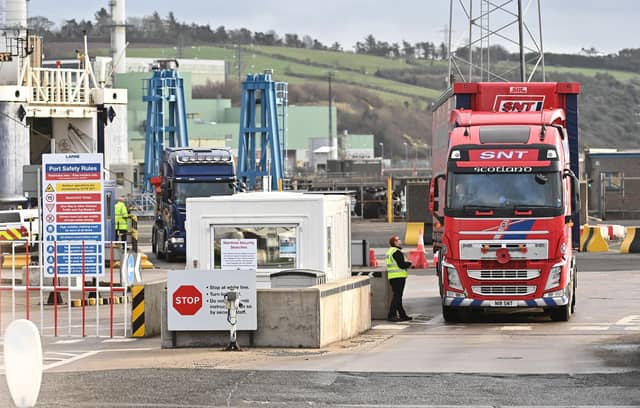

The government at Westminster intended this to be reassuring, even if it was a flimsy argument. In the Safeguarding the Union deal that Rishi Sunak’s administration made with the DUP, for example, the document claimed that the Windsor Framework applied only to trade in goods and, “the vast majority of public policy was entirely untouched by it.”
When Irish nationalists and pro-EU liberals in Ulster said similar things, they had a more hostile, condescending edge. The Alliance Party’s MP at the time, Stephen Farry, insinuated that unionists were being histrionic by, “reacting to the (NI) protocol in constitutional and economic terms.” It was difficult to pick which of these claims was more bizarre.
His party leader, Naomi Long, made the arch but typically facile comment that “where you get your sausages from doesn’t define your identity”. The implication was that it was idiotic to believe that restricting trade between Northern Ireland and the rest of the UK could affect the strength of the Union.
If those arguments seem like a long time ago, that’s prinicipally because they now look so redundant.
Indeed, all the pretexts that were used to talk down to unionists about their opposition to the sea border have by now more or less evaporated.
The idea that the framework provided privileged access to both the EU and the UK markets, amounting to “the best of both worlds”, has proved a fantasy. The economist, Dr Esmond Birnie, has carefully broken down the figures, showing that sales to the EU (leaving out the Republic) have actually fallen.
The majority of businesses in the province have experienced problems due to the post-Brexit arrangements, and there has been no increase in outside investment, as the likes of Sunak predicted. An increasing number of British products, like certain models of car and white goods, can no longer be sold there, or will soon become unavailable.
Most importantly, Northern Ireland remains under the authority of Brussels, not just where regulations for goods are concerned, but across a vast range of public policies.
The High Court ruled that immigration laws, introduced by the Tories, infringed the Windsor Framework. There is every chance that new migration policies proposed by Labour will be subjected to challenges on this basis too.
The proposed generational anti-smoking legislation, introduced by the government, is also almost certain to be unenforceable in this province, due to single market rules. This effect of the framework is likely to dismay health campaigners and anti-cancer charities.
Even legacy laws, intended specifically to address the fallout of the Northern Ireland Troubles, were deemed by the courts to clash with EU edicts, which they said must have priority.
The Conservative government, and the sea border’s supporters, previously denied the constitutional impact of the framework. The message now from nationalists, Alliance and, increasingly, Labour ministers, to unionists who believe that their place in the UK has been diluted, is to claim that this was all an inevitable outcome of Brexit.
From belittling pro-Union concerns, the attitude has effectively become, “suck it up”. The fact that these problems affect Northern Ireland’s economy and all its people seems to them irrelevant, set against their ideological commitment to an all-Ireland setup (in nationalists’ case) and to integration with the EU (for Alliance).
At Westminster, Labour’s only proposed solution to Windsor Framework problems is to realign, voluntarily, with various aspects of EU regulations. While this threatens to inflict new burdens on British businesses, it does not actually resolve the chief Irish Sea border issues.
The EU has not indicated that Starmer’s "reset” of relationships with Brussels will bring about any reduction in checks or paperwork. Indeed, it has demanded that trade barriers between Great Britain and Northern Ireland should be enforced more rigorously, in return for allowing the UK to submit again to the single market’s food and agriculture rules. Labour’s strategy of capitulating to the EU’s demands only encourages the bloc to ask for more.
Meanwhile, the campaign to use the framework to undermine the province’s place in the UK has become much more open.
At Stormont, last week, Sinn Fein introduced a motion demanding that MLAs at the assembly should gain "observer status” at the European Parliament. Predictably, this incendiary suggestion gained support, not just from other Irish separatists, but the pro-EU Alliance Party, which is supposed to be agnostic on constitutional issues.
The proposal aped a similar campaign from a cross-party group of Irish MEPs, which claimed observer status should be granted, “before a possible reunification”.
At the Assembly, unionist MLAs blocked this motion, using a power-sharing safeguard called a “petition of concern”. The Alliance Party described this decision as “a shameful perversion of democracy”. In fact, while petitions have been used, on occasion, to block votes that have little relevance to cross-community sensitivities or constitutional matters, this was exactly the kind of divisive stunt they are intended to protect against.
That unionists should simply stand by, while their opponents agitate to re-integrate Northern Ireland with the EU, or even “prepare” for its annexation by the Republic, is clearly ridiculous. But it typifies the attitude of the aggressive coalition effectively operating at Stormont between Irish separatists, who want to destroy the Union, and self-styled “progressives”, with their fanatical allegiance to Brussels.