
Owen Polley: Gradual erosion is the biggest threat to Northern Ireland’s place in the UK
The campaign to destroy Northern Ireland’s place in the United Kingdom is so loud and incessant it can be easy to forget that it is a political campaign at all.
It is certainly not a genuine ‘conversation’ about the future of this island, as nationalist activists and their media supporters like to pretend. It is not a proper debate either.

The outcome of this discussion is pre-determined and, if you suggest otherwise, your opponents will soon remind you that you are regarded only as an impediment to ‘progress’.
It is always the same tiny handful of ‘unionists’ who become involved in Ireland’s Future and similar organisations. They accept Irish separatist assumptions, use Irish separatist language and express disdain for Britain, rather than enthusiasm for Northern Ireland participating in the UK.
The best explanation for these people is that they enjoy the attention and the plaudits they receive from nationalists.
No doubt, the republican commemorations over the next few days will try to further amplify the idea that an all-Ireland state is imminent. For everyone else, the rebellion of Easter 1916 is a reminder that Irish ‘independence’ was always driven by anti-Britishness and the Republic’s origin story is linked inseparably to anti-British terrorism.
The challenge in the present day is not to allow a small core of nationalist extremists to determine our future like they did back then.
For all the hype, most people in Northern Ireland and the Republic remain uninterested in the campaign for annexation, as demonstrated in repeated opinion polls.
The current government in Dublin is sceptical too.
There are of course many problems with the Republic’s administration, which I have pointed out in this column.
The interstate European Court of Human Rights case against the UK on legacy legislation is outrageously hypocritical.
The Republic also consistently lectures Britain and other more responsible states on foreign affairs, while refusing to contribute to its own defence or moderate its language on Israel, gaining it the reputation of the most anti-semitic country in the West.
And while Dublin does not want the expense or constitutional upheaval of absorbing Northern Ireland, it acts like it has some kind of authority here, meddling frequently in our affairs.
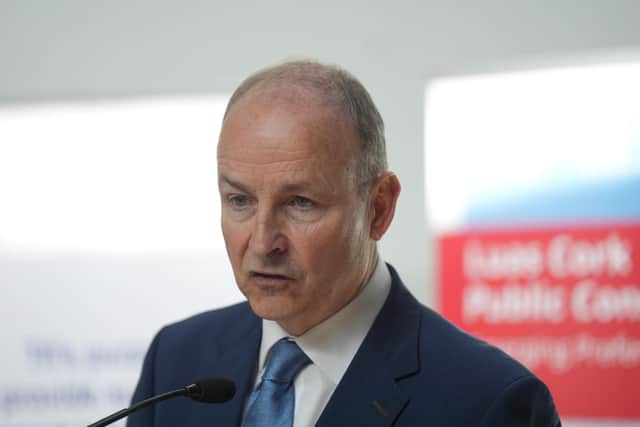
At the same time, the Taoiseach, Micheal Martin, and his deputy, Simon Harris, have played down the prospects of a ‘border poll’. In theory, Martin remains supportive of the aspiration for an all-Ireland state, at some unspecified time in the future. But in a recent interview he ruled out holding a referendum by 2030, which was a key demand from Sinn Fein and its fellow travellers at Ireland’s Future.
One of the taoiseach’s pet schemes is a ‘Shared Island’ unit that funds cross-border projects and reconciliation programmes. This kind of initiative will always make unionists suspicious and indeed we should be wary of all-Irelandism edging us away from the rest of the UK.
Martin and Harris, though, have at least made some concessions to unionist sensibilities. That is not something you could say of their predecessor, Leo Varadkar, or his sidekick, Simon Coveney.
It is scarcely a year since the former taoiseach left office, loathed by the Irish public and humiliated by two referendum defeats. During that time, he has repeatedly called for Northern Ireland’s annexation by the Republic.
Most recently, he described an all-Ireland state as the “great cause of our generation”, at an Ireland’s Future rally in Philadelphia.
It is actually good news that this organisation was forced to appeal to Irish Americans to again interfere in Northern Ireland’s affairs. Just months ago, campaigners thought the southern election would force Dublin to drive the case for a border poll.
As for Varadkar, he was once portrayed as one of the EU’s most influential leaders, thanks to his hardline anti-UK stance during Brexit negotiations. Now, he is reduced to hawking shop-soiled Irish separatism alongside a motley cast of Shinners and other nationalist zealots.
That’s not to say that the movement he is involved with is not dangerous and sinister. Its activists are obsessively persistent, insinuating themselves everywhere. And their slippery use of language has an effect on society.
Last week, Senator George Mitchell gave a speech at Queen’s University in Belfast. The former ‘peace process’ mediator is now 91 and we cannot know the genesis of his remarks, but some of them showed traces of nationalist thinking.
He framed Northern Ireland’s development in the context of ‘this island’ and its young people. And though he did not call for a border referendum, saying it was not his place to suggest a poll, he claimed we should “think in the direction that change can take us”.
The border ‘debate’ certainly makes for arresting newspaper copy and stimulating radio and TV. This cannot quite explain the obsession of some BBC Northern Ireland political programmes and their producers, but it sustains an impression of momentum that opinion polls do not support.
For proponents of the Union, that is a challenge, but the biggest threat to our constitutional position is still not an early vote on the border. We should be more worried about our place in the UK being gradually eroded, particularly if we are edged towards all-Ireland institutions, thinking and symbolism.
This will happen more readily if we are deceived into accepting that the ‘conversation’ about Northern Ireland’s status is genuine. Or if we show naivety towards nationalism’s ever-evolving list of grievances and demands.