
Owen Polley: It is hard to care about purity of Brexit that never applied to Northern Ireland
The government’s deal with the EU last week was described as a ‘betrayal of Brexit’ and a disaster for the UK, by some of its fiercest opponents. You could see why they were angry.
Keir Starmer capitulated on fishing, granting EU vessels access to British waters for 12 years, after initially offering four. He agreed to pay Brussels substantial sums of money, merely for the privilege of a closer relationship.
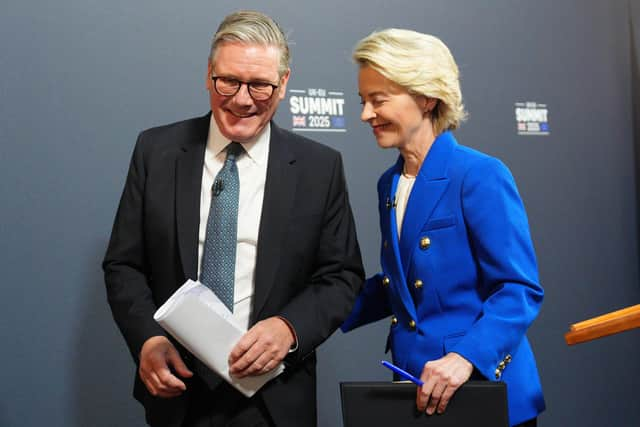

Most importantly, in return for an agreement on agrifood, he allowed the EU to make some laws for Britain again and submitted the whole UK to the judgments of its courts.
From an exclusively Northern Ireland perspective, it is harder to be outraged. It has become difficult to care much about the purity of Brexit, when we were effectively excluded from that project from the beginning.
The most significant part of this deal, for our economy, is the proposed sanitary and phytosanitary (SPS) agreement with Brussels. The ‘reset’ did not include details, which will be negotiated later, but we know the government intends to accept the EU’s food and agriculture rules, now and in the future.
If there are disputes, the European Court of Justice (ECJ) will decide who is in the right, and Brussels’ officials may inspect British farms and factories, to make sure its regulations are followed.
In return, food, drink and plants from Great Britain should be able to move to the EU (and Northern Ireland) without many of the veterinary certificates, identity checks and physical checks that are currently required. If the deal delivers what the government promised, the sea border will soften for this kind of trade.
It is important to emphasise that customs checks and paperwork will still apply to these goods. Last week, even the Secretary of State, Hilary Benn, was vague on this point. But there was nothing in the announcement that suggested these requirements would be dropped.
The fact that he was evasive is an indictment of the way in which ministers, both Conservative and Labour, have often seemed ignorant about what exactly they’ve signed up to.
From a completely objective standpoint, this was almost certainly a lousy deal, negotiated by a weak prime minister. It was galling, though, to listen to figures like Steve Baker, the former hardline Brexiteer and NIO minister, raging about EU law applying to the rest of the UK, when he justified Northern Ireland being left under Brussels’ jurisdiction.
Likewise, Kemi Badenoch accused Starmer of “selling out our sovereignty” to the EU. Yet the Conservative leader has continued to defend the Windsor Framework. She was clearly not so bothered about the UK’s sovereignty in Northern Ireland being ‘sold out’.
I’ve always wanted unionists in Northern Ireland to take a broad UK perspective, rather than look at issues from a parochial standpoint. The goal of pro-Union parties should always be to play an ever greater role in the political, cultural and economic life of our nation. We should care about the whole country.
At the same time, it would take an almost inhuman spirit of self-sacrifice to accept, as I suspect has been implied by some Brexit diehards, that Northern Ireland should effectively ‘take one for the team’; that, in essence, we must ‘lie back and think of Britain’, so the rest of the country can leave the EU without difficulties.
On the centre-right of British politics, there is often an innate unionism and sense of pride in Northern Ireland’s place in the UK, that is not common in the Labour Party. However, many professed unionists were so committed to delivering Brexit over the past few years that they forgot to treat the Union with care.
It makes it difficult to stomach their hypocrisy now.
None of this is to say that Labour’s deal comes anywhere close to solving our problems with the Windsor Framework. Even as the media digested its significance, the Department of Agriculture emailed businesses confirming that the latest tranche of labelling requirements for food would go ahead as planned on July 1.
The goal, the email said, was to implement the framework “in a faithful way”.
While moving food may eventually become easier, the government is pushing ahead with plans to make the border harder. Most movements of goods are unaffected by the new agreement, customs formalities stay in place and we remain under the authority of Brussels.
Unlike the Conservatives, Labour is not in the least ashamed or coy about treating Northern Ireland differently. The trade minister, Douglas Alexander, recently claimed without regret that we had been cut off from the rest of the UK, to “protect a hard-won peace”.
The unionist parties actually reacted to last week’s deal rather sensibly. They acknowledged that it may eventually make it easier to move food to Northern Ireland but focused on all the problems that the Windsor Framework continues to cause.
Until we get rid of the framework, the sea border will remain in place, with all the disruption and the dilution of the Union that entails.
It would be wrong to applaud the government after weak negotiations, which did not even extend to delaying food labelling that will supposedly soon be redundant.
It would be needlessly purist, though, to reject anything that makes life easier in Northern Ireland. Particularly if the argument for its rejection is that it betrays a Brexit that we were never allowed to enjoy.