
Owen Polley: It's up to unionists to put an end to destructive woke madness in Northern Ireland
In the rest of the UK, there is some evidence that ‘woke’ politics are in retreat. In Northern Ireland, though, ‘progressives’ still treat these ideas with new-fangled enthusiasm.

Many Northern Irish politicians fail to acknowledge that we have an immigration problem, despite the riots that followed an asylum seeker attempting to behead a local man.
They relied on misleading and out of date statistics to deny the scale of new arrivals. The debate has scarcely moved beyond slogans like ‘refugees welcome here’ and ‘diversity is our strength’.
Similarly, our coterie of commissions and ombudsmen have all but refused to change their advice on trans policies, in response to the Supreme Court’s decision that gender means sex for the purposes of equality legislation.
Meanwhile, in the last Stormont term, the Alliance party, in conjunction with Irish nationalists, tried to raise the age of criminal responsibility to 14, ignoring warnings about the effects this would have on law and order.
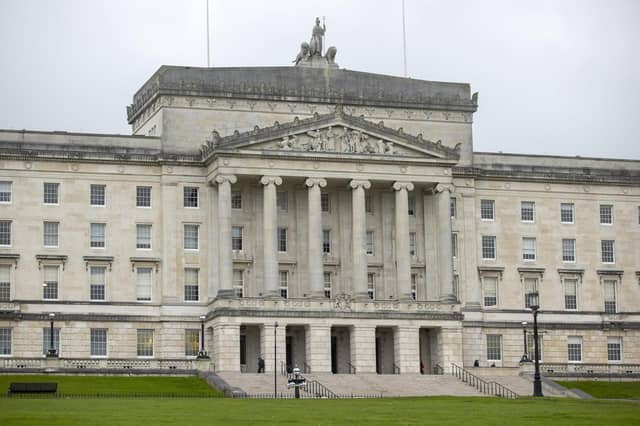
The idea that Stormont does very little is well-established. The fact that, when the devolved institutions do act, they often cause harm, is less frequently highlighted.
In this Assembly in particular, blocking bad policies has become at least as important to sensible MLAs as passing good ones.
Between Sinn Fein and the SDLP, who aim ultimately to destroy Northern Ireland, and Alliance, with its desperation to seem on the ‘progressive’ side of every argument, there is a majority intent on doing silly and even ruinous things.
It has been left to unionist parties to stop their worst, most destructive plans.
This is not always a comfortable or popular role, but it’s vital if Northern Ireland is not to become even more dysfunctional. It also means that the Assembly’s cross-community safeguards have never been more important.
Calls to drop these protections accompanied the vote on the age of criminal responsibility.
This was a complicated issue that was flattened into simple rhetoric about children’s rights. The justice minister, Naomi Long, wanted to raise the threshold from 10 to 14 for most offences.
This might sound fine in theory, but UUP leader, Jon Burrows, was especially effective at showing how the legislation could prevent the police from investigating crimes and maintaining order.
Four Ulster Unionist MLAs joined the DUP and TUV in signing a ‘petition of concern’ on the proposed law change, although two subsequently supported a motion to raise the threshold to 12.
The petition, a key Belfast Agreement safeguard, means that 30 or more MLAs from two or more parties can require a vote to command a majority of both unionists and nationalists in the Assembly.
There is a long history of complaints about the alleged misuse of the mechanism, which has, at times, frustrated parties on either side of the constitutional divide.
You often hear it said that the petition should apply only to cultural or constitutional matters. However, there was never anything in the agreement or subsequent legislation confining its use to particular policy areas.
In Northern Ireland, almost any issue can be deemed divisive, or relevant to our constitutional status.
The petition was also reformed relatively recently, in an attempt to ensure it was used sparingly.
The New Decade, New Approach deal resulted in legislation in 2022 that required petitions of concern to be signed by MLAs from at least two parties, whereas previously 30 MLAs from one party was sufficient. A kind of cooling off period was also introduced, between the triggering of the petition and the actual vote.
The DUP was always the mechanism’s most enthusiastic user and the UUP often criticised its effects on government. Mr Burrows made a compelling argument, though, that the criminal responsibility debate was important enough to justify this exception.
Alliance, and its supporters on the issue, claimed they had the weight of expert opinion behind them.
Its main advocates, though, looked a lot like the industry of left-leaning third sector bodies, lobbyists and academics that have an outsized influence on so many decisions in Northern Ireland. It would be naive not to see an ideological slant to this policy.
The same people tend to argue constantly for provisions that undermine the idea of personal responsibility, privilege certain groups and frame political demands in the language of human rights.
Unfortunately, there will continue to be potential legislation that unionists should face down, even against a tide of outrage.
This includes Sinn Fein’s so-called ‘Good Jobs Bill’, which businesses say could decimate the economy. Predictably, those proposals are supported by the trade unions, as well as Alliance and the SDLP.
Previously, nationalist parties adamantly defended cross-community safeguards, like the petition of concern, or the ability of the two biggest executive parties to block legislation. They argued that these mechanisms prevented minorities from being ignored or abused.
Now, thanks to Alliance’s radical makeover, nationalists can often sideline unionists if they need a simple majority, so consensus politics is no longer important to them.
Stormont really does work badly, so it is tricky for unionists to argue against changing it. Many of the assembly’s failings, though, are built into the idea of devolution, and will be difficult to overcome without completely abandoning its principles.
Meanwhile, this executive is arguably Northern Ireland’s worst ever. One of the few saving graces is that pro-Union MLAs can stop its excesses.
That is a worthwhile job and the tools that make it possible have never been more vital.