
Owen Polley: Jon Burrows must make sure row doesn’t become part of pattern
What’s next for the UUP? It is a question that newspaper columnists could have asked almost any week in the last 30 years.
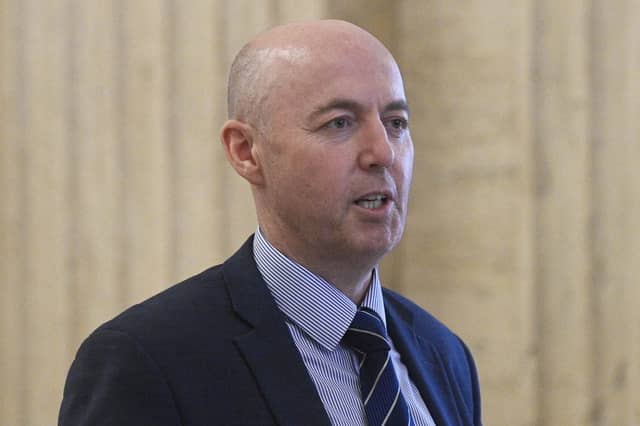

The only difference is that the party recently received a morale boost, when an opinion poll suggested that it was more popular than the DUP.
The proviso is that this result was recorded in very particular circumstances. The Lucid Talk survey was the first since Jeffrey Donaldson’s conviction for child sex abuse.
There are also valid questions about whether the UUP has strong enough candidates to turn a surge in support into Assembly seats.
Still, the poll was encouraging for the party’s new leader, Jon Burrows.
Unfortunately, it was quickly followed up by a row with his health minister, which ended in Mike Nesbitt’s resignation.
Their argument was over the minister’s plans to close emergency surgery at Causeway Hospital and move it to Antrim Area Hospital. The rights and wrongs were far from straightforward, as David Thompson explained in his column on Saturday.
Mr Burrows changed his message subtly over the course of last week.
At a meeting in Coleraine, he initially said that he would ‘never agree’ to changes proposed by the Northern Trust and endorsed by Mr Nesbitt.
After the health minister’s resignation, though, his emphasis was on the lack of evidence that the department presented to justify its decision.
This was a reasonable point.
At the same time, successive health ministers have commissioned reports over several decades that all recommended centralising services in fewer hospitals.
They all remain largely unimplemented.
The problem is that there is never agreement about which sites should be closed.
Over the intervening years, it has become even more difficult to provide safe, efficient care in some hospitals, because they struggle to find enough staff.
In fact, it is hard to imagine an MLA or campaign group accepting any reasons that a minister might give for shutting down a service in their local hospital.
As soon as he resigned, Mr Nesbitt was turned into some kind of healthcare superhero by the UUP’s rivals. In truth, he wrestled with an out of date system, and, outside his department, there were all kinds of resistance to change.
The new health minister, Robbie Butler, will encounter the same challenges.
Mike Nesbitt’s time in the UUP was also not without problems, if we set aside his approach to his ministerial brief.
Some of his attitudes to constitutional issues were extraordinary for somebody who twice led a unionist party.
In the aftermath of Brexit, he told The Australian newspaper that Northern Ireland would not be ‘worse off’ in an all-island state.
He repeatedly supported the De Souza campaign to stop people here automatically receiving British citizenship.
He even co-sponsored an event at Stormont that advocated votes in EU parliamentary elections for Irish passport holders in Northern Ireland.
These were not complicated issues, from a unionist point of view. They all involved proposals to dilute British sovereignty or make us even more different to the rest of the UK.
Indeed, just two weeks ago, Nesbitt stood alongside Sinn Fein’s John O’Dowd and claimed that Stormont should receive, not a few hundred million, but £3 billion a year extra from the Treasury.
The fiercest republican could scarcely have come up with a figure that was more detached from financial reality, or more calculated to strain our relationship with Westminster.
Northern Ireland already receives substantially more public cash per capita than England, Scotland or Wales.
The row with Nesbitt may have been a blow to Burrows, but he handled the fallout well.
The former health minister’s resignation letter was a brutal, sarcastic attack on Burrows’ leadership, his relative lack of political experience and his communication with UUP colleagues.
The leader’s official response, thanking Nesbitt for his service and commending his work, was restrained and dignified. The choice of one of his internal critics, Robbie Butler, as the new health minister, was also a diplomatic decision.
This has stopped internal dissent against his leadership from escalating, for the time being.
Meanwhile, the question of whether emergency surgery at Causeway should shut is complicated.
We know with certainty, though, that our health service needs reform.
That job can seem like it has scarcely begun, 15 years after Transforming Your Care and 25 years after a review by the late Maurice Hayes set out the case for centralisation.
The UUP leader may have a reasonable argument, but the way he presented it carried a hint of the parish pump populism that has prevented Stormont from making progress.
This is unfortunate, because Burrows presumably wants to position the Ulster Unionists as an alternative to the ‘dysfunction’ of an executive dominated by the DUP and Sinn Fein.
The UUP could present itself as the party that is honest with voters, by admitting that governing is not easy and sometimes involves making unpopular decisions.
It is a niche that may become harder to fill after last week’s row. However, that is not inevitable.
It depends whether Burrows can defend his stance on Causeway Hospital as a conscientious reaction to a unique set of circumstances.
The alternative is that it could start to seem like part of a pattern.
Then, the Ulster Unionists would struggle to distinguish themselves from the rest of the parties at Stormont that consistently take easy, populist lines on issues like health, public sector reform and funding from Westminster.