
Owen Polley: Like the rest of the UK, NI progressives just can’t get serious about immigration
The Labour government unveiled a package of new immigration policies last week. Its aim, according to Number 10, was to ‘restore control to our borders’ and ‘reduce record high levels of net migration’.
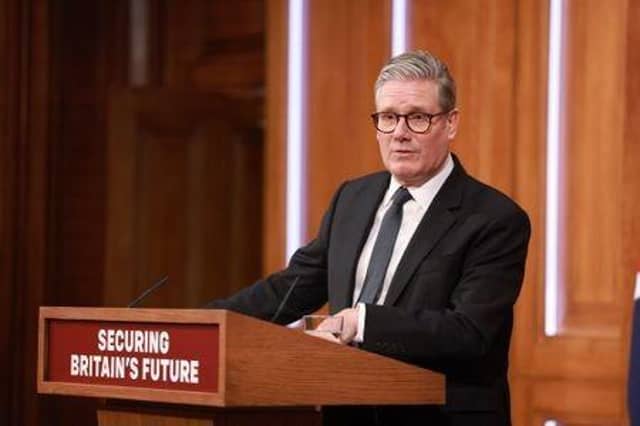

You could be forgiven for being cynical about this message from the prime minister. All of his immediate predecessors, from David Cameron onwards, claimed they would do the same, but the number of new arrivals rocketed.
Even the last Labour PM, Gordon Brown, promised to drive down net migration, back in 2010. There is little reason to believe that this will be the government that finally gets immigration under control.
For one thing, Sir Keir is a relatively recent convert to the idea that migration should go down.
During his Labour leadership campaign, in 2020, Starmer urged his party to, “Welcome migrants. Not scapegoat them”. He told supporters, “We have to make the case for the benefits of migration; for the benefits of free movement”.
Even in 2020 this kind of language, which repeated platitudes about diversity and liberalism, was looking shop-soiled and redundant. It was already clear that the UK was losing control of its borders and the country’s sense of togetherness was being eroded as a result.
There must have been some wry chuckles last week, after Starmer belatedly acknowledged these facts and faced a wave of hysteria from fellow progressives. These are the type of people who trade in high-minded cliches and disdain for their fellow citizens, while routinely ignoring what is happening around them.
A great deal of the overreaction focused on the prime minister’s warning that the UK risked becoming “an island of strangers”, unless it introduced stricter migration controls.
Some left-wing politicians claimed Starmer was deliberately copying language used first by Enoch Powell. The former Conservative MP, who later represented South Down for the Ulster Unionists, is always a useful pantomime villain to invoke.
In his famous ‘Rivers of Blood’ speech, Powell predicted that white people in Britain would one day consider “themselves ... strangers in their own country.”
The independent MP, Zarah Sultana, who was expelled from the Labour party last year, claimed Starmer’s speech “put lives at risk” by echoing this phrase. The Nottingham East MP, Nadia Whittome, who still sits on the government benches, suggested the prime minister had mimicked the “scaremongering of the far right”.
Starmer should remember that this is what happens when you try to launch a discussion about migration and its effects. A section of the political class and the media immediately starts screeching about racism, ignoring the unprecedented scale of the problem in the UK and the difficulties it causes.
If this lack of seriousness about the topic is bad in the rest of Britain, like so many other political trends, worse examples can be found in Northern Ireland.
The former UUP leader, Lord Empey, recently expressed concerns that it was impossible to integrate “something in the region of 15,000 people a week coming into the UK.”
This was a legitimate criticism of government failures, articulated in a strikingly moderate tone.
The Alliance MLA, Paula Bradshaw, quickly wrote to the News Letter attacking Lord Empey’s remarks. The letter failed to challenge his arguments or figures, as the peer noted in his rebuttal on Saturday, but it accused people who were concerned about immigration of “being manipulated by far-right groups and social media lies”.
This was a particularly patronising and contemptuous line.
So far, Northern Ireland has been impacted less than the rest of the UK by the recent influx of newcomers.
At the same time, our society has changed very quickly, as anyone can plainly see.
The communities most affected by these developments are often working class and predominantly unionist.
It is very easy to demonise people from these areas, based on a few unfortunate incidents.
Actually, though, just like their counterparts on the mainland, residents have overwhelmingly been tolerant of immigration, even if they are worried by its effects.
They are perfectly capable of separating the political issues, which are undeniable, from the way they treat individuals each day.
Many migrants have of course contributed to the UK and Northern Ireland positively. Indeed, every government, including the current one, wants to balance the country’s need for certain skills against the imperative of stemming an unsustainable tide of people.
There is nothing necessarily wrong, either, in calling for careful language.
However, both Lord Empey and Keir Starmer were both restrained and moderate in their comments, despite attempts to insinuate otherwise. They were attacked for merely raising the topic.
Rather than engage in a serious discussion about migration, its effects on our society and how we manage it, a certain type of ‘progressive’ instinctively loses their mind when the subject is mentioned.
The idea that any society can manage an unlimited number of new arrivals for an indefinite period, simply by investing in services and housing, as Bradshaw implied last week, is laughable. It’s the sort of meaningless, feel good commonplace that stands in for debate in a social media age.
Meanwhile, almost a million extra people continue to come to the UK every year, all of them needing to be housed, looked after and educated. The problem is so bad that a progressive Labour government, led by a human rights lawyer, feels the need to address it.
Starmer, unlike his left-wing critics, is at least obliged to pay the real world some attention.