
Owen Polley: Only Alliance struggled to see that Sinn Fein was flying the Palestinian flag over Belfast as provocation
There is little doubt that anti-Israel sentiment and anti-semitism in nationalist Ireland are real and visceral.
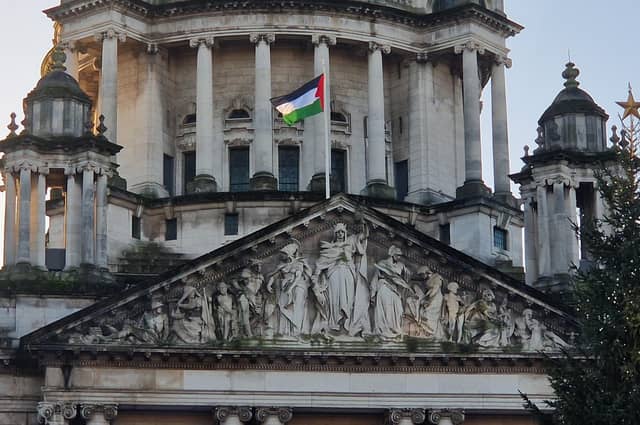

The reaction to the war in Gaza has been hysterically one-sided. But it is not just that.
As soon as Hamas terrorists attacked Israel, killing over 1,200 innocent people and taking hundreds more hostage, republicans expressed solidarity with Palestine rather than commiserating, even for a day, with Jewish victims.
Their reaction to these horrific attacks was to immediately empathise with the perpetrators and even to slyly celebrate their atrocities. For that reason, we simply cannot take seriously the idea that it was the scale of the Israeli response to Hamas that has appalled Irish republicans.
The People Before Profit MLA, Gerry Carroll, tweeted ‘Victory to the Palestinian resistance’ long before Israel reacted to Hamas’s butchery. In the aftermath of the attacks, which included young people being murdered at a music festival, Sinn Fein’s Deirdre Hargey posted, ‘Free Free Palestine’.
In west Belfast, an Irish language school uploaded a video of its pupils waving Palestinian flags, while a boy delivered a speech quoting the IRA terrorist Bobby Sands.
These were just three prominent examples. Even the then taoiseach, Leo Varadkar, offered only brief condemnation of Hamas, before launching into a lecture about the need for Israeli ‘restraint’.
As Israel mourned the victims of one of the most brutal terror attacks in memory, let’s be honest, Irish republicans could not wait to bring out their Palestinian flags and sneer on social media.
The pretence that this was anything other than an outburst of hatred was either dishonest or naive. And that loathing, which is so deep that I think it must be considered anti-semitic, has only intensified during Israel’s campaign in Gaza.
Every claim that Hamas has made during the war, however unlikely or unverified, seems to be believed by the majority of nationalists, north and south. Every Israeli explanation or challenge, from the point of view of Irish separatists, is a lie from a genocidal, apartheid regime.
Some brave Irish critics have spoken out against this consensus, but their voices are marginal.
The irony is that the same people who act effectively as conduits for Hamas propaganda have the audacity to accuse unionists of extreme views on the war, or of being ‘far right’ for seeing Israel’s point of view.
Nationalists are undoubtedly emotionally invested in the conflict in the Middle East, even if their views on it are deeply biased. At their heart, though, these over-the-top displays of pro-Palestinian support must surely, at least subconsciously, be as much about themselves and their highly-developed victim complex.
The flying of the Palestinian flag at Belfast City Hall last week was no humanitarian act of solidarity. It was intended as a provocation, as even the Alliance party seemed belatedly to realise.
For reasons that may not make historical sense, Palestinian symbols have become something like subsidiary emblems of Irish republicanism.
Nationalists have long drawn crude parallels between their own dispute with Britain and Zionist ‘colonialism’. That’s been the case at least since the bogey of ‘partition’, which has been blamed for every problem in both the Republic and Northern Ireland, was mooted for the Mandate of Palestine in 1947, which was effectively under British control.
Although there were initially some Irish nationalists who likened their own nation-building ambitions with the aspirations of Jews in Israel, the anti-Israeli narrative has been fixed for most of that state’s existence.
The Palestinian flag is now firmly linked to terrorism and republicanism, in a Northern Ireland context. In fact, the conflict has become an excuse to flaunt symbols that unionists find offensive, while claiming the moral high-ground.
Don’t forget that, again in the aftermath of October 7, before any counter-attack was even conceived, republican activists displayed a giant Palestinian flag on Belfast’s Black Mountain. This site has been repeatedly used to show that extreme republican messages can be rubbed in the faces of unionists and moderates, who can do nothing about it.
The Palestinian flag controversy has parallels with some of the most aggressive Irish language policies. Sinn Fein knows exactly what it’s doing, moderate nationalists know exactly what it’s doing and unionists know exactly what it’s doing. Until Monday, the only party that often didn’t seem to have a clue was Alliance.
That party’s younger generation is devoted to progressive posturing and the dogmas of identity rather than reconciling people in Northern Ireland.
Its councillors in Belfast eventually changed their mind on the Palestinian flag.
But they had already voted to fly it on the so-called international day of solidarity for Palestine, before a unionist legal challenge intervened. By then, the damage was done.
Across the west, and in Britain, politics have become polarised in a way that has created even more division in Northern Ireland.
The left and, by implication, those who see themselves as ‘progressive’, are now expected to see the Gaza conflict as a simple moral fable.
The progressives’ over-emphasis on race and identity, in league with modish theories about privilege, has encouraged them to empathise with Islamists and terrorists, rather than having even a twinge of sympathy for a country like Israel that is western in outlook, with democratic institutions.
This trend is why we have a so-called middle ground party that seems, not only more in tune with nationalists, but sometimes to stand with the most feral wing of republicanism.