
Owen Polley: Politics in Northern Ireland is set to be just as turbulent in 2026 as it was last year
Across the UK, 2025 was a year of restlessness and dissatisfaction with politics. This was not a trend that Northern Ireland escaped.

Many of the big themes that dominated the last 12 months will clearly persist into 2026. It is difficult to predict, though, whether they will cause new crises or just bring about more uncertainty.
The Labour government remains almost incurably unpopular.
Its problems, and a sense of national unease, were reflected again in a row about the Egyptian ‘activist’ Alaa Abd el-Fattah, who arrived in the UK last week.
The prime minister, Sir Keir Starmer, welcomed al-Fattah enthusiastically, seemingly oblivious to his history of expressing viciously anti-British, anti-Jewish and anti-white views.
This was just the latest episode that made people feel the state is out of touch with their priorities, particularly where immigration is concerned.
Admittedly, the Conservative opposition, under Kemi Badenoch, articulated these concerns more effectively last year.
But, in government, the Tories also campaigned for Mr el-Fattah’s release. This contradiction summed up why they will continue to have a hard job persuading voters that they stand for radically different values to Labour.
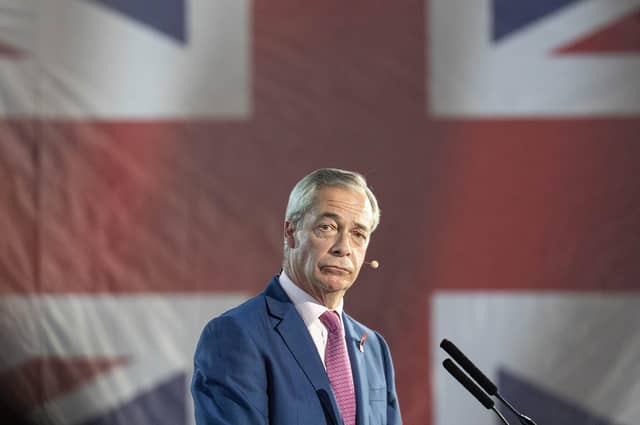
The sense of disillusionment with the two traditional parties meant that, in 2025, Nigel Farage’s Reform UK gained more support in by-elections and opinion polls.
It may have tapped into voters’ concerns, but there are still plenty of doubts about Reform’s underlying beliefs and plans for government. The el-Fattah affair, though, suggested again that problems with the civil service and the culture at Whitehall have become deeply ingrained.
Some highly informed people think that a Reform government now offers the best chance of restoring Britain’s institutions.
For unionists in Ulster, there remain valid questions about Farage’s commitment to strengthening the Union. They cannot afford, though, to simply dismiss him as an English nationalist, rather than a potential prime minister.
Alongside that complex UK-wide picture, unionists have to grapple with serious ongoing issues in Northern Ireland.
There are unlikely to be elections this year, but we cannot assume that power-sharing at Stormont will survive 2026.
The risk of collapse comes principally from Sinn Fein, as it becomes more aggressive in the face of poor opinion poll results.
The party is likely to face elections in 2027 and it knows from past experience that, when it collapses the institutions, it is usually rewarded with concessions from opponents and support from separatist voters.
In truth, nationalists see power-sharing mainly as a means to dilute Britishness in Northern Ireland.
When that process is slowed or halted, even briefly, their grievance machine is on hand to demonise unionists for having aspirations and beliefs of their own.
Many pro-Union voters will ask whether Stormont’s survival matters, when it consistently achieves so little. This is a valid point, but we saw that even a Conservative government repeatedly refused to implement direct rule, when Sinn Fein last collapsed the executive.
With a Labour PM in No 10, and one who has already displayed weakness to Dublin, the assembly’s power-sharing safeguards may now be the only way to ensure that unionism is not sidelined.
Indeed, the new year reminded us that the DUP’s own Stormont boycott, aimed at removing the Irish Sea border, achieved nothing. On the January 1 onerous new customs procedures were introduced for companies supplying goods to Northern Ireland, as well as a veterinary medicines border.
The Windsor Framework remains the biggest challenge to our place in the UK and the local economy.
Unfortunately, the unionist parties seem increasingly out of ideas on what to do about it. While we have effectively been cut off from Britain’s economic and political mainstream in order to placate Irish separatists, that existential problem gets less coverage in much of the media than nationalists’ latest invented grievances.
Partly, that’s because of the make-up of Stormont, which nationalists can dominate, thanks to the pro-EU leanings of Alliance. The ‘constitutionally neutral’ party has struggled in recent polling, perhaps due to its lack of nuance on controversial social issues or its ministers’ failure to deliver anything other than pompous soundbites.
Meanwhile, the Ulster Unionist leader, Mike Nesbitt, has decided to stand down from the leadership.
The party performed steadily but unspectacularly under his guidance. Nesbitt, though, recently added confused messages on issues like all-Ireland healthcare and gender treatments to some baffling interventions in the past.
The UUP’s problem is that many potential replacements as leader have already been tried, while others are clearly unsuitable. The frontrunner, Robbie Butler, sometimes uses weaker, more Ulstercentric language than Nesbitt. That is why the North Antrim MLA, Jon Burrows, is a serious contender, despite less than six months experience at Stormont.
The air of confidence he gave the party, as well as his tendency to put across strong messages when needed, clearly worried some of the UUP’s assembly rivals last year. Alliance’s MLAs targeted Mr Burrows repeatedly, for example.
Some commentators have speculated that Naomi Long may also step down as Alliance’s leader this year. Unfortunately, for level-headed Alliance supporters, she would probably be replaced by a politician even more focused on divisive ‘woke’ causes, rather than practical policies.
Whoever ends up in charge of Stormont’s parties this year, we can be sure the challenges they face will be difficult and unpredictable. It is likely that in Northern Ireland, as in the rest of the UK, 2026 will be just as defined by political turbulence as 2025.