
Owen Polley: Sinn Fein’s latest tantrums are a sign of weakness in polls
Even if you set aside their attitude to violence, there is a basic problem with working with Irish republicans.

They are aware that their movement is likely to die if it does not constantly get its way and this thought menaces them.
Sinn Fein tells its voters that it is making progress towards achieving an all-Ireland state, while, in the meantime, it builds a ‘genuinely shared’ society here (for which you can read ‘less British’).
If Northern Ireland’s place in the UK is not continually undermined and its daily life rendered less and less recognisable to the rest of the country, the party is failing and voters will abandon it.
In addition, Sinn Fein believes that its goals will inevitably be realised and that no reasonable person could disagree with them.
As a result, it sees any alternative view of Northern Ireland’s future as an outrageous attempt to prevent progress and impede the innate human rights of everybody in this province to glory in all things Irish and left wing, while demonising anything remotely British or conservative.
This way of looking at the world means that Sinn Fein is never likely to become a reliable partner in the executive, much less play a positive role in a devolved government.
And it explains why the idea is once again being circulated that the party may collapse Stormont, in response to its latest list of confected grievances.
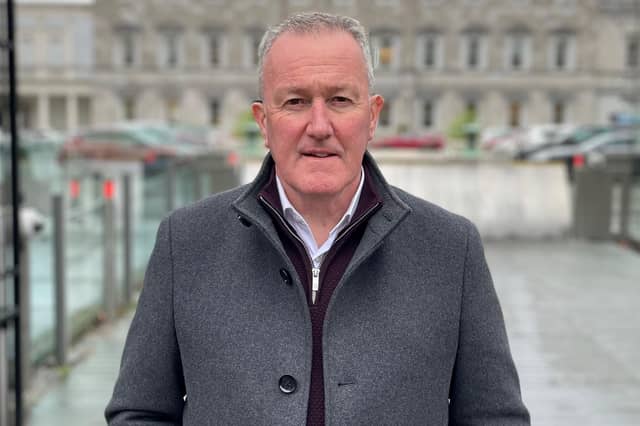
This notion has been encouraged by Conor Murphy, now a southern Irish senator, who claimed last week that the executive was “in a precarious place” and said “there is a danger that the wheels could come off the wagon”.
According to him, it will be the DUP’s fault if the assembly falls.
This argument was echoed in an Irish News article, by the South Antrim MLA and Sinn Fein’s ‘national chairman’, Declan Kearney.
The implication is that the DUP must help republicans to deliver their goals and that Sinn Fein has simply asked for reasonable things and been spurned by unionists. This analysis is shameless and laughable.
Still, Irish republicans have never struggled to find an audience for shameless and laughable claims.
This particular fit of belligerence was prompted by the latest Lucid Talk opinion poll, which suggested that Sinn Fein’s support was at a five-year low.
Its loss of popularity should not be surprising.
Now that they form the largest party at Stormont, the Shinners have fewer excuses for failing to take responsibility for the issues that face Northern Ireland. That is why they are being mocked, even by the SDLP, for blaming every problem they encounter on Westminster or the DUP.
The party has failed utterly to come up with plans that could command some form of consensus. For example, its finance minister, John O’Dowd, drafted a budget that even his own colleagues do not accept.
Sinn Fein has not faltered, though, in its speciality, which is pushing divisive schemes and making unrealistic demands. That is an area in which it will never be surpassed.
These demands and schemes become the fuel for its grievance-machine, which can be cranked up at moments of difficulty or tension. It is this process that we are witnessing at the moment.
The failure of the GAA to build Casement Park on time or on budget, for instance, is now portrayed as evidence of outrageous sectarianism by unionists.
The logic is that the organisation was entitled to receive however much money it wanted, to build a stadium to whichever lavish specifications it fancied.
The duty of unionists at the assembly was to counter-sign the cheques and worry where the cash came from later.
The idea that the DUP has treated the Irish language with unfairness is another common but transparent wheeze. This newspaper has reported how, in almost every corner of this province, Gaelic has actually been foisted on communities that have either never asked for it, or actively oppose its imposition.
Some of the issues cited by Sinn Fein do not, at first glance, seem to involve our constitutional status or identity. They do however concern whether Northern Ireland can work properly, and they affect how our society functions.
In his Irish News article, Kearney accused the DUP of blocking his party’s euphemistically titled, ‘Good Jobs Bill’.
This proposed legislation is an attempt to impose requirements on employers that business groups say would be a disaster for the economy and destroy the jobs market. It is basically a charter of trade union demands.
This fits with Sinn Fein’s populist left-wing view of the world. Perhaps more pertinently, if the legislation damaged Northern Ireland’s prosperity, or caused unemployment, then republicans would simply blame those effects on our place in the UK.
It is exactly the kind of law, in other words, that the DUP should be blocking. And it shows why power-sharing safeguards are currently so important.
Sinn Fein’s grievances may be invented and its arguments flimsy, but previous experiences will encourage it to believe that it could be rewarded for collapsing the assembly. It can also be confident that many people, both in Northern Ireland and elsewhere, would simply blame unionists.
The DUP, and other pro-Union parties in the assembly, should, nevertheless, show no weakness in response to these republican tantrums. They are not elected to deliver Sinn Fein’s objectives, or help it undermine Northern Ireland’s place in the Union.