
Owen Polley: Stormont ducks responsibility and it lacks accountability
People in Northern Ireland have been justifiably cynical about their devolved political system over the decades since it was introduced.
The assembly at Stormont was arguably never intended mainly to provide good government. Instead, it was supposed to encourage ‘peace and stability’, in the words of Lord Bew, and offer a forum through which political differences were managed.

Unfortunately our devolved institutions were also given significant powers that affected our daily lives. Their limitations were not harmless, but allowed many important aspects of our society to degenerate.
The political parties that made up our executive, rather than trying to improve how they did business, complained constantly that they needed more money. The problems we experienced were not supposedly down to their failings, but arose from historical ‘underfunding’.
That formula was followed again last week, when the health minister, Mike Nesbitt, refused to support an extra allocation of £350 million to his department. That sum amounted to 57% of the added funding from the government’s recent budget.
Despite successive reports recommending that we have fewer, better hospitals, attracting and retaining the best medical expertise, our health system remains unreformed because the executive has never had the bravery or the unity to follow through on that programme. Meanwhile, we struggle to recruit enough doctors, who receive far bigger wages elsewhere, but we pay vast sums to fill rota gaps with locums, many of whom were trained abroad and struggle to work effectively in our system.
In Northern Ireland, the NHS is now so big and inefficient that it could swallow the province’s entire yearly budget and still provide an inadequate service.
Some of the problems that we are experiencing in education are not dissimilar.
Last week, the minister, Paul Givan, welcomed an audit office report, which suggested that the schools’ estate needed significant investment and highlighted a ‘maintenance backlog’. That may have been accurate, but the report also hinted that previous work on amalgamating schools and cutting empty desks was never implemented. Since then, more tiny Irish language institutions have been opened at taxpayers’ expense, creating even more division and duplication across the various sectors.
On Wednesday, yet another obvious example of the executive’s failures resurfaced at Stormont’s infrastructure committee. Northern Ireland Water’s Chief Executive, Sara Venning, told MLAs that our waste water system is at ‘breaking point’. For decades, politicians ignored the need for significant investment, because it meant potentially introducing water charges.
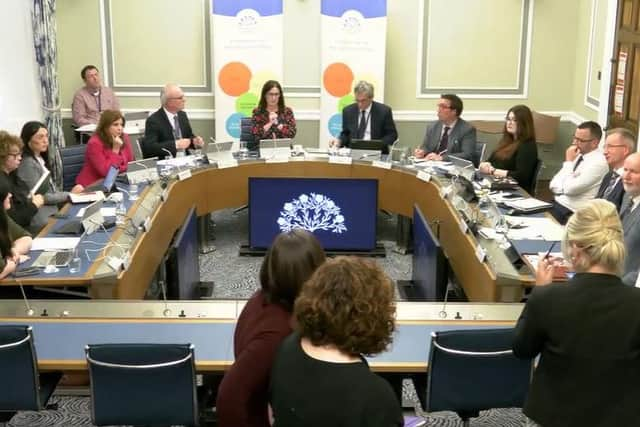
Perhaps these issues could have been better addressed if our politicians were scrutinised properly and made accountable for their conduct. Instead, the workings of government remain opaque.
Until Jim Allister’s private member’s act tightened up the rules, minutes were not taken for many meetings. Meanwhile, the Covid inquiry shed more light on a culture at Stormont of deleting communications, like WhatsApp messages, in case they proved inconvenient later on.
Last week, the executive office failed to release notes of a controversial meeting between Michelle O’Neill and Paula Bradshaw that the News Letter requested under Freedom of Information laws. The two women met before O’Neill was questioned about recent scandals by the Executive Office committee, which Bradshaw chairs.
The minutes for the meeting, extraordinarily, were written up five days after it took place. They revealed that O’Neill was provided with MLAs’ questions in advance, but the office has refused to release a more contemporaneous account of the discussion. This episode deepens the suspicion that Stormont business is conducted in an atmosphere of cosiness and lack of accountability.
To add to this picture of dysfunction, an Electoral Commission report last week criticised the co-option process, which allows parties to simply replace assembly members who stand down. The argument in favour of this mechanism is that it saves money, by preventing by-elections, and helps protect smaller parties’ presence at Stormont.
At the same time, we elect individual MLAs and charge them with working for our constituencies at the assembly.
The parties in Northern Ireland have used co-option tactically and prolifically, to shuffle their pack of talent, as if politicians were part of a football squad rather than representatives of the people. Strong candidates are fielded in multiple elections, and if an MLA becomes an MP, they are simply substituted at Stormont. The consequence is that voters are often represented in the assembly by members that they did not get the chance to elect and, in some cases, may never have heard of.
It is just another example of our system lacking transparency and failing to make decision-makers accountable directly to the public.
If we could largely ignore Stormont, a lot of this might be easier to overlook. Instead, it seems to have an increasingly direct impact on our lives. During the Covid pandemic, executive ministers were responsible for restricting our freedoms. And now, the justice minister, Naomi Long, wants to introduce hate crime laws that threaten to police what we are allowed to say and think.
Perhaps most concerningly of all, the Stormont vote on extending Irish Sea border arrangements has effectively been gerrymandered in order to keep Northern Ireland outside the UK internal market and under the authority of Brussels. Cross-community safeguards will be set aside, so that a coalition of nationalists and pro-EU fanatics can trample over our rights to play a full part in our own country.
If genuine transparency and accountability are not injected into Stormont soon, it is likely to slip further into disrepute and voters will only become more disillusioned with their local politicians.