
Owen Polley: Stormont has to start facing down trade unions' incessant demands
Why are so many politicians in Northern Ireland in thrall to public sector trade unions? It’s an important question, because this trend has prevented progress in the province, hampered the growth of our economy and exacerbated many of our most persistent problems.
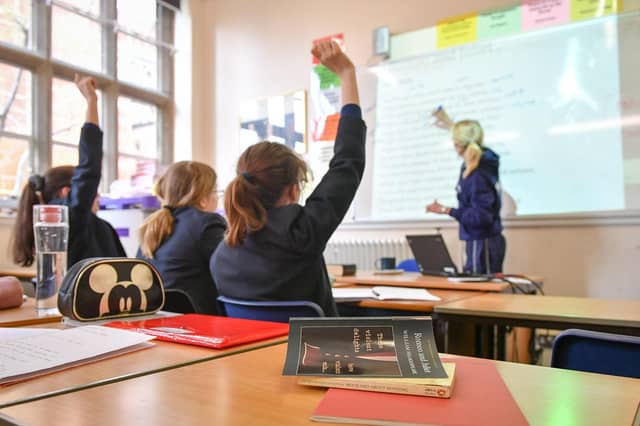

Last week, we saw another example, after the education minister sensibly suggested that teachers should be prevented from disrupting school inspections, as part of industrial action ‘short of strike’.
Members of the Stormont Executive frequently come up with ill-advised proposals, but let’s be fair to Paul Givan, this was not one of them. School inspections were always hated by teachers and some inspectors were regarded with fear and dread. However, the system was supposed to ensure education standards stayed high and identified potential problems.
In Northern Ireland, that largely worked well. We gained a reputation for good schools that produced young people with desirable skills.
Unfortunately, industrial action disrupted this safeguard, so that it almost ceased to function. According to Mr Givan, three quarters of inspections, which are carried out by the Education and Training Institute (ETI), have been affected over the last eight years.
In other words, there has frequently been no way to test schools independently, or ensure they are providing an adequate education.
As parents will know, industrial action ‘short of strike’ affected children in other ways too. In many schools, extra activities out of school hours stopped and parent-teacher meetings took place during the day, rather than in the evening, which was an inconvenience to working people.
Many of us hoped that these practices would cease, after teachers were awarded a 5.5% pay offer earlier this year.
The proposals to ensure that inspections go unhindered in the future is surely a minimum expectation, and a sensible precaution.
In Great Britain, teachers are legally bound to cooperate with inspectors and Mr Givan wants to extend that requirement to Northern Ireland. In response, the teaching union, the NASUWT, has histrionically accused the minister of threatening to criminalise teachers.
You would have thought that rival politicians, deciding that this was not a productive fight to pick, would have supported the minister or kept quiet. Instead, for many of them, the Pavlovian instinct to defend the unions kicked in.
The SDLP’s Cara Hunter waffled about teachers becoming ‘political footballs’, without broaching the subject of whether inspections were necessary.
The Ulster Unionists prevaricated with a meaningless statement about ‘conversing’ with teachers and educators. And Alliance, while it acknowledged that action short of strike damaged the education system, criticised the minister and repeated the overheated language about criminalisation.
On this occasion, the problem is not even that nationalists want to align our rules with the Republic, while unionists are reluctant to speak out and lose votes from the public sector. In the south, teachers are also required to cooperate with the inspection system.
This is not the first time that politicians have appeared unwilling to disagree with trade unions, even when their case seemed unreasonable.
Unlike their counterparts in Great Britain, for many years, drivers in Northern Ireland were unable to tax their vehicles online, because ministers worried it might cost jobs at the DVLA in Coleraine. We were stuck with an outdated and inconvenient system, because the unions insisted our public sector must remain over-large and inefficient.
As this newspaper has pointed out repeatedly, all the Stormont parties supported handsome pay awards for public sector workers, before the current government embarked on its spending spree. Nobody raised concerns about salaries and perks crowding out the private sector, or made the case that public sector pensions constituted a benefit that other workers could only dream about.
Earlier this summer, the economist Dr Esmond Birnie analysed the latest figures, and suggested that Stormont was under-investing in the future of our economy, preferring to prioritise high levels of short-term public spending instead. Our politicians were not prepared to take potentially unpopular decisions, so this imbalance continued.
In this instance, Paul Givan and the DUP deserved praise for suggesting reasonable safeguards for the education system. Unfortunately, though, unionists have often been just as inclined as nationalists to avoid difficult financial choices and even to dodge taking on overly powerful public sector unions.
These are organisations, it is important to stress, that often include in their leadership highly politicised far-left activists.
Under the Labour government, growth is struggling to keep up with spending, borrowing costs are rising dangerously and there are already suggestions that the International Monetary Fund (IMF) may have to intervene. This problem is not down, entirely, to public sector pay awards, but they certainly did not help.
Across the country, it is likely that politicians, even on the left, will have to face down the trade unions’ incessant demands. The alternative could be national bankruptcy.
This may seem like a remote concern for Stormont politicians, who are not known for taking responsibility for their own problems, never mind those of the nation. As I’ve argued before, Irish nationalists almost have an incentive to encourage bad decisions, then blame the outcome on the Westminster government, or claim that partition is the problem.
Unionists, if they are to be credible and relevant, have to be better than that. That means championing public sector reforms that should have been implemented many years ago.
It also requires a sceptical attitude to trade unions and some determination to ignore their constant attempts to prevent necessary change.