
Owen Polley: The right should be wary of Donald Trump but not at the cost of their conservative beliefs
For anyone trying to make sense of Donald Trump’s politics, it has been another confusing week.
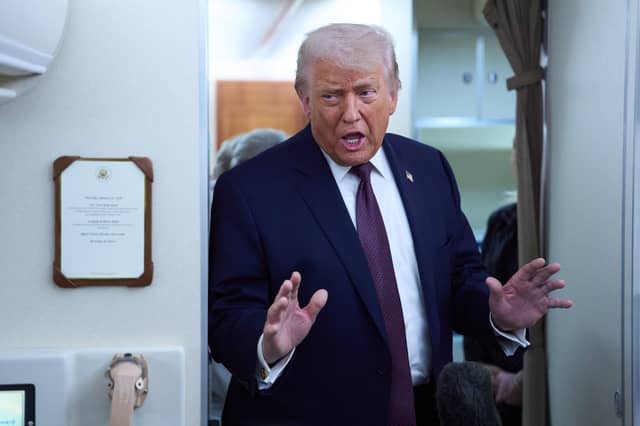

His threats to annex Greenland caused fury across Europe, before the US president claimed to have struck a deal with Nato over the territory. He unveiled a new ‘board of peace’, claiming that it would help resolve conflicts in Gaza and Ukraine.
Then Trump somehow found time to insult Britain’s armed forces, among those of other allies, by claiming they’d stayed ‘a little back’ from the front lines in Afghanistan. The UK lost nearly 500 personnel in that conflict and hundreds were seriously injured.
Many unionists in Northern Ireland, like others on the right of British politics, have a sneaking regard for the president.
They find Trump’s style brash and abrasive, but they like that he “annoys all the right people”. The White House’s tendency to comment on UK politics, particularly from a Northern Ireland perspective, was previously galling, but now the right finds its messages congenial.
The vice-president, JD Vance, for example, claimed that free speech in Britain is being suppressed, which resonates with people who see conservative views being demonised and even criminalised.
Trump has repeatedly attacked the London mayor, Sadiq Khan, who personifies everything the right despises about Labour.
And the president implies, rightly, that immigration to the UK is out of control and multiculturalism has allowed Islamic extremism to flourish.
The US’s foreign policies, admittedly, have been more divisive among right-leaning Brits.
Trump’s approach to Ukraine was never in line with prevailing British opinions on Russia under Vladimir Putin.
Then again, US special forces removed a president in Venezuela whose defenders included Sinn Fein and many on the far left.
In the Middle East, he supports Israel and brokered a peace deal of sorts. In Africa, he attacked Islamists in Nigeria in the name of persecuted Christians. And in Europe, he repeatedly chides the EU.
Trump even takes a dim view of the Republic of Ireland’s aggressive tax bolthole economy and its habit of sanctimoniously lecturing the rest of the west on foreign policy, while outsourcing the defence of its own borders to the UK and Nato.
There was a definite sense that the right in Britain had a useful ally in Trump. This seems finally to be fading thanks to the president’s Greenland gambit and his outrageous comments about our troops.
The Tory peer, Daniel Hannan, summed up the mood last week when he predicted on social media that “Trump would harm conservatives everywhere,” sooner or later.
In Britain, Trump’s rhetoric on Greenland happened to coincide with high-profile former Conservative ministers joining Reform UK.
Nigel Farage is the British politician most closely linked to the US president. His party seems unstoppable currently, but it could become tainted by his association with Trump.
Centrist Conservatives, like former prime minister Theresa May and her ex justice secretary, David Gauke, used the proximity of these events to urge the Tory leader Kemi Badenoch to turn away from the ‘populist right’.
They are using the word populist as a slur, implying that their view of politics was more serious than the current Conservative direction, but this is deeply misleading.
The mainstream right had only just started to confront deep problems in our society that previously it largely ignored. It will certainly not recover by again neglecting these issues.
Trump’s style is unedifying and his policies are often questionable. At the same time, some of the themes that he talks about are genuinely important.
His critique of some of the things that are wrong with Britain is also undoubtedly accurate.
Last week, at the Davos summit, he criticised the UK for failing to exploit its North Sea oil reserves, and instead importing energy at great cost. This is self-evidently a damaging policy that does nothing to protect the environment and punishes British people for no benefit.
The continued failure to stem immigration is indeed a threat to the UK’s way of life, as well as a source of fresh problems with Islamic terrorism. Indeed, it is the people who fail to acknowledge this who we should now regard as unserious, despite their attempts to imply that migration is the preoccupation of ‘populists’.
So-called centrists also cast the idea that Britain’s institutions need radical reform as unconservative. In fact, more far-thinking conservatives are simply calling for the civil service and other parts of the public sector to be restored, undoing damage caused by decades of ‘progressive’ theories, centred on diversity, multiculturalism and an ever-expanding interpretation of human rights.
Then there is the spiralling cost of the welfare system, which has been again allowed to get out of control. The idea that it is compassionate to allow benefits costs to soar, or that it is ‘populist’ to suggest that there is a problem, is not credible.
The tendency of British people, across the political spectrum, to identify with particular US politicians or parties has always been bizarre. The president is a glaring example of how different politics is across the Atlantic.
Donald Trump may have come to prominence in the US for some of the same reasons that the right in the UK is starting to get more assertive. That does not mean that unionists or conservatives should ape his style or example.
But they certainly should not abandon more challenging policies on immigration and other topics, because of criticism aimed at Trump.