
Owen Polley: Unionist populism on public money helps nationalists to damage Northern Ireland's place in the UK
Northern Ireland’s economic strategy is based on delivering ‘jam today’ rather than investing in the future, according to the University of Ulster economist, Dr Esmond Birnie.
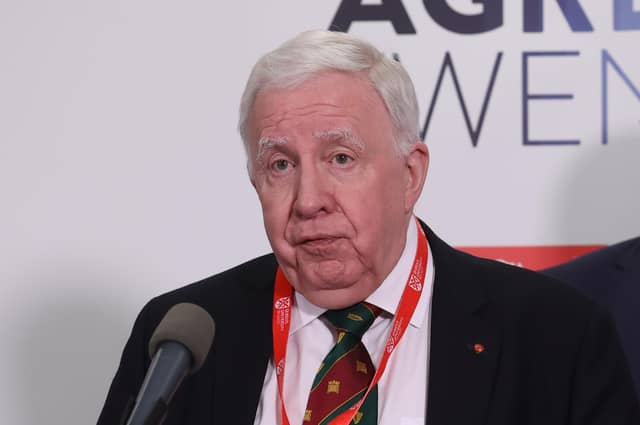

He was commenting on new data on the ‘Structure of the NI Economy’, from the Northern Ireland Statistics and Research Agency (Nisra). And his diagnosis was timely for two reasons.
Firstly, it exposed the habit of short-term thinking at Stormont, where ministers generally prefer to make popular announcements rather than tackle long-standing problems. Secondly, it suggested supporters of the Irish Sea border misinterpreted statistics when they implied that our economy was flourishing under the Windsor Framework.
In Northern Ireland, Dr Birnie noted, the amount of money invested in things like infrastructure or machinery, which are needed to secure prosperity in the future, is lower per head than in the rest of the UK. To keep our economy growing, we rely instead on high levels of short-term spending in the public sector, which is bigger than in the rest of the country.
If you wanted an example, you could point to the state of our health service.
The executive often has to come up with emergency funding to cut waiting lists, hire expensive locum doctors or manage other crises. However, the more important task of reforming the health system so that it becomes sustainable (and doesn’t keep having to be bailed out) has been neglected by successive ministers.
On a similar theme, Stormont has repeatedly refused to introduce water rates. In the meantime, our water and sewerage system is constantly in crisis, according to the people in charge of maintaining it. Now, it is so stretched that it hampers our efforts to attract new businesses and build houses. There are also suggestions that it contributed to the poisoning of Lough Neagh.
When Northern Ireland needs big, complicated building projects, for roads and other infrastructure, those tend to be neglected too. Partly, that’s because our politicians cannot agree where the cash should be spent. It is also because it would take too long for people to see the benefits. Ministers prefer to use money to provide an immediate sugar rush for our economy.
What, if anything, does any of this have to do with the Windsor Framework?
Well, a similar kind of short-termism has been used to argue that we are doing well under the post-Brexit set-up.
The Irish Sea border is particularly hard on manufacturers, which nearly always have to bring supplies into Northern Ireland from Great Britain through the red lane, with full customs formalities and extra costs. This is important, because making things out of raw materials or parts is one of the most productive endeavours for any economy.
At the turn of the year, Stormont voted to extend the sea border for at least four more years. Although every unionist MLA voted against this motion, their objections were overridden, because, on a one-off basis, power-sharing safeguards were set aside.
To quell the anger generated by this extraordinary piece of gerrymandering and provide an alternative focus for pro-Union parties, the government triggered an ‘independent’ review of the framework. This six-month exercise, conducted by Labour peer and former secretary of state, Lord Murphy, closed on Saturday.
You could be cynical about its worth, and the final report is unlikely to be candid, but it was a chance for businesses and politicians to air their arguments.
In a detailed submission by the TUV, for example, the party quoted Ashley Piggott, the CEO of AJ Power, a leading diesel generator company from Portadown. The businessman told GB News that, “in all honesty in seven years time I think there will be little to no manufacturing in Northern Ireland”.
The TUV’s paper argued that the true impact of the framework was disguised by Westminster focusing on the economic success of the services industry. The document pointed out that, “the Windsor Framework does not pertain to services but goods” and this sector was booming “precisely because it is not subject to the Irish Sea border”.
That distinction is not generally made when the statistics on economic activity and growth are published. Equally, there is usually very little analysis of how much wealth is generated by the private sector and how much is maintained through keeping government spending so high.
The UUP MLA, Steve Aiken, has argued repeatedly that the assembly committee set-up to scrutinise the framework lacks any curiosity about its effects. With a few exceptions, this desire not to know is replicated across Stormont and Westminster. Even among some unionists, the attitude is that it is better not to look at the sea border too closely.
They should be aware, though, that nationalists will not hesitate to claim that any economic problems we experience come from Northern Ireland being part of the UK. It will not matter if the issues have blatantly arisen from the framework or that, previously, separatists said the sea border was a ‘unique advantage’.
The problem will be similar if short-term thinking means we are less prosperous in the future. There is an incentive for nationalists to make bad, populist decisions, the outcome of which they can blame on Westminster.
It may not be particularly fair, but the onus is on unionists to be more responsible, far-sighted and honest with the public, when they talk about the economy. When they make populist arguments, they damage the Union, and people’s prosperity.