
Owen Polley: Unionists have reason to be wary of Farage and Reform
The insurgent party, Reform UK, is thinking about organising in Northern Ireland. As the News Letter reported last week, Nigel Farage’s latest vehicle is understood to have approached local members, to gauge whether it is worthwhile setting up local branches.
At the last general election, Reform campaigned in Northern Ireland on a joint platform with the TUV.
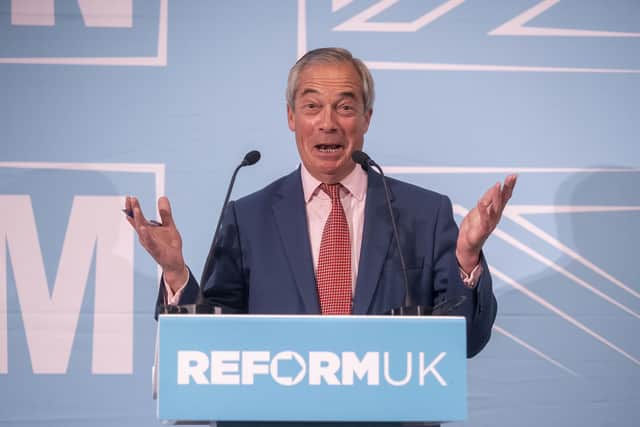

This alliance suffered when Mr Farage became leader. He openly supported two DUP candidates competing against the TUV, including Ian Paisley, who was eventually defeated by Jim Allister in North Antrim.
The two parties now have an uncertain relationship. Reform supported Mr Allister’s proposals for replacing the Windsor Framework with a system of ‘mutual enforcement’.
Equally, though, the TUV leader has maintained distance between his party and Reform at Westminster. There is mutual wariness and some suspicion of Mr Farage. He is a talented campaigner, with a knack for articulating the public’s frustrations and fears, but he’s said some troubling things about Northern Ireland.
Suspicions about Farage are not confined to unionists.
On the BBC’s ‘The View’ programme, the former taoiseach, Leo Varadkar, claimed that demands for a border poll, and Northern Ireland’s annexation by the Republic, would take ‘centre stage’ if Mr Farage were to become prime minister.
Those comments were as predictable as they were boring.
As the campaign for an all-Ireland state continues to stagnate, Irish separatist activists and their media allies must search for ever more ingenious excuses to bring up this hackneyed topic.
Since Varadkar left office, he’s remained in the public eye only by calling for this province’s destruction, and its absorption by the Irish Republic. It’s an extraordinary way for somebody who once posed as an important world leader to behave, particularly to a supposedly friendly neighbouring country.
According to Varadkar, every political development makes an all-Ireland state more likely.
He supported this specific argument by claiming that Reform-led councils are “preventing people from flying pride or progress flags … I don’t think most people in Northern Ireland would like that”.
The progress flag, you may be blissfully unaware, contains symbols that represent support for the demands of the transgender lobby. The idea that a substantial cohort of voters might change their constitutional preference because they want public institutions to display these extremist emblems is almost laughable.
Which is not to say that Farage is not controversial or divisive, because he clearly is. That is part of his attraction.
For some time, Reform has topped national opinion polls, suggesting that, if an election were held right now, it would have a realistic chance of forming the next government.
The notion that its appeal is confined to England has been damaged by consistently strong polling in Scotland, and an impressive performance at the Hamilton by-election.
The sentiments that Reform taps into – concerns about immigration, feelings of being ignored, disgruntlement with ‘progressive’ ideas and disillusionment with established political parties – are common across the whole UK.
This includes Northern Ireland, even though our political landscape is even more singular than Scotland.
At the same time, many people here already believe that too many parties are competing for pro-Union votes, particularly in Westminster elections.
Most elections in Northern Ireland are not first past the post contests. In the rest of the UK, Reform is good at reaching voters who are disillusioned or angry with the other parties. They turn to Farage, in effect, because he represents a vote for ‘none of the above’.
There are lots of people with similar attitudes in Northern Ireland and many of them regard themselves as unionists, or at least feel an allegiance to the UK. It is possible that Reform could give a certain type of voter a reason to return to polling booths.
If they could be persuaded to transfer to other pro-Union candidates, it may even eventually mean more unionist representatives in local councils or at Stormont.
In theory, every unionist should welcome national parties getting involved in Northern Ireland politics, as a potential step towards integration with the UK mainstream.
The theory, though, runs up against some unpleasant facts. Farage praised Mary-Lou McDonald, claimed a ‘united Ireland’ would happen ‘one day’ and let down his party’s allies in the TUV.
It is not remotely clear, either, whether Reform UK’s nationwide success will last until the next election, or whether voters will eventually recoil from the prospect of Farage as PM.
The party has suffered a number of high-profile internal disagreements already. Its former co-leader, Ben Habib, warned voters in Northern Ireland last week not to trust Reform on the Union. He resigned after a row with Farage, claiming that the party’s organisation was not democratic.
Recently, the party chairman, Zia Yusuf, resigned, only to return two days later in a different role. The reasons were not clear, but he seemed to disagree with a question in parliament about banning the burka, from the new Reform MP, Sarah Pochin.
It is difficult to envisage Reform gaining traction in Northern Ireland’s crowded electoral marketplace, even if it is not impossible. The Conservatives came closest to bringing national politics here successfully, but that was through a pact with the UUP.
At least, Reform’s potential arrival should warn the existing unionist parties that it is risky to ignore voters’ disaffection with their current representatives. Or to treat Northern Ireland as a ‘place apart’, rather than trying to integrate it more thoroughly with the rest of the UK.