
Owen Polley: Unionists unfortunately have the same, entitled 'place apart' attitude as nationalists to demanding more cash for Northern Ireland
After a number of tetchy exchanges at Stormont, some commentators recently alleged that unionists were stoking ‘culture wars’.

The implication was that pro-Union representatives, particularly in the DUP, were deliberately picking unimportant fights, to distract from their failings on more serious issues. In a previous column, I argued this was nonsense.
The DUP and the UUP were in fact forced to stiffen their positions after repeated aggressions from Sinn Fein, but also from the SDLP and Alliance.
For example, there are the ceaseless attempts to force the Irish language into public spaces, even where it is clearly not wanted; the idea that it is sectarian to expect the GAA to receive only a fair allocation of taxpayers’ money to build Casement Park; the refusal to accept the Supreme Court’s judgment that gender means sex for the purposes of equality legislation; the insistence on trying to pursue anti-Israel policies, which should properly be none of the executive’s business, and prevent our companies from selling to the Israeli market.
The pro-Union parties had to at least give the impression of resisting these Irish republican-led offensives. If they had not, unionist voters would have been justifiably angry, and accused them of weakness.
In fact, the parties have often not been nearly firm enough in emphasising their differences with the ‘progressive’ consensus at Stormont and insisting that we should be treated like the rest of the UK. That is the case, particularly, where funding is concerned.
Rather than take a responsible attitude to Stormont’s finances and to the economic situation across Britain, unionists are often just as inclined as nationalists to demand ever more public money from the Treasury, while blaming their own wastefulness on Westminster.
For nationalists, who want to destroy Northern Ireland and the Union, this approach makes sense. For those who claim to cherish our place in the UK, it suggests venality, a sense of entitlement and a worrying strand of exceptionalism.
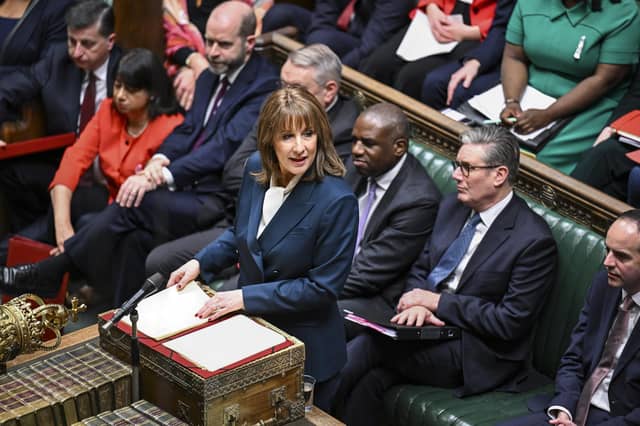
Which brings us to the Autumn budget unveiled last week by the Chancellor, Rachel Reeves.
There were enormous problems with her statement, which was rightly savaged by opponents in the House of Commons.
Labour’s strategy is effectively to raise taxes, punishing those who work and save, in order to spend a substantial proportion of this money on increasing benefits. In fact, it seems the chancellor exaggerated the scale of the fiscal 'black hole' facing the government, specifically to tax and spend more.
In the House of Commons, the Tory leader, Kemi Badenoch, described Reeves’ statement as a ‘budget for Benefits Street’.
To be fair, the DUP and the UUP also implied that the government’s preference for high taxes was misguided.
The DUP’s Sammy Wilson, for example, focused on the chancellor’s decision to freeze the threshold at which people start paying tax – which amounts to a significant tax rise, particularly when prices are continuing to go up.
He also slammed the cost of ‘net zero’ environmental targets.
What was missing from his party’s analysis, and the responses from other parties in Northern Ireland, was an acknowledgement that both Stormont and Westminster should restrict spending and limit the expansion of the state.
The UUP’s Robin Swann was explicit about demanding more cash, asserting that the extra £370 million the government claimed it would provide for Stormont won’t “touch the sides”. This was similar to an argument made by Gavin Robinson, before the budget was delivered. He implied that Labour needed to splurge money here or it would be failing to ‘support’ Northern Ireland.
After Reeves’ statement, indeed, the Communities Minister, Gordon Lyons, complained that government provision came “nowhere close” to meeting our demands and needs.
This government is failing Northern Ireland in countless ways. In the budget specifically, it announced an almost insulting scheme aimed at helping companies navigate the Windsor Framework, which will do very little to offset the damage caused by the Irish Sea border.
At the same time, it cannot be expected to bail out Stormont, because our ministers repeatedly spend more money than they have.
The executive’s financial problems are not caused mainly by ‘underfunding’. Far more important are its repeated failures to reform the public sector or take unpopular, but necessary decisions, like closing acute hospitals or introducing water rates.
Stormont is set to spend £400 million more this year than was provided through the block grant from Westminster.
Yet, just weeks ago, it appointed an activist Irish language commissioner and a commissioner for Ulster-Scots and the British identity. These offices will be funded by the taxpayer and the commissioners are already demanding that their powers be granted soon, so they can start racking up costs.
These are just two of Northern Ireland’s completely unnecessary publicly funded jobs. We have an ever-growing industry of third sector organisations, community groups, arms-length bodies, ombudsmen and commissions, all feeding hungrily on public money.
That is something unionist parties, whose leaders presumably want Northern Ireland to be a productive part of the UK, could target for criticism and cuts. It might even mean, in theory, that there would be more money to spend on health and education.
Voters would certainly appreciate an honest, realistic approach to spending from their representatives, rather than waste and whinging. Unfortunately, from unionists, we too often have exactly the same entitled, ‘place apart’ attitude to cash that we get from nationalists who want to undermine the Union.