
Owen Polley: Whether or not unionism is united, it still needs to do better
It’s hard to believe, but it is now almost a year since the DUP ended months of speculation and struck its ‘Safeguarding the Union’ deal with the Conservative government.
In January 2024, during a meeting at Larchfield Estate near Lisburn, the party voted to support its then leader Sir Jeffrey Donaldson and return to Stormont.
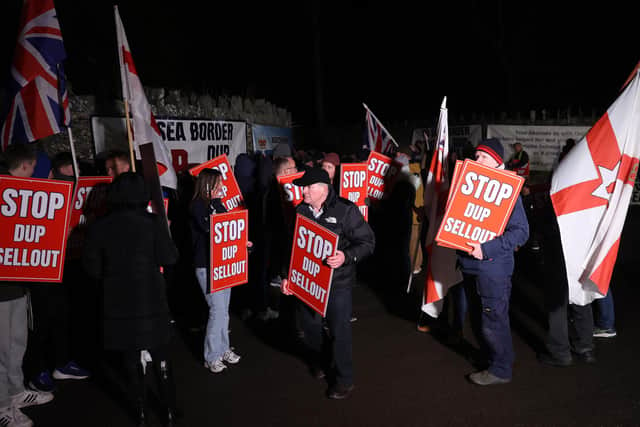

That event is perhaps now best remembered for the anger and confusion caused by Jamie Bryson, the anti-sea border campaigner, who live-streamed proceedings on Twitter even as DUP officials tried to stem the leak. It subsequently emerged that a party member wore a secret ‘wire’, broadcasting the meeting directly to Mr Bryson, as part of a plot to ‘torpedo’ Donaldson’s plans.
At the time, of course, the DUP claimed that its deal had removed the Irish Sea border and stopped an automatic pipeline of EU law. This assertion was rubbished by its opponents, before being dropped and forgotten by the party itself.
The DUP’s current leader, Gavin Robinson, still insists that ‘Safeguarding the Union’ made ‘progress’ toward dealing with Windsor Framework issues. Now, even that interpretation is difficult to support, as the sea border becomes harder and businesses suffer its effects.
The simple truth is that the DUP needed an agreement with the government to justify its policies and boast about its achievements. But it returned to Stormont for reasons that had little to do with the contents of ‘Safeguarding the Union’.
Most importantly, its leaders decided that boycotting power-sharing had become more likely to damage the party than bring it success. They explained this point slightly differently in public, by expressing concern for the Union, but the thrust was the same.
On a similar theme, they concluded that their efforts to get rid of the framework were not getting anywhere. If they continued to concentrate only on that aim, they would give the impression they were losing.
These two strands of reasoning were combined in Donaldson’s claim that he wanted to ‘make Northern Ireland work’.
His argument was that voters were becoming frustrated about a lack of progress on everyday issues. If the DUP’s boycott continued, people might decide the Union (or the DUP) was not working for this part of the UK, and explore the possibility of an all-Ireland state.
This was not a new theory. The Ulster Unionist Party, under Doug Beattie, had voiced it ever since Paul Givan resigned as first minister and collapsed the executive.
Effectively, the parties took different routes, but arrived at the same place.
It wasn’t surprising then, that this newspaper reported last week that the DUP and the UUP may be exploring new ways of coming together.
The two parties’ outlooks and broad principles have become increasingly difficult to distinguish. They use similar language, like ‘making Northern Ireland work’, and express similar sentiments.
The idea of ‘unionist unity’ is consistently popular with grassroots unionists. It is often portrayed as a quick way to arrest unionism’s decline. That is a simplistic conclusion, but you can see the attraction of combining the two parties’ votes.
The last serious talks about unity reportedly took place in 2022, following that year’s bruising assembly election.
Sinn Fein became the biggest party in that poll and would eventually nominate Michelle O’Neill as first minister. But, had the DUP and UUP formed a joint ticket, in theory they might have outpolled Sinn Fein by 30,000 votes and beaten its total of MLAs comfortably.
In 2010, the Conservatives’ shadow secretary of state, Owen Paterson, chaired talks about unionists coming together, at Hatfield House in Hertfordshire. Although the Tories were confident of beating Labour in the election that year, they were worried that they might struggle to form a government if there was a hung parliament.
David Cameron’s party forged an electoral pact with the UUP, but some Conservatives and unionists were interested in a broader coalition. Those talks were not fruitful, and the rival unionist parties attacked each other bitterly in the subsequent election, which did result in a hung parliament and the Tory/Lib Dem coalition.
In 2010, the talks were at least aimed at involving Northern Ireland more thoroughly in mainstream national politics. There is now no ‘big idea’ behind uniting the parties, other than boosting their prospects at Stormont.
Unfortunately, if the DUP and the UUP sound the same these days, it is not because they’re saying anything particularly interesting or compelling.
They’re both inclined to blame Northern Ireland’s problems on a lack of generosity from Westminster, rather than the executive’s repeated failures to reform public services. Their policies on the Irish Sea border are both confused. At times they seem to be alive to the chaos it will cause; at others they cast it almost as an opportunity.
Most damning of all, neither seems particularly driven by a desire to put Northern Ireland at the heart of the UK’s political, commercial and cultural life.
If the two parties started again properly in a new organisation, perhaps they could implement more coherent policies and tell voters a more convincing story. The idea of a larger unionist party is certainly appealing. Michelle O’Neill’s conduct has shown that unionists’ apprehensions about a Sinn Fein first minister were well-founded.
Northern Ireland problems, though, will not be solved by simply taking back that post.
It’s not at all clear whether unionism needs to be united or just better at what it does.