
Paul Clark: Why I’ve always been fascinated by the Great War – particularly the Somme
UTV Live at 6 presenter Paul Clark explains his passion for the First World War – and his family ties to the Somme.
They called it “The Great War to end all wars”. Actually, there was nothing great about it. The name reflected its sheer scale, unprecedented global reach, and the catastrophic loss of life. They were unmatched in history, up to that time.

Without the events of 1914-18, there would not have been communism in Russia, fascism in Germany in the 1930s, and The Second World War itself.
That, in turn, led to The Cold War, Korea, the Cuban Missile Crisis, Vietnam, and the Middle East.

Much closer to home, it raises the question about the political division of Ireland.
To some, the First World War must appear to be ancient history. But, over a hundred years after it ended, we are still living with the echoes of that time.
The “Great War” has always fascinated me. My grand uncle, Donald Clark, was a soldier in the 14th Battalion Royal Irish Rifles. He was a member of the YCV. He fought at the Somme, in July 1916. He survived! He didn’t die until 1980 – living long enough to know that it was not “The Great War to end all wars”.
My interest in the period is two-fold. History has always fascinated me. The First World War brought that history into sharp focus – particularly on the island of Ireland.
The Third Home Rule Act had just become law in 1914. It permitted Irish self-government within the British Empire, rather than full independence or total separation from the UK. It sought to establish a devolved parliament in Dublin to manage local domestic affairs, while Westminster retained overall control.
This prospect alarmed unionists! An Irish Parliament with a Catholic nationalist majority frightened Protestants in Ulster. Led by Sir Edward Carson, unionists formed the Ulster Volunteer Force to resist Home Rule by force.
However, escalating tensions in Europe, and the outbreak of war in 1914, led to Home Rule being put on hold.
This resulted in many nationalists and unionists fighting for different political reasons. But they could find common cause in fighting for the British.
Unionists fought to demonstrate their loyalty to the Crown and secure Ulster's place in the UK. Nationalists fought to secure the promised Home Rule.
While both groups enlisted in the British Army, they did so to achieve opposing political goals at home. My grand uncle, Donald, was a Belfast Protestant, and a unionist. His brother, my grandfather, signed the Ulster Covenant.
However, German bullets did not distinguish between Catholic and Protestant; unionist or nationalist. The war exacted a high price in all human life.
Millions died, and the vast majority of the British were buried where they fell. Too many do not have a grave, or a name.
The Imperial War Graves Commission was established in 1917. It became The Commonwealth War Graves Commission in 1960, to better reflect the Commonwealth of Nations.
Originally, there had been an expectation that people would only visit these cemeteries until that generation became too frail to travel, or died.
But the world has changed out of all recognition. Comparatively easy travel – and a growing interest from future generations – now means that more people than ever are visiting these cemeteries and memorials.
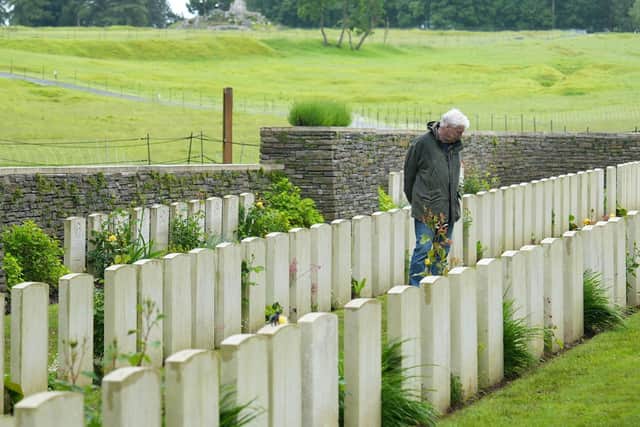
But going to see the war graves is not dark tourism. It is a pilgrimage. Millions of people travel annually to these sites and cemeteries to pay respects, explore family history, and learn about the sacrifices made during war.
In my job, I have been to the battlefields many times. I never tire of going to these “theatres of war”.
I have just returned from a journey to northern France. This time I was accompanied by colleagues from UTV. Our interest is fuelled by more than our jobs. So, accompanied by our head of security, Colin Barbour, and two cameramen, John Vennard and Alan Deans, we spent a week walking-the-walk, with surprising results.
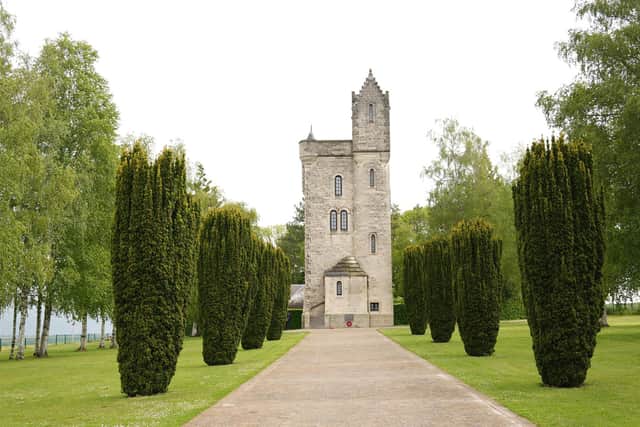
Yes, our main interest was the Battle of the Somme. July 1, 1916 remains the bloodiest day in the history of the British Army. Our go-to locations included the huge Memorial to the Missing at Thiepval, and the nearby Ulster Tower. That was one of the first monuments to be erected on the Western Front.
Our journey took us to the German War Cemetery at Fricourt. I have always felt it important to pay respects at all cemeteries. The poppy wreaths tell their own story… we weren’t the only visitors from the UK.
We also travelled to Flanders, in Belgium. At the Menin Gate in Ieper/Ypres there is a solemn act of remembrance every evening at 8pm, when The Last Post is sounded.
We found ourselves in the company of Greengairs Thistle Flute Band, from Scotland. They even dressed for the occasion, wearing the traditional Tommy uniform, from the period.
Alan Deans knew he had a relation buried in France, who’d died in the First World War. Albert Grainger worshipped at Agnes Street Presbyterian Church, off the Shankill Road. Interestingly, he joined the Black Watch, rather than an Irish regiment. He died in October 1916, later in the Somme campaign; and is buried at Dernancourt Communal Cemetery Extension, near the town of Albert. He was 19!
The Pipers' Memorial in the village of Longueval, also on the Somme, is a striking, all-white monument, dedicated to the thousands of pipers across all Allied units and nationalities who served and fell during the Great War. Many of them bravely played troops over the top, despite shelling and gunfire.
While paying our respects, we were approached by an Englishman who informed us of a burial taking place in a nearby Commonwealth War Cemetery.
Squadron Leader George Fidler flew a Hurricane and was shot down on May 19, 1940, as the Allies were retreating towards Dunkirk. He had no known grave until now. His remains were discovered during an excavation. He was buried with full military honours, at London Cemetery.
Forced back by relentless pressure, the Allied forces retreated into a shrinking pocket around Dunkirk. John Vennard had a great uncle who served in The Irish Guards. Thomas Henry Mawhinney survived, but many of his colleagues did not. He was awarded the Military Medal.
His war ended in North Africa in 1943. He’s buried in La Reunion War Cemetery in Algeria.
But, finally, I return to the main reason for our journey – The Somme. On a previous visit to the Thiepval Memorial I came across a message on a poppy wreath which read – “…and don’t forget the animals.”
Horses and mules were essential for moving troops, hauling heavy artillery, and bringing up food and ammunition through the mud. In the days before mass mechanisation, they were the army’s logistical backbone.
Millions died or disappeared during The Great War. They knew danger; they knew fear. The animals could tell when a shell was coming close and if, when halted, the horses heard the whine of an approaching salvo, they would tremble and sidle closer to their drivers, burying their muzzles into the men’s chests.
We honour their memory, with this deeply moving epitaph… They had no choice!!!
l Paul Clark is the main presenter of UTV Live at 6. He has visited The Somme Battlefield many times, and is passionate about the period
l This article also appears on the UTV website, www.itv.com/utv