
Paul McElhinney: Alistair Cooke – a quality journalist of a bygone era who set the highest standards for his work
In an age overwhelmed by social media, sound bites, fake news and short attention spans, it is worth harking back to a time which revered a different type of reporting and commentary and a different type of journalist.
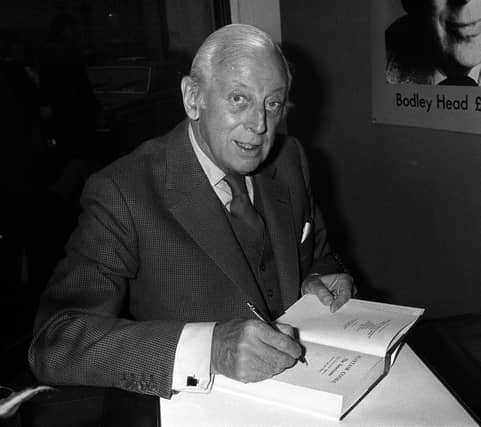

Alistair Cooke, the renowned BBC radio and TV commentator and author was not alone in espousing and demonstrating the old traditional values of truth, accuracy, balance and civility in debate, but he was perhaps, their best exponent.
From the late 1940s until the 2000s, BBC Radio transmitted his weekly broadcast, ‘Letter from America’ focusing on interesting current events in the United States for a mainly British audience.
For those of us of a certain age, it was a regular part of our media education and a marvellous opening up of that Pandora’s Box of delights that was the United States.
Its heyday was the post-WW2 era as the ‘special relationship’ between the US and the UK was developing and as the reach of electronic media was expanding.
Cooke’s broadcasts, delivered with avuncular and smooth panache, helped cement that relationship and to inspire generations of listeners. It was originally intended as a 13-week series. It lasted for 50 years.
Cooke was born in Salford in 1908 and the family moved to Blackpool in 1917 where Cooke spent the rest of his youth.
A bright young man, he attended Blackpool Grammar School and Jesus College, Cambridge, where he established a reputation as a writer for college magazines and a member of the college acting fraternity.
Cooke also had an association with Northern Ireland. His mother came from Armoy in the Glens of Antrim, but on moving to work in England, married Samuel Cooke, a Methodist minister and with him, established a home in the north-west of England.
Alistair Cooke, himself, never visited Northern Ireland but did write several pieces on the unfolding tragedy of the Troubles. He wrote a moving piece for the ‘Guardian’ after the assassination of Lord Mountbatten and his other pieces showed a broadmindedness and sense of context for Ulster’s long history.
His career took him to the heights of power and influence in Britain and the United States. With the exception of several journalistic forays into the politics of Ulster, his interest and attention were elsewhere.
After Cambridge, in 1932 Cooke was awarded a scholarship by the Commonwealth Fund Fellowship which allowed him to study at both Harvard and Yale universities. It was there that he developed his great interest in and attachment to the US.
Returning for a few years to the UK, he emigrated to the US in 1937, becoming a citizen in 1941.
Most people, when remembering Alistair Cooke, will allude to his mid- Atlantic voice and persona, apt for someone relaying impressions of America to a largely British audience. He had the perfect voice for radio and the right appearance for television. He ably demonstrated the latter in his BBC TV series ‘America’ in the 1980s.
Most will recall Cooke for his ‘Letter from America’ radio series, but he had previously worked as a journalist for the ‘Guardian’, then the ‘Manchester Guardian’, the proud and highly regarded journal of the liberal, mercantile north-west of England, Cooke’s own hinterland.
Cooke’s career brought him into contact with many famous and interesting people. He crystallized that list down to six persons which became a published book entitled ‘Six Great Men’. The six were:
Charlie Chaplin, Edward VIII, Humphrey Bogart, HL Mencken, Adlai Stevenson and Bertrand Russell. Many might query the validity of the list now, but he had met all of them and each had qualities which Cooke saw as ‘great’.
Cooke was also a keen golfer. He revered the great American golfer Bobby Jones whom he met and wrote about. Jones was the Tiger Woods or Jack Nicklaus of his era, dominating world golf in the 1930s.
Cooke also became a close friend of Nicklaus, someone who, like Cooke, straddled the US/UK divide in the second half of the 20th century, by great wins in the Majors in both countries. A useful golfer himself, he was able to detect talent where he saw it and wrote intelligently about the sport.
Always near the centre of political news, he was widely commended for his coverage of the assassination of John F Kennedy in 1963. He was also present at the hotel in Los Angeles when Robert Kennedy was assassinated in 1968 - a searing experience he transmitted evocatively in the media.
Cooke married twice with two children from his first marriage and two stepchildren from his second. He died at the age of 95 in 2004, having just peeked into the 21st century. His death was marked by a strange grave-robbing incident in which his bones were stolen from his grave by a New York gang and sold for transplant - a shocking denouement to a successful life.
Cooke had witnessed the advent of the internet and the beginnings of the digital age, but the dubious benefits of social media age eluded him.
He was without doubt, a throwback to an earlier, less complex age but someone who set the highest standards for his work. In so doing, he won a wide, loyal and discerning audience. He was, for many, a ‘window on the world’. Many might now follow his example.
l Paul McElhinney is a full-time writer living in Wexford. He was an official in the Department of the Taoiseach in the 1980s and a corporate executive with an international oil and gas company in London and Washington DC in the 1990s. He has also acted as a consultant and has lectured at third level. He has had published a biography of Sir George Beamish, ‘The Lion of the RAF’, and his main interests are in politics, history, sport and culture.