
Paul McElhinney: Paul McElhinney: Bill McLaren – a towering icon in the world of rugby and we were fortunate to have had someone of his calibre
In times of war and international uncertainty, a look back at the comforting certainties of the past is often a helpful antidote. The world of sport provides many examples of individuals who delivered that ‘feelgood factor.’
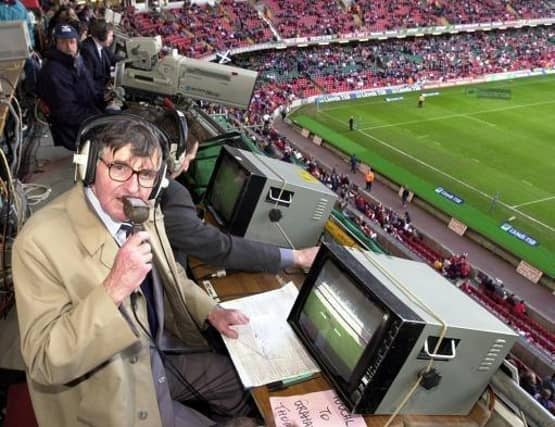

It was in these early months of the year during the height of the international rugby season that he was in his pomp. With his distinctive Scottish Borders burr and huge love and respect for the game, Bill McLaren was the ‘voice of rugby’ for generations of enthusiasts as the lead BBC commentator during the Six (and Five) Nations tournament.
So etched was he in the public mind that many react with surprise to hear that he passed away as far back as 2010. He also had the ‘voice for rugby’, starting his career as a radio commentator for the BBC in the early 1950s before eventually moving to television in the 1960s as that medium began to dominate.
The BBC was blessed with good sports commentators. Golf had Peter Allis, cricket had John Arlott, motor racing had Murray Walker, tennis had Dan Maskell and rugby had Bill McLaren.
His career spanned from 1952 to 2002, a half century that witnessed huge changes in the game: the introduction of professionalism, the banning and unbanning of South African teams, the Five becoming the Six Nations and the huge expansion of the game to new countries.
Serving with the Royal Artillery in Italy and North Africa in the Second World War and not long out of school, he witnessed the ravages at the Battle of Monte Cassino. After the War, he returned home to Hawick.
A rugby player himself, Bill was a member of Hawick RFC, when he was selected as a flanker for the final Scottish trial in 1947 at the age of 24. Contracting TB at the time (which nearly killed him), he was to miss out on his ambition to play for Scotland.
A rider to this story is that he was chosen as a guinea pig in hospital for a trial of the new drug, streptomycin, which saved his life. While in hospital, he proposed to his beloved Bette with whom he had a very happy marriage and family until his death in 2010 at age 86.
After restoring his health, he became a teacher of PE and embarked on local sports journalism which was eventually to open up so many doors.
Bill was known for his quaint and understated witticisms. Players were often upbraided on air for engaging in a ‘bit of argy bargy’ and how ‘they’ll be celebrating in the valleys’ after a Welsh win.
These were always delivered with a hint of irony and a twinkle in his eye. He was also famed for his lack of bias which won him many friends and admirers outside his own bailiwick.
Although he continued to commentate during the professional rugby era (post-1995), he was symbolic of the values of the amateur era when rugby was more of a sport and less of a business.
He had a strong audience in all the home nations and he gained a worldwide reputation for his commentaries outside Britain and Ireland.
Even with such an exalted reputation, he never lost touch with his roots, remaining a proud Hawick man all his life, coaching club teams over the years. Indeed, his first job in journalism was with the ‘Hawick Express’ from which he was noticed and taken up by the BBC – the rest is history.
Hawick alone has provided many great Scottish internationals including: Jim Renwick, Alan Cranston, Colin Deans, Alan Tomes, Tony Stanger, Darcy Graham, Rory Sutherland and Stuart Hogg including nine Lions. Several were coached by McLaren.
Despite never becoming an international player himself, he was the first non-international to have been selected to the International Rugby Hall of Fame.
He could not contain his delight when his son-in-law, Alan Lawson, and later his two grandsons, Rory Lawson and Jim Thompson, were capped for Scotland. Not short of official recognition himself, he was awarded an OBE, an MBE and a CBE.
In his declining years, he suffered from Alzheimer’s Disease, particularly sad for someone who had a razor-sharp memory for detail.
On his last day as a BBC commentator at the Wales v Scotland Six Nations match in 2002, he was serenaded off by the Cardiff crowd with a rendition of ‘For He’s a Jolly Good Fellow’.
Entering the Scottish dressing room after the match, in another touching gesture, he was presented with a Scottish jersey - perhaps the one that got away over 50 years previously.
For anyone growing up with an interest in rugby union in the amateur era, Bill McLaren was a indissoluble part of the landscape, transmitting a great love and knowledge of the game through his commentating.
His appeal was worldwide and the world was fortunate to have had someone of his calibre.
l Paul McElhinney is a full-time writer living in Wexford. Educated at St. Gerard’s School, Glenstal Abbey School and Trinity College Dublin, he joined the Irish Civil Service in 1980.
He was an official in the Department of the Taoiseach in the 1980s and a corporate executive with an international oil and gas company in London and Washington DC in the 1990s.
Among his publications are a biography of Air Marshal Sir George Beamish, ‘The Lion of the RAF’, and his main interests are in politics, history, sport and culture.